The most devastating strike in a master’s repertoire isn’t a complex aerial maneuver but a perfectly executed fundamental refined through thousands of repetitions. While many practitioners view basic drills as a preliminary phase, true technical excellence in JKA Shotokan requires a deep understanding that karate kihon is the strategic engine driving all advanced performance. It’s common to feel frustrated when stances feel unstable or when the connection between basic movements and live kumite seems fragmented. You aren’t alone in managing the complexities of Japanese terminology and the high-precision requirements of global grading standards.
This guide provides a comprehensive solution for students seeking to elevate their practice and achieve greater efficiency in their physical movement. You’ll learn the essential principles and training methods needed to build a powerful, balanced foundation that translates directly to sparring success and examination readiness. We’ll explore the synergy between body mechanics and mental discipline, offering a clear roadmap to mastering the core techniques that define the Japan Karate Association’s world-class standards in 2026.
Key Takeaways
- Understand how karate kihon functions as the essential mechanical engine that creates synergy between the three pillars of Shotokan excellence.
- Identify the core technical requirements for stable stances and linear power generation to significantly improve your overall physical coordination.
- Master the sophisticated body mechanics of hip rotation and breath control to achieve maximum operational efficiency in every strike.
- Navigate the official JKA examination process and learn how the JKA Passport facilitates international recognition of your technical progress.
- Discover how official training programs in Dubai provide a strategic bridge to standardized global curriculum and elite-level instruction.
What is Karate Kihon? The Engine of Shotokan Performance
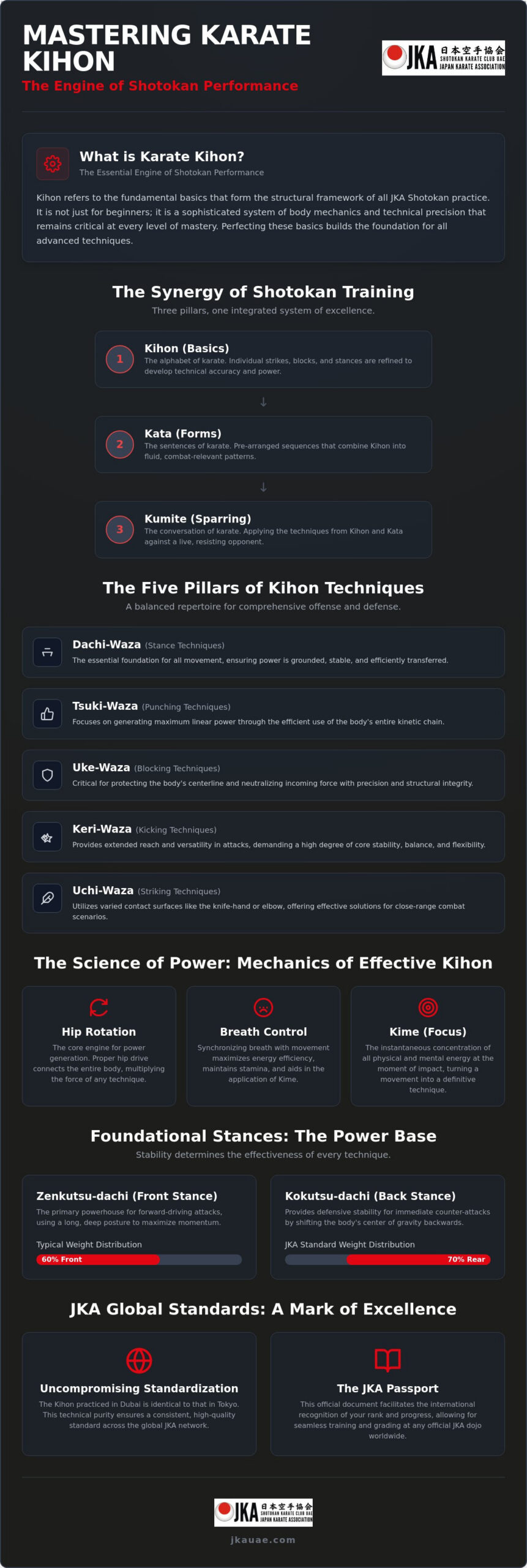
In the disciplined environment of a JKA dojo, every session begins with a commitment to technical precision. The term Karate Kihon refers to the fundamental basics that serve as the structural framework for all Shotokan practice. It’s not merely a set of introductory exercises for beginners; it’s a sophisticated system of body mechanics that remains relevant at every level of mastery, including the highest dan ranks. JKA training is built upon three integrated pillars: Kihon (basics), Kata (forms), and Kumite (sparring). These elements function in a state of constant synergy, where the technical accuracy developed in basics provides the operational efficiency required for advanced combat.
Practicing these techniques in organized lines, often referred to as Ido Kihon, is a deliberate training method. This structure fosters a sense of collective discipline and allows instructors to monitor the synchronization of the entire group. By repeating strikes, blocks, and stances while moving across the floor, students develop the focus needed to maintain balance under pressure. This rigorous approach ensures that every student, regardless of their location, adheres to the exact technical specifications defined by the Japan Karate Association.
The Relationship Between Kihon and Kata
Think of kihon as the individual letters of an alphabet. While a single punch or block is powerful on its own, its true utility is realized when combined with other movements to create the “sentences” found in Mastering Karate Kata: A Beginner’s Guide. You can’t write a coherent narrative without mastering the alphabet first. Similarly, a practitioner must refine individual techniques before attempting the complex transitions and timing required in Shotokan forms. This sequential progression ensures that the student’s foundation is stable enough to support more intricate patterns of movement.
Why Standardisation Matters in JKA Shotokan
The JKA maintains an uncompromising commitment to technical purity across its global network. This standardization is a core component of our organizational excellence, ensuring that the karate kihon practiced in Dubai is identical to that taught in Tokyo or London. Such consistency allows for a seamless transition between dojos and facilitates international recognition of rank. Central to this practice is the concept of Kime, or focus. Kime represents the instantaneous concentration of energy at the moment of impact, transforming a simple basic movement into a definitive, functional technique.
The Five Pillars of Kihon Techniques
Technical proficiency in JKA Shotokan is built upon five distinct pillars of movement. Each category represents a specific operational capability that contributes to the practitioner’s total defensive and offensive repertoire. Mastery of karate kihon requires balanced development across these pillars to ensure a comprehensive skillset that meets global standards. This rigorous, structured approach is mirrored in elite academic environments like the Yale Shotokan Karate Club, where technical precision serves as the primary metric for progression. By isolating these components, students can identify and optimize specific mechanical inefficiencies in their practice.
- Dachi-Waza (Stance Techniques): This serves as the essential foundation of all movement, ensuring that power is grounded and stable.
- Tsuki-Waza (Punching Techniques): These focus on the generation of maximum linear power through the efficient use of the body’s kinetic chain.
- Uke-Waza (Blocking Techniques): These are critical for protecting the body’s centerline and neutralizing incoming force with precision.
- Keri-Waza (Kicking Techniques): These provide extended reach and versatility, though they demand a high degree of core stability and balance.
- Uchi-Waza (Striking Techniques): These utilize varied contact surfaces, such as the knife-hand or the elbow, to offer solutions for diverse combat scenarios.
Mastering Fundamental Stances (Dachi)
The stability of your base determines the ultimate effectiveness of your technique. Zenkutsu-dachi, or front stance, is the primary powerhouse for forward-driving attacks, utilizing a long, deep posture to maximize momentum. Conversely, Kokutsu-dachi shifts 70 percent of the weight to the rear leg, providing the defensive stability needed for immediate counter-attacks. Kiba-dachi, the horse stance, is fundamental for developing lateral balance and lower body strength. Students who participate in structured Shotokan Karate Classes often find that dedicated stance training significantly improves their overall physical coordination.
Essential Punches and Blocks for Beginners
Initial training focuses on the mechanical distinction between Oi-zuki and Gyaku-zuki. The lunge punch utilizes the momentum of a full step to deliver force, while the reverse punch relies on the rapid rotation of the hips from a stationary position. Defensive capability is established through the four basic blocks: Age-uke, Uchi-uke, Soto-uke, and Gedan-barai. Each block is designed to redirect force away from the body’s vital organs while maintaining a counter-ready posture. Refining these basics through consistent karate kihon practice ensures that every movement becomes instinctive. The Hikite, or pulling hand, functions as the essential mechanical lever that generates the necessary torque and counter-force for every punch.
The Science of Power: Mechanics of Effective Kihon
Achieving technical excellence in karate kihon requires more than just mimicry of movement; it demands an understanding of the underlying physics that govern force production. The JKA curriculum emphasizes a floor-to-fist connection, where power originates from the ground and travels through the kinetic chain of the legs and torso. This process relies on the strategic synchronization of hip rotation, known as Jun-kaiten, and hip vibration. These movements aren’t merely stylistic choices but are essential for generating the torque necessary to deliver a definitive technique. By pushing off the floor with the rear leg, the practitioner initiates a wave of energy that is amplified by the rotation of the pelvis and finally released through the striking surface.
Hip rotation provides the primary engine for linear strikes, while vibration, a rapid micro-rotation, augments power in confined spaces. This mechanical force is further amplified by Ibuki, or breath control. By coordinating a sharp exhalation with the moment of impact, a practitioner stabilizes their core and ensures that the body’s internal pressure supports the external strike. This synergy between physical rotation and respiratory timing is what differentiates a standard movement from a high-performance JKA technique. It’s this precise coordination that allows a smaller practitioner to generate force that far exceeds their physical weight.
Centering Your Gravity
Maintaining technical integrity is impossible without a vertically aligned spine. Technical errors often stem from a disconnected center, or Hara. When practitioners lean forward or lift their heels during basic drills, they compromise their stability and dissipate potential energy. Keeping the weight distributed according to the specific stance requirements ensures that the center of gravity remains a source of power rather than a liability. This focus on centering allows for rapid transitions between offensive and defensive postures without a loss of balance, ensuring every basic technique is grounded in stability.
Developing Speed Through Relaxation
Speed is a byproduct of relaxation. Muscles that remain perpetually tense move significantly slower than those that are soft and pliable. The cycle of speed in karate kihon involves a transition from a relaxed state during the movement phase to an instantaneous, full-body contraction at the point of impact. This moment of total tension, or Kime, is what defines the efficacy of the strike. Practicing combinations that emphasize this relax-contract rhythm allows students to increase their hand and foot speed without sacrificing technical precision. Drills that focus on snapping the technique back to a relaxed state immediately after impact are particularly effective for developing the explosive power required for JKA excellence.
Training for Progression: Exams and the JKA Passport
Technical proficiency in karate kihon is measured through a standardized examination system that ensures quality control across all global branches. As a student moves from White Belt (9th Kyu) to Black Belt (Shodan), the complexity of these foundational drills increases significantly. Initial exams focus on single techniques and basic stances, while advanced levels require the execution of multi-stage combinations with perfect balance and timing. Consistent attendance in official classes is vital for developing the muscle memory required to perform these movements instinctively under the pressure of an evaluation. This structured progression ensures that every rank achieved is a true reflection of the practitioner’s operational capability.
Examiners prioritize four key indicators of excellence: technical form, explosive power, internal spirit (Kiai), and mental focus. A successful candidate demonstrates not just the ability to move, but the capacity to apply the mechanical principles discussed in previous sections. For instance, the transition to Shodan requires a minimum of six months of training at 1st Kyu, ensuring that the practitioner has fully integrated the required technical standards. This rigorous vetting process is what maintains the integrity of the JKA brand worldwide. If you’re planning to advance your rank, securing a Karate Belt Examination slot is the next strategic step in your professional development.
The JKA Passport serves as the definitive record of a practitioner’s journey, documenting every technical milestone and seminar attended. This document is essential for students who value international mobility and professional recognition. It functions as a global credential, verifying your rank and training history to instructors anywhere in the world. Without this official record, a student’s progress remains localized, but with it, they’re part of an elite global infrastructure of martial artists.
Step-by-Step Preparation for Belt Examinations
Reviewing the official JKA syllabus for your specific rank is the first step toward a successful grading. Students must practice karate kihon in both stationary formats to refine mechanics and moving formats to develop spatial awareness. The Kiai, a focused vocalization of energy, isn’t just a sound; it’s a demonstration of confidence and internal unity that examiners use to gauge a student’s readiness. Mastering these basics in a controlled environment allows you to execute them with precision when it matters most.
The Global Value of JKA Certification
JKA ranks are respected in over 100 countries due to the association’s uncompromising standards. The JKA Passport acts as a global training record, allowing you to train seamlessly if you travel or relocate. It provides a strategic bridge between local training and international innovation, ensuring your hard work is recognized by any JKA-affiliated dojo. Check out The JKA Passport: Your Global Training Record to understand how this system supports your long-term success and technical growth.
Mastering Kihon at JKA Shotokan Karate Club Dubai
Training in the UAE offers a strategic advantage for those seeking standardized martial arts education within a professional framework. JKA Shotokan Karate Club Dubai provides a structured environment where the theoretical principles of karate kihon are transformed into functional physical skills. Our dojos across Dubai and Sharjah prioritize technical excellence, ensuring that every session aligns with the global standards established by the headquarters in Japan. This direct link to international expertise allows our students to receive instruction that’s both current and operationally effective.
Adhering to professional standards includes the mandatory use of the official JKA Karate Gi. This uniform is more than a traditional garment; it’s a tool for standardized training that allows instructors to clearly observe body alignment and joint positioning during complex movements. By maintaining this level of consistency, we ensure that every student is prepared for the rigorous demands of international certification. Our commitment to quality is reflected in every aspect of our facility management and instructional delivery, providing a reliable partnership for your long-term growth.
Class Structure and Instructional Excellence
Every session begins with intensive karate kihon training to sharpen both the mind and body. This foundational work is essential for developing the focus required for advanced performance in both Kata and Kumite. Our Senseis provide bespoke feedback in real-time, correcting posture and mechanical inefficiencies to ensure every strike is delivered with maximum efficiency. This disciplined approach creates a safe and highly organized environment suitable for practitioners of all ages, from young children to corporate professionals seeking a challenging physical outlet.
Join the JKA UAE Community
We invite prospective students to experience our training methods firsthand through trial classes available for kids and adults at our various UAE locations. Whether you’re preparing for upcoming JKA belt examinations or looking to improve your physical coordination through technical workshops, our community offers the support needed for sustained progress. We provide a clear roadmap for advancement, ensuring that your training in Dubai is recognized by the global JKA network. Register for a trial class at JKA Dubai today and begin your journey toward technical mastery in a world-class environment.
Elevate Your Technical Performance with JKA Dubai
Technical mastery in Shotokan is a continuous process of refining the mechanics that define your practice. By prioritizing karate kihon, you establish a foundation that supports every advanced maneuver, from intricate kata to high-stakes kumite. This disciplined approach ensures that your movements are grounded in scientific principles, allowing for maximum force and precision in every strike. You’re not just learning movements; you’re developing a sophisticated system of body mechanics that scales with your ambition.
As the official UAE branch of the Japan Karate Association, we provide a strategic bridge to a standardized international curriculum. Our expert instructors offer bespoke support for kids, teens, and adults, ensuring that every student’s progress is documented in the JKA Passport for global recognition. This commitment to excellence transforms your training into a professional pursuit of technical proficiency and personal discipline. Start Your JKA Journey: Book a Trial Class in Dubai and join an elite community dedicated to martial arts excellence. We’re ready to help you achieve your next technical milestone.
Frequently Asked Questions
What is the literal meaning of Kihon in karate?
Kihon literally means “foundation” or “basics” in Japanese. In the context of JKA Shotokan, it represents the fundamental building blocks of movement that enable all advanced techniques. It’s the technical bedrock upon which your entire martial arts career is built. This concept ensures that every practitioner, regardless of their current rank, maintains a commitment to technical precision and operational excellence throughout their journey.
How often should a beginner practice Kihon?
Beginners should aim for a minimum of two to three structured sessions per week to ensure steady progress. Consistent repetition in karate kihon is essential for converting manual movements into instinctive muscle memory. This frequency allows the body to adapt to the specific physical demands of Shotokan stances and strikes. Regular attendance facilitates the steady development of balance and power required for upcoming belt examinations.
Why do we shout (Kiai) during Kihon practice?
The Kiai is a focused vocalization used to synchronize breath control with maximum muscle contraction at the moment of impact. This coordination stabilizes the core and amplifies the force of a technique. It serves as a clear indicator of a student’s mental focus and internal energy during examinations. Beyond power generation, it builds confidence and demonstrates the practitioner’s total commitment to the execution of the move.
Can I learn Kihon at home or do I need a dojo?
While home practice is valuable for reinforcement, initial learning must occur within a professional dojo environment. Expert instructors provide the real-time feedback necessary to correct posture and prevent the development of mechanical errors. Training under a qualified Sensei ensures that your foundation meets global JKA standards. This structured environment provides the necessary infrastructure and safety protocols that are impossible to replicate in a home setting.
What is the difference between Kihon and Kata?
Kihon involves practicing individual techniques in isolation or simple lines, whereas Kata is a complex, choreographed pattern of movements simulating a fight against multiple opponents. You can view karate kihon as the individual words that are eventually combined to form the sophisticated “sentences” of a Kata performance. Mastery of the individual components is a prerequisite for executing the fluid transitions and timing found in advanced forms.
How long does it take to master basic karate techniques?
Achieving basic technical proficiency typically requires three months of regular training to reach the first grading level. However, true mastery of these fundamentals is a lifelong pursuit that continues even at the highest black belt ranks. Each belt level introduces new layers of mechanical complexity and power generation. Consistent practice ensures that these basics remain sharp, providing the necessary stability for all advanced martial arts applications.
Is Kihon training different for kids and adults at JKA Dubai?
The technical curriculum remains identical for both groups to maintain global standardization, but the instructional delivery is tailored to the audience’s developmental stage. Kids Karate Classes emphasize discipline and motor skill development through structured drills. Conversely, adult sessions focus on the sophisticated science of power and operational efficiency in combat. Both groups follow the same JKA syllabus, ensuring that the final technical output meets our rigorous institutional standards.
What equipment do I need to start practicing Kihon?
To begin your training, you’ll need an official JKA Karate Gi, which is designed to withstand the rigors of traditional practice. Once you begin your journey, a JKA Passport is required to document your technical milestones and ensure your rank is recognized internationally. These items represent the primary equipment needed to integrate into our global community. Most other requirements are provided through the professional infrastructure of our dojos.