A black belt earned in a local gym often loses its value the moment you cross international borders. While many martial arts schools operate as “belt factories” with inconsistent standards, the Japan Karate Association maintains a rigorous global curriculum that ensures technical proficiency from Dubai to Tokyo. You likely want to ensure your hard work results in a rank that carries weight worldwide. This guide provides the JKA belt system explained through the lens of professional excellence. It offers a transparent roadmap for your martial arts development.
We’ll explore the structured progression through the 10 Kyu and 10 Dan levels. This includes mandatory requirements like the six-month training period necessary before attempting a Shodan examination. You’ll discover how our approach integrates Kihon, Kata, and Kumite to deliver a Total Solution for technical and character growth. With 70 students successfully passing their black belt exams in Dubai on June 7, 2026, the path to mastery is proven and attainable. By understanding the official syllabus and the role of the JKA Passport, you can pursue your training with the confidence that your rank is recognized by an industry titan with a presence in over 100 countries.
Key Takeaways
- Understand how the JKA ranking framework serves as a standardized global curriculum, guiding practitioners from foundational Kyu ranks to advanced Dan levels.
- Discover the specific evaluation criteria for Kihon, Kata, and Kumite that authorized technical examiners use to assess your readiness for advancement.
- Having the JKA belt system explained ensures you understand the rigorous technical requirements and time-in-grade prerequisites necessary for professional mastery.
- Learn why the JKA Passport acts as a critical, portable record that guarantees your rank is recognized across the international JKA World Federation network.
- Identify the essential logistical steps and professional equipment, including the official JKA Karate Gi, required for a successful Karate Belt Examination in the UAE.
The JKA Ranking Framework: More Than Just Belt Colors
The Japan Karate Association (JKA) stands as the primary authority for traditional Shotokan Karate, maintaining a rigorous global curriculum that transcends local training methods. When you consider the JKA belt system explained, it’s essential to view it as a professional framework for technical mastery rather than a simple collection of colored belts. This standardized approach ensures that the transition from foundational “Kyu” ranks to advanced “Dan” ranks follows a logical, performance-based trajectory. At JKA Shotokan Karate Club Dubai, we adhere to these international benchmarks to provide our students with a rank that is both technically sound and globally recognized.
The role of JKA Headquarters in Tokyo is to ensure that these standards remain consistent across all member nations. This centralized control is what separates a professional martial arts education from casual recreational activities. Every progression is overseen by authorized technical examiners who evaluate practitioners against the same criteria used at the headquarters. This level of oversight guarantees that the technical proficiency of a student in the UAE aligns perfectly with their peers in Japan or Europe. It’s this commitment to institutional excellence that defines our approach to student development.
The Philosophy of Progression
Progression within this ranking framework is designed to mirror a student’s technical precision and internal discipline. The JKA doesn’t prioritize the speed of advancement; instead, it emphasizes the cultivation of character and technical maturity. Each rank serves as a strategic roadmap for martial arts education, ensuring that students internalize the fundamental mechanics before moving to more complex applications. By focusing on technical accuracy over the rapid accumulation of belts, we foster an environment where achievement is rooted in genuine capability and resilience. It’s a journey that demands patience and consistent effort.
Institutional Stability and Standards
One of the most significant advantages of this framework is its ability to prevent the “belt factory” phenomenon often seen in commercial martial arts centers. Because our ranks are governed by international standards, they can’t be awarded based on time served or fees paid. This institutional stability provides a reliable benchmark for quality that is recognized by over 100 member countries worldwide. For those interested in how these standards integrate with our local training programs, we recommend exploring our approach to Traditional Karate Training: The Definitive Guide to JKA Shotokan in the UAE. This global recognition ensures that a rank earned at JKA Shotokan Karate Club Dubai remains a respected credential, providing practitioners with a professional advantage that remains valid throughout their lives.
Understanding Kyu and Dan: The Two Phases of Karate Education
The JKA curriculum isn’t a random collection of techniques; it’s a dual-phase educational journey. When looking at the JKA belt system explained, you’ll see a clear distinction between the Kyu (student) and Dan (advanced) ranks. This structure ensures that every practitioner builds a solid technical foundation before moving into specialized mastery. Ranks aren’t handed out. They’re earned through consistent training and adherence to the official JKA examination requirements. This professional framework guarantees that a student’s progress is measured against global benchmarks rather than local preferences.
The Kyu Ranks: Building the Foundation
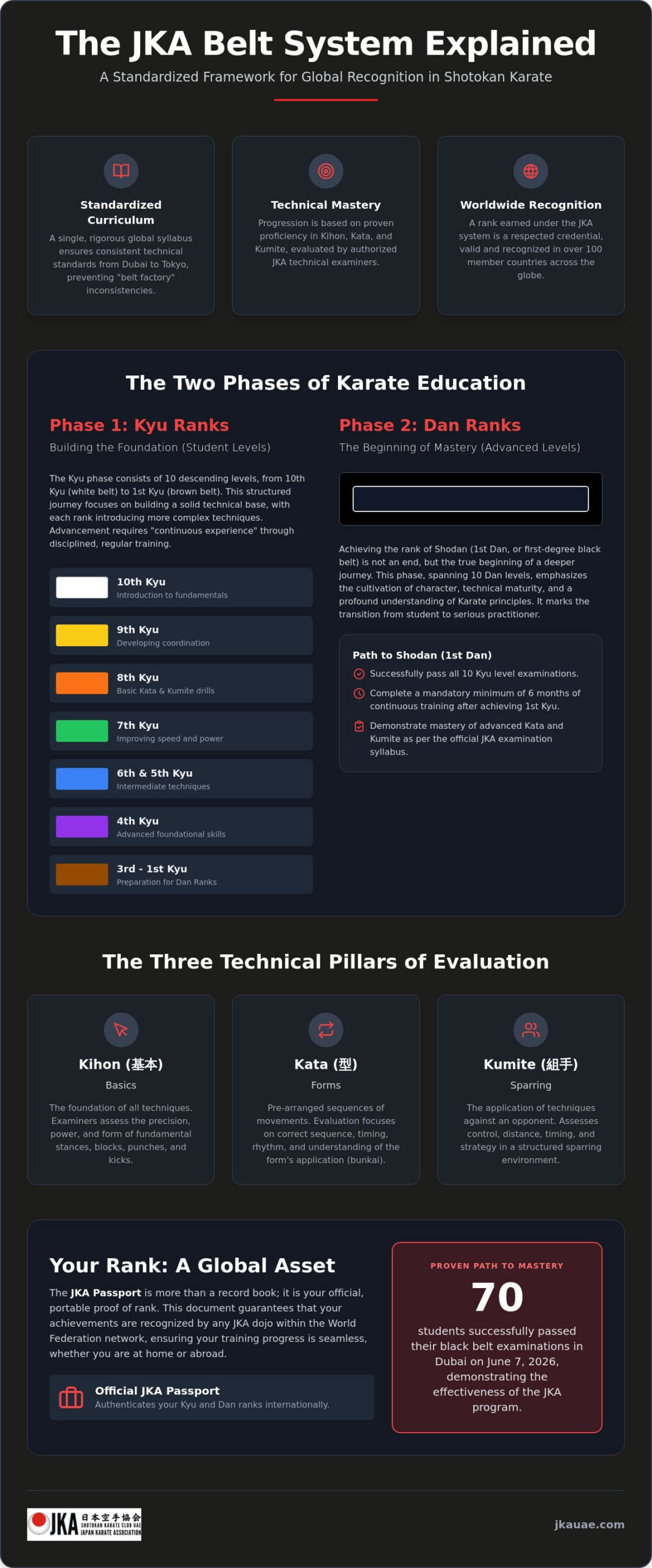
The Kyu phase consists of 10 levels, descending from 10th Kyu (white belt) to 1st Kyu (brown belt). Each level represents a specific stage of technical maturity. For example, early ranks focus on basic stances and coordination. Middle ranks introduce more complex kata and sparring drills. To be eligible for an exam, students must demonstrate “continuous experience.” This means regular attendance is mandatory. You can’t simply show up for a test. You must prove your commitment through months of disciplined practice. This approach ensures that by the time a student reaches brown belt, they possess the stamina and precision required for the next phase.
The Dan Ranks: The Beginning of Mastery
Many people mistakenly believe that earning a black belt is the end of the journey. In reality, “Shodan” (1st Dan) literally means “first step.” This is where the practitioner becomes a “Yudansha,” or a person holding a Dan rank. The transition from 1st Kyu to 1st Dan is a significant professional milestone. JKA HQ mandates a minimum of six months of training at the 1st Kyu level before a student can even attempt the Shodan examination. This period is essential for refining the technical nuances that separate a student from a practitioner of advanced standing.
As you progress higher, the requirements become even more stringent. For ranks like 3rd Dan and above, there are strict age requirements. These ensure the practitioner has the physical and mental maturity to represent the association at a leadership level. While lower Dan ranks are often tested locally by authorized examiners, very high-level certifications may require testing at the JKA Headquarters in Tokyo. This centralized control maintains the global validity of every rank. If you’re ready to start this journey, exploring our Shotokan Karate classes in Dubai provides the first step toward these international standards.
The Technical Pillars: Kihon, Kata, and Kumite in Belt Advancement
JKA rank advancement relies on a balanced synergy of three technical pillars. These aren’t isolated skills. They form an integrated solution for martial arts mastery. When you see the JKA belt system explained in a professional context, you’ll notice that Kihon (basics), Kata (forms), and Kumite (sparring) are evaluated with equal weight. This comprehensive assessment ensures that technical proficiency is matched by practical application. Authorized examiners look for technical precision, power, and the mental discipline required to represent the association globally.
Kihon and Kata Requirements
Kihon involves a rigorous audit of the fundamental mechanics behind every strike, block, and kick. Examiners prioritize form, power, and stance stability over the sheer volume of techniques. For a beginner, the focus is often on the Heian Shodan kata, which builds the initial framework for movement and coordination. As a student progresses toward the Dan ranks, the complexity increases significantly with advanced kata like Bassai Dai. These advanced forms require a sophisticated understanding of timing, rhythm, and the application of force. Kata is the core of Shotokan technical evaluation. It serves as a living library of techniques that must be executed with absolute precision. For those refining their foundation, Mastering Karate Basics: A Guide for Dubai Students provides detailed insights into maintaining stance stability during these high-level forms.
The Role of Kumite in Grading
Kumite serves as the practical application of basics and forms. It isn’t about raw aggression; it’s about demonstrating control and technical precision in a highly regulated environment. The progression begins with Gohon Kumite, a five-step sparring drill that focuses on basic distance and timing. As students advance, they move toward Jiyu Kumite, or free sparring, where they must apply their skills dynamically against an opponent. This transition tests whether a practitioner can maintain their technical integrity under pressure.
During examinations at JKA UAE, safety protocols are strictly enforced to maintain a professional atmosphere. Examiners don’t just look for successful hits. They evaluate “Zanshin,” or the practitioner’s state of continuous awareness. This mental readiness must be evident before, during, and after every exchange. It proves that the student has the discipline required to handle the technical capabilities of a higher rank. This holistic approach is why 70 students successfully passed their black belt exams in Dubai on June 7, 2026. It’s a testament to the effectiveness of a curriculum that values technical excellence and safety equally.
Examination Readiness: Preparing for Your Karate Belt Test in the UAE
Preparing for a formal evaluation requires more than just memorizing a sequence of movements. It’s a professional audit of your technical progress and mental resilience. At JKA Shotokan Karate Club Dubai, the path to the next rank is never guaranteed by time alone. Our Senseis evaluate each student based on their consistency, technical precision, and adherence to the standards found in the JKA belt system explained during your initial training. This rigorous assessment ensures that when you step onto the mat for your test, you’re truly prepared to represent the association’s global standards. We prioritize a strategic approach to readiness that builds confidence through repetitive refinement.
Mental preparation is just as critical as physical agility. Managing nerves is a key component of the test. Examiners look for “Reigi,” or proper etiquette, which demonstrates your respect for the art and your peers. This includes everything from the way you tie your belt to the focus in your eyes during a bow. Demonstrating this level of discipline proves that you possess the character necessary to hold a higher rank. It’s about maintaining a state of mental readiness that proves you’ve moved beyond basic mechanics into a more sophisticated understanding of martial arts philosophy.
The Grading Procedure at JKA UAE
On the day of the exam at our Dubai or Sharjah dojos, students face a panel of authorized JKA technical examiners. This isn’t a casual assessment; it’s a formal proceeding where every block and strike is recorded. The examiners look for the technical integrity and power that we’ve discussed in previous modules. Once the examination is complete, the results are meticulously documented for submission to the international registry. For successful candidates, official certificates are issued directly from JKA Headquarters in Japan. This centralized process ensures your rank carries the same weight in Abu Dhabi or Fujairah as it does in Tokyo. It provides a permanent, verified record of your achievement within the international JKA World Federation.
Pre-Exam Checklist for Parents and Students
To ensure a smooth examination process, students must meet specific logistical requirements. Professionalism starts with your equipment and documentation. Use this checklist to prepare for your upcoming session:
- JKA Passport: Ensure your passport is up to date with your current training records and membership status. This is your primary identity document within the global JKA network.
- Official JKA Karate Gi: Your Gi must be clean, pressed, and in excellent condition. Wearing the official JKA Karate Gi is a requirement that reflects your respect for the examination panel and the standards of JKA Shotokan Karate Club Dubai.
- Refinement: Register for pre-exam Karate Seminars and Workshops. These sessions allow you to refine your techniques with senior instructors before the official grading.
Taking these steps ensures you can focus entirely on your performance during the test. If you’re ready to advance your rank and demonstrate your growth, register for your next Karate Belt Examination to begin the formal certification process.
The Global Value of a JKA Rank: Passport and International Recognition
Earning a rank at JKA Shotokan Karate Club Dubai represents a strategic investment in a credential that remains valid across the globe. Because we adhere strictly to the standards found in the JKA belt system explained in this guide, your technical achievements are recognized in over 100 countries. This international synergy ensures that the proficiency you develop in the UAE is immediately understood by instructors from Tokyo to London. You aren’t merely joining a local school; you’re entering a professional global infrastructure that values technical consistency and institutional stability. This provides a sense of security for practitioners who require their hard-earned ranks to carry weight far beyond the borders of the Middle East.
The prestige of a JKA rank is solidified by the fact that certificates are issued directly by the Japan Karate Association in Tokyo. This centralized authority prevents the dilution of standards and provides a permanent, verified record of your mastery. For families who may relocate internationally due to professional commitments, this level of recognition is invaluable. It eliminates the need to begin your training from scratch at a new dojo. Your progress is documented in a way that transcends regional borders, ensuring your technical standing remains intact wherever your career or life takes you.
Portability and Training Across Borders
The JKA Passport serves as your portable, professional training record. It documents every seminar, workshop, and successful examination you attend, providing a verified history of your martial arts journey. This passport allows students to walk into any official JKA branch worldwide and continue their training without interruption. It’s a critical tool for maintaining the continuity of your education. It’s important to understand that the JKA rank is a technical certification, not just a belt. It represents a standardized level of expertise that is audited by authorized technical examiners. This gives you a professional advantage in any martial arts environment, as your skills are backed by the world’s most prestigious Shotokan organization.
Joining the JKA UAE Community
Starting your journey toward a globally recognized rank begins with your first session at our Dubai or Sharjah dojos. Whether you’re looking for kids’ classes or adult training, our curriculum provides a clear roadmap to mastery. We prioritize long-term partnerships with our students, offering a stable environment where excellence is the only standard. You can explore our specific offerings and schedule on the Karate Classes in Dubai: Authentic JKA Shotokan Training for 2026 page.
We invite you to experience the reliability and excellence of a truly international martial arts program. Our instructors are dedicated to providing the bespoke support you need to navigate the JKA belt system explained in our dojos. By joining JKA Shotokan Karate Club Dubai, you’re choosing a partner committed to your technical and personal success. Schedule your first session at JKA UAE today and take the first step toward a rank that the entire world respects.
Begin Your Global Journey to Martial Arts Mastery
Navigating the professional path from white to black belt is a strategic commitment to technical excellence and personal discipline. Having the JKA belt system explained reveals a structured framework where every rank is a verified milestone recognized in over 100 countries. This curriculum ensures that your development in Kihon, Kata, and Kumite meets the exact standards maintained at the Tokyo JKA HQ. By choosing a professional training environment, you ensure your progress is a permanent credential rather than a temporary achievement.
As an official branch of the Japan Karate Association, we provide the institutional stability and expert instruction necessary for long-term success. We provide international JKA Passports to all members, ensuring your rank is portable and professionally documented worldwide. Our authorized examiners are dedicated to maintaining the highest levels of technical integrity in every Karate Belt Examination. We invite you to experience a partnership built on reliability and a shared commitment to mastery. Join JKA UAE and start your journey from white to black belt today. Your first step toward a globally recognized black belt begins with a single session in our world-class dojos.
Frequently Asked Questions
How long does it take to move from one belt to the next in JKA Shotokan?
Progression timing varies based on individual dedication, but achieving a black belt (Shodan) typically requires three to five years of disciplined training. For Kyu ranks, students generally train for three to six months between examinations. This timeframe ensures the technical maturity required by the JKA belt system explained in our curriculum is fully internalized before any advancement is granted.
Can I skip a belt if I have previous experience in another karate style?
New practitioners usually begin at the 10th Kyu regardless of previous experience in non-JKA styles. This policy ensures every student develops the specific technical precision and stance stability required by our global standards. Authorized examiners may conduct a technical audit to determine the most appropriate starting point for those with significant prior experience in traditional Shotokan.
What happens if a student fails their belt examination?
Students who don’t meet the required standards receive a detailed technical critique from the authorized examiner. They must continue their training until the next scheduled Karate Belt Examination, focusing on the specific areas highlighted for improvement. This process ensures that every rank awarded remains a reliable indicator of technical proficiency and operational excellence within the association.
Is the JKA belt system the same for children and adults?
The rank structure and technical syllabus remain consistent for both children and adults to maintain institutional integrity. While the foundational mechanics are identical, the JKA implements specific age prerequisites for higher Dan ranks, such as 3rd Dan and above. This ensures that advanced practitioners possess the physical and mental maturity necessary to represent the association at a leadership level internationally.
What is the difference between a Kyu rank and a Dan rank?
Kyu ranks represent the foundational student phase, moving from 10th Kyu to 1st Kyu. Dan ranks signify the advanced phase for black belt holders, known as Yudansha. Having the JKA belt system explained as a dual-phase journey helps students understand that Kyu levels focus on building a technical foundation, while Dan levels emphasize the refinement of specialized expertise.
Do I need a JKA Passport to take a belt exam in Dubai?
A JKA Passport is a mandatory requirement for all official examinations in Dubai, Sharjah, and Abu Dhabi. It serves as a portable, professional training record that verifies your membership and rank eligibility across the global network. Without this document, your examination results cannot be registered with the JKA Headquarters in Tokyo for international recognition and certification.
Are JKA belts recognized by other karate organizations?
JKA ranks are recognized globally across over 100 member countries within the JKA World Federation network. While other independent organizations have their own criteria, a JKA certificate is widely respected as the gold standard in traditional Shotokan. Its rigorous technical requirements and centralized certification process make it a highly portable and authoritative credential in the martial arts industry.
How much does a karate belt examination cost at JKA UAE?
Examination fees depend on the specific rank being attempted and include administrative costs and official certification from JKA HQ in Japan. Because these fees are subject to change based on international headquarters’ regulations and membership status, we recommend contacting our Dubai or Sharjah branches directly. This ensures you receive the most current information regarding the requirements for your specific advancement level.