Your child’s first karate class for kids isn’t merely an introduction to a sport; it’s a formal initiation into a legacy of discipline and character development that has shaped leaders for generations. Many parents in Dubai seek more than just physical activity. They look for an environment where respect is paramount and focus is a requirement. It’s natural to feel uncertain about whether your child will feel overwhelmed by the strict etiquette of a traditional dojo or how authentic Shotokan differs from generic coaching.
We understand that you want a seamless transition into this prestigious educational path. This guide provides the clarity you need to prepare your child for the structure and tradition of an authentic JKA debut. You’ll discover how to navigate dojo protocols, manage expectations, and ensure your child feels confident from the moment they bow onto the mat. We’ll outline the essential steps to turn a simple trial into a lifelong journey of personal excellence and strategic growth within the JKA Shotokan Karate Club Dubai, ensuring your child is ready for the long term developmental path ahead.
Key Takeaways
- Recognize the dojo as a specialized environment for discipline and focus, establishing clear mental expectations for your child’s behavior and respect.
- Gain insight into the formal structure of a traditional Shotokan lesson, ranging from the meditative opening ceremony to dynamic martial arts warm-ups.
- Distinguish authentic JKA education from general coaching to ensure your child’s first karate class for kids aligns with globally recognized technical standards.
- Familiarize yourself with fundamental “Reiho” protocols, such as traditional bowing and basic Japanese commands, to instill immediate confidence in your child.
- Understand the formal requirements for long-term progression, including the acquisition of the official JKA Karate Gi and the JKA Passport for global grading.
Preparing for the First Karate Class: The Mental and Physical Transition
Entering a JKA dojo represents a significant transition from the external world into a dedicated environment of mutual respect and rigorous mental focus. Unlike general martial arts coaching that may prioritize games to keep children entertained, a Shotokan karate education at JKA Shotokan Karate Club Dubai begins with understanding the sanctity of the training hall. For a child’s first karate class for kids, the primary objective isn’t mastering high kicks or complex strikes. Instead, the curriculum emphasizes the fundamental pillars of listening, basic posture, and stillness. This structured approach ensures that students develop the discipline required for the long-term Belt System and builds a foundation for future technical success.
The Sensei serves as more than an instructor; they’re a mentor and a guardian of a centuries-old tradition. We encourage young practitioners to adopt Shoshin, or a “beginner’s mind.” This mindset involves approaching every lesson with humility and an eagerness to learn, regardless of any prior exposure to other activities. Our instructors, certified by the JKA World Federation, maintain a professional hierarchy that fosters respect and accountability. It’s this commitment to excellence that defines our Kids Karate program and sets it apart from casual recreational activities in the region.
The Importance of Punctuality and Presence
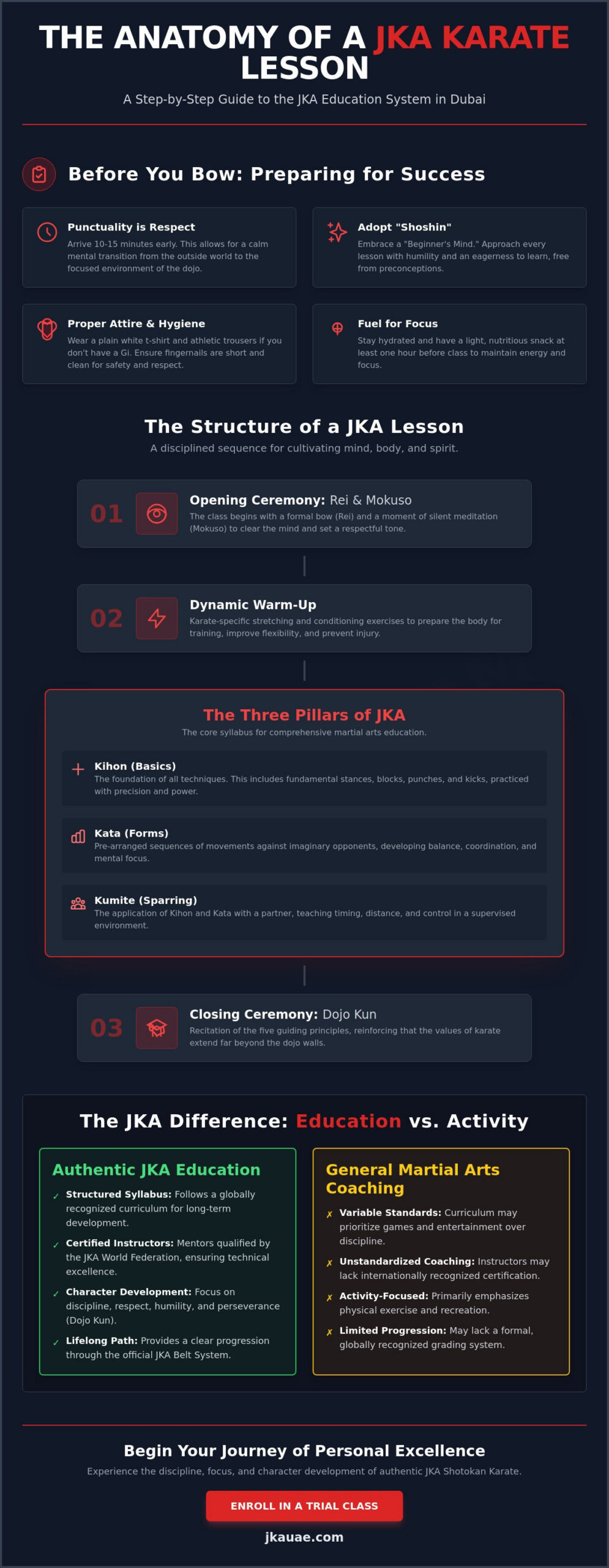
Arriving at least 10 minutes before the scheduled start time is essential for observing dojo etiquette. This window allows your child to mentally transition from the bustling environment of Dubai to the focused atmosphere of the mat. It also provides necessary time for the traditional bow at the entrance, which is a primary sign of respect for the space and the art. We ask that parents remain quiet observers during the session. Your silent support allows the student to build a direct, professional relationship with their instructor without external distractions. You can consult our Schedule to plan your arrival and ensure a calm start to the journey.
Physical Requirements for Day One
Proper preparation begins well before your child steps onto the mat. Ensure they’re well-hydrated and have consumed a light, nutritious snack at least an hour prior to training to maintain energy levels. Hygiene is a non-negotiable standard of respect in our dojo. Students must have short, clean fingernails and toenails to ensure the safety of their training partners during drills. If your child’s official JKA Karate Gi is still being processed, a plain white t-shirt and comfortable athletic trousers are acceptable for the initial session. This attention to detail reflects the institutional pride we maintain across all our Karate Classes in Dubai, creating a synergy between personal presentation and martial excellence.
The Anatomy of a Traditional Shotokan Lesson
A traditional JKA lesson is a highly organized sequence designed to cultivate discipline and technical precision. It begins with the Opening Ceremony, featuring the traditional bow (Rei) and a brief period of meditation known as Mokuso. This isn’t just a formality. It’s a strategic pause to clear the mind of external distractions. For a child attending their first karate class for kids, this moment of silence establishes the serious nature of the training hall. Following this, the class moves into dynamic stretching tailored specifically for martial arts movements. Research has shown that such structured physical education significantly aids motor and cognitive development in young karate students, optimizing their ability to process complex instructions.
The core of the JKA syllabus rests on three pillars: Kihon (basics), Kata (forms), and Kumite (sparring). These elements work in synergy to provide a comprehensive education system. The session concludes with a Closing Ceremony where students recite the Dojo Kun. These are five principles that guide a practitioner’s character: Seek perfection of character, Be faithful, Endeavor, Respect others, and Refrain from violent behavior. This reinforces the JKA Education concept, ensuring the values learned on the mat translate into daily life. If you’re ready to see this structure in action, exploring our Kids Karate Classes is the ideal next step.
Kihon: Building the Foundation
During the first karate class for kids, the focus is almost entirely on Kihon. This involves learning basic stances and straight punches. Instructors emphasize Kime, or the sudden tensing of the muscles at the point of impact, alongside proper breathing techniques. Repetitive practice of these basics isn’t a sign of lack of progress; it’s the secret to achieving karate excellence. By mastering these foundational movements, students build the stability required for the entire Belt System.
Introduction to Kata and Kumite
As students progress, they’re introduced to Kata, which are choreographed patterns of movements against imaginary opponents. For a child, we explain this as a “map” of karate techniques. Safety remains the highest priority during Kumite, or sparring. In the initial stages, this consists of simple distance drills and controlled movements. There’s a strict emphasis on non-contact and self-control, ensuring that youth practitioners develop confidence without the risk of injury. This methodical approach is a hallmark of the JKA Shotokan Karate Club Dubai, where we prioritize long term growth over short term gains.
Traditional JKA Standards vs. General Sport Karate
Choosing the right environment for your child’s first karate class for kids involves understanding the distinction between recreational sport karate and the traditional JKA syllabus. Many commercial clubs in Dubai prioritize trophies and rapid belt advancement, often sacrificing technical depth for entertainment. In contrast, JKA Shotokan Karate Club Dubai operates as an official branch of the Japan Karate Association. This ensures that every technique taught adheres to a global standard of technical accuracy and instructional excellence. Our lineage connects students directly to the JKA World Federation, providing a level of authenticity that general martial arts coaching cannot replicate.
The technical standardization within JKA is absolute. A student learning a basic block in Dubai receives the exact same instruction as a student at the JKA headquarters in Tokyo. This uniformity is a cornerstone of our educational philosophy, creating a reliable framework for long term progress. Scientific reviews regarding the benefits of martial arts for children confirm that such structured programs significantly enhance coordination, balance, and strength. We focus on these physical outcomes alongside the JKA Education model, which views karate as a lifelong path toward self-mastery rather than a seasonal sport.
The Global Recognition of Ranks
A belt earned within our dojo carries international weight because JKA grading standards are recognized worldwide. Each student receives a JKA Passport, an official document that records their training history and examinations. This passport allows a practitioner to continue their journey at any JKA branch across the globe without losing their progress. It’s a testament to the student’s commitment and the dojo’s institutional pride. Learn how this discipline translates into teen karate classes for future leaders who require international accreditation and recognized standards of excellence.
The Focus on Character over Competition
Traditional Shotokan is a journey against one’s own previous limits. While sport karate emphasizes winning matches, we emphasize the Dojo Kun. These five principles—character, sincerity, effort, etiquette, and self-control—are the true metrics of success. We don’t measure a student’s worth by the number of medals on their wall, but by their humility and perseverance. See our guide on karate classes for teens to understand the long-term development path that moves beyond the mat and into the formation of a resilient personality.
Dojo Etiquette: The “Reiho” Every Beginner Must Know
Traditional JKA karate is governed by Reiho, a sophisticated code of etiquette that ensures the dojo remains a space of mutual respect and operational discipline. It’s what separates a JKA education from a standard fitness center or casual recreational activity. During their first karate class for kids, students are introduced to the fundamental concept of bowing (Rei). We teach that a bow is a strategic gesture of gratitude and humility. Students bow upon entering the dojo to acknowledge the sanctity of the training space and bow to the Sensei to demonstrate their readiness to learn. This protocol isn’t just tradition; it’s a tool for mental centering that prepares the practitioner for the rigors of training.
The dojo is a quiet zone where focus is the primary currency. By removing the noise and distractions of the outside world, students can engage more deeply with their technical development. We utilize specific Japanese commands such as “Hajime” (begin) and “Yame” (stop), which require immediate compliance and sharp attention. This level of structure fosters self-control and allows our Karate Classes in Dubai to function with the same precision found at our international headquarters. If you’re ready to begin this journey of character development, Contact our team to book your child’s introductory session.
The Meaning of “Oss”
“Oss” is a contraction of the Japanese phrase “Osu no Seishin,” which translates to the spirit of perseverance. In our dojo, “Oss” serves multiple functions: it’s used to say “I understand,” “Thank you,” or as a formal greeting. More importantly, it represents a commitment to push through challenges and maintain a positive attitude under pressure. We encourage children to take this “spirit of Osu” into their schoolwork and daily responsibilities, developing the resilience to face obstacles with a calm and determined mind. It’s a core component of the character development we prioritize in every session.
Respecting the Uniform
The official JKA Karate Gi is a symbol of equality and commitment. The white uniform represents a clean slate, emphasizing that every student begins their journey with humility and a willingness to learn. We teach beginners that proper care of the Gi is a sign of respect for the art and themselves. This includes learning how to fold the uniform neatly after every class. To maintain a safe and focused environment, all jewelry, watches, and accessories must be removed before stepping onto the mat. This ensures that the student is physically and mentally prepared to focus solely on their progression within the Belt System, free from external vanity or distraction.
Starting Your Journey with JKA Shotokan Karate Club
Initiating a journey with JKA Shotokan Karate Club Dubai involves more than a simple registration; it’s a commitment to a globally recognized education system. After the first karate class for kids, the focus shifts toward integrating the student into our structured curriculum. Families can register for introductory sessions at any of our official branches across the UAE. This initial phase is a strategic partnership between the Sensei and the parents, ensuring the child’s developmental needs are met with precision and care. We provide a comprehensive support structure that guides every new practitioner through their first three months of training, culminating in their initial Karate Belt Examination.
Acquiring the official JKA Karate Gi and the JKA Passport represents the first physical step into our community after the first karate class for kids. The Gi isn’t merely a uniform but a tool for operational efficiency on the mat, designed to withstand the rigors of traditional training. In tandem with the Gi, the JKA Passport serves as the definitive record of a student’s technical progression. This document ensures that every hour spent in our Karate Classes in Dubai is officially recognized by the JKA World Federation, providing a seamless bridge between local effort and international standards.
The JKA Passport: A Life-Long Training Record
The JKA Passport is a unique marker of our institutional pride and a primary seal of quality for the student. It documents every seminar, workshop, and rank advancement achieved throughout the practitioner’s life. Unlike local club certificates, this passport carries international weight, making it an essential asset for families who may travel or relocate. It serves as a permanent record of the student’s dedication and is often a significant point of pride for young karateka as they see their progress officially stamped and verified by a global authority.
Next Steps for New Families
We invite you to schedule a trial session to observe our environment and witness the synergy between discipline and technical excellence firsthand. Our Schedule is designed to accommodate the diverse needs of Dubai’s families, offering various timings for Kids Karate, Adults Karate, and Ladies Karate. Once you’ve experienced the JKA difference, our team will assist you with the final enrollment process and equipment fitting. Begin your child’s path to excellence with JKA UAE today.
Embarking on a Path of Character and Excellence
Preparing for the first karate class for kids involves more than physical readiness; it requires an alignment with the traditions of respect and discipline that define the JKA legacy. By understanding the anatomy of a traditional lesson and the importance of Reiho, your child begins a journey where technical precision meets personal growth. This foundation ensures that the values of humility and perseverance are instilled from the very first bow on the mat, creating a clear distinction between authentic education and recreational sport.
As the official UAE branch of the Japan Karate Association, our dojo offers a level of stability and expertise that generic martial arts coaching cannot match. We provide a comprehensive education system led by certified JKA instructors, ensuring your child receives an international JKA Passport and an official Gi to mark their entry into our global community. This structured approach builds the confidence and focus necessary for success both inside and outside the training hall.
Register Your Child for an Official JKA Trial Class today to witness how our commitment to excellence can transform your child’s developmental path. We look forward to partnering with your family to cultivate the next generation of resilient and respectful leaders.
Frequently Asked Questions
Is my child too young to start karate classes?
Most children are ready to begin training at age four or five. At this stage, they’ve developed the motor skills and attention span necessary to follow the structured JKA syllabus. Our instructors focus on coordination and basic discipline, ensuring the environment is both age-appropriate and technically sound. Starting early allows for a longer developmental path within our comprehensive education system, fostering respect from a formative age.
Can my child try a class before committing to a full term?
Yes, we offer introductory trial sessions to allow families to experience the dojo environment firsthand. This initial visit is crucial for assessing how your child responds to the formal structure of a traditional lesson. It provides an opportunity to meet the Sensei and observe our standards of excellence before proceeding with full enrollment and the acquisition of the JKA Passport for official record-keeping.
What should my child wear to their very first karate lesson?
For their first karate class for kids, your child should wear comfortable, loose-fitting athletic attire if an official Gi is not yet available. A plain white t-shirt and dark tracksuit bottoms are ideal. Training is conducted barefoot to maintain traditional standards and ensure safety on the mat. Once the trial period is complete, we facilitate the purchase of the official JKA Karate Gi to ensure uniformity.
How does traditional karate differ from “sport” karate or MMA?
Traditional JKA karate prioritizes character development and technical perfection over competitive points or combat sports. Unlike MMA or sport-centric clubs, our curriculum follows a centuries-old syllabus governed by the Japan Karate Association. Every technique is standardized globally, focusing on self-control and the perfection of character rather than merely winning matches or burning calories in a casual fitness setting. This creates a more stable educational environment.
What happens if my child is shy or nervous about starting?
It’s common for children to feel apprehensive about the strict etiquette of a new environment. Our certified instructors are experienced in managing these transitions with a blend of professional authority and supportive mentorship. The predictable structure of the opening ceremony and repetitive basics often provides a sense of security that helps nervous students build confidence and focus over their initial few sessions in the dojo.
How often should a beginner attend classes to see progress?
We recommend a minimum of two sessions per week to ensure steady progress and retention of the technical syllabus. Consistent attendance allows the student to build muscle memory and stay aligned with the grading requirements of the Belt System. Regular participation also reinforces the habit of discipline, which is a core objective of our JKA education model for young practitioners seeking long-term growth.
Is karate safe for children? What is the risk of injury?
Safety is our highest operational priority, and the risk of injury is significantly lower than in many contact sports. Traditional Shotokan training emphasizes non-contact techniques and controlled movements. Beginners focus on individual kihon before moving to partner drills, which are always supervised by qualified instructors. We maintain strict hygiene and dojo protocols to ensure a secure training environment for every student during their first karate class for kids.
Do parents need to stay and watch the entire class?
While parents are welcome to observe from the designated seating area, we encourage a professional distance to foster the student’s independence. Your quiet presence as a silent observer supports the dojo’s focused atmosphere. This allows your child to build a direct relationship with their Sensei and take full responsibility for their own training, which is essential for their development of humility and personal responsibility.