What if the highest level of physical discipline actually provides the safest environment for your child’s development? Many parents asking, “is karate safe for my child,” often find themselves caught between the desire for their child to gain confidence and the fear of potential injury or aggressive gym cultures. It’s a valid concern, especially when the line between high-impact combat sports and traditional martial arts feels blurred.
We understand that your primary objective is a secure space where your child can build focus without compromising their physical well-being. This guide demonstrates how JKA Shotokan Karate utilizes international standards and a controlled curriculum to mitigate risk. You’ll learn about the 2026 World Karate Federation safety updates, including mandatory headgear for under-14s, and how our certified instructors implement a structured kihon, kata, and kumite system. We’ll explore the strategic importance of the JKA Passport in tracking progress and why a standardized approach ensures your child’s safety remains our institutional priority.
Key Takeaways
- Distinguish between JKA Shotokan and high-impact combat sports to understand how controlled technique protocols protect young practitioners.
- Discover the empirical data that answers the question, “is karate safe for my child,” by comparing dojo safety records with those of popular team sports.
- Identify the role of the Japan Karate Association (JKA) in establishing global safety benchmarks through mandatory instructor certifications and standardized training protocols.
- Access a practical checklist for evaluating karate academies in the UAE, ensuring the environment prioritizes disciplined instruction over chaotic physical play.
Defining Safety in Traditional Karate: Beyond the Combat Myth
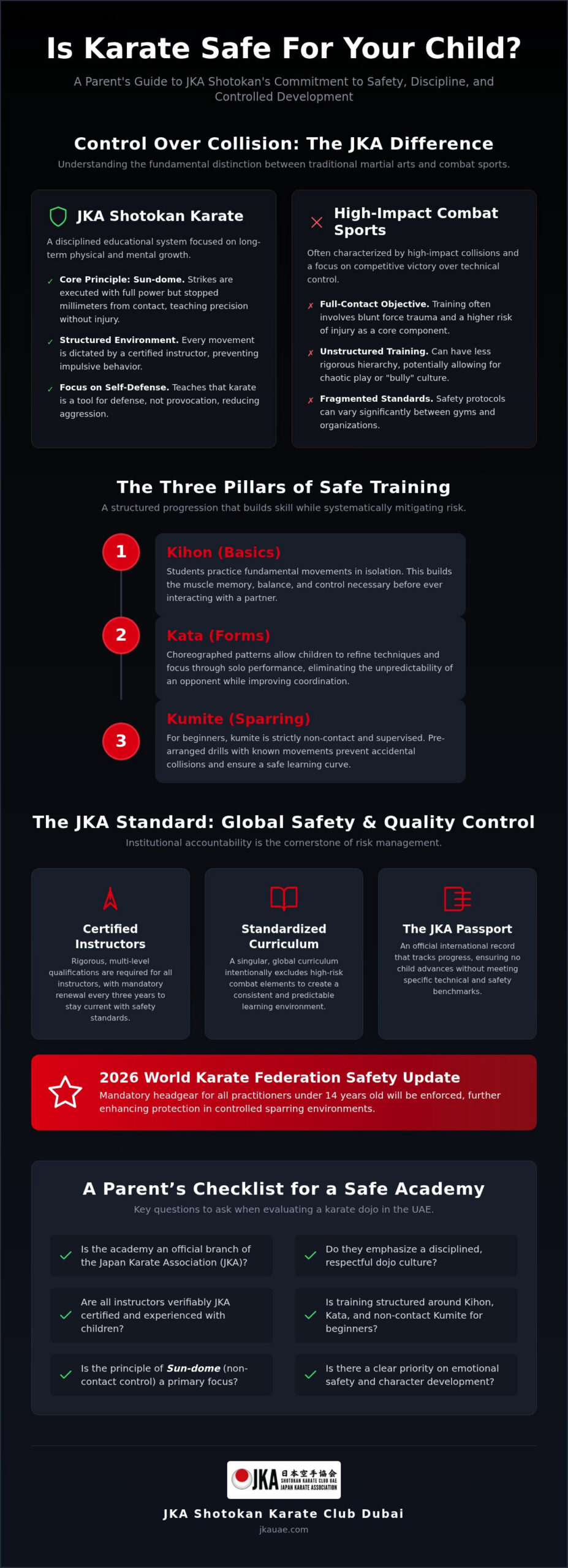
Many parents feel a natural hesitation when considering martial arts, often conflating traditional instruction with the high-impact collisions seen in modern combat sports. Traditional JKA Shotokan is not a combat sport; it’s a disciplined educational system designed for long-term physical and mental development. If you’re asking, “is karate safe for my child,” the answer lies in our institutional commitment to control over force. We strictly enforce the concept of Sun-dome, a technical requirement where strikes are executed with full power but arrested millimeters before contact. This protocol ensures practitioners develop maximum precision without the risk of blunt force trauma or injury.
Discipline serves as the primary safety feature in every class at our Shotokan Karate Classes. Unlike unstructured play or high-intensity gym environments, the dojo operates under a rigorous hierarchy of authority. Every movement is dictated by a certified instructor, leaving no room for the impulsive behavior or “bully” culture that parents often fear. This structured atmosphere creates a safe environment where students learn to respect the physical boundaries of their peers through consistent, professional instruction.
The Three Pillars of Safe Training: Kihon, Kata, and Kumite
To understand What is Karate? in a traditional context, one must examine the structural hierarchy of our training. Safety is integrated into three distinct phases:
- Kihon (Basics): Students practice fundamental movements in isolation. This builds the muscle memory and balance necessary to control their bodies before they ever interact with a partner.
- Kata (Forms): These choreographed patterns allow children to refine their techniques and focus through solo performance. It’s a physical practice that eliminates the unpredictability of an opponent while improving coordination.
- Kumite (Sparring): For beginners, kumite is strictly supervised and non-contact. Students engage in pre-arranged drills where every move is known in advance, preventing accidental collisions and fostering a safe learning curve.
Emotional Safety and the Prevention of Aggression
Physical protection is only one facet of our approach. We prioritize emotional safety by cultivating a dojo environment rooted in mutual respect. The practice of the Rei (bow) isn’t merely a ritual; it’s a functional safety protocol that acknowledges the partner’s well-being. This culture effectively dismantles aggressive mentalities. Traditional training reduces impulsive aggression in children by providing a healthy outlet for energy and teaching them that karate is a tool for self-defense, never for provocation. By emphasizing focus and self-restraint, we ensure that the skills learned in the dojo contribute to a child’s character rather than increasing their volatility.
The JKA Standard: Institutional Oversight and Quality Control
Institutional oversight is the cornerstone of risk management in youth sports. When parents ask, “is karate safe for my child,” they are often seeking the structural accountability that generic gyms or fitness fads lack. As the official UAE branch of the Japan Karate Association, we operate under a global mandate of excellence. Every instructor must undergo a rigorous, multi-level qualification system that requires renewal every three years. This ensures that pedagogical methods remain aligned with the latest safety standards and technical requirements for 2026. Our instructors are not just practitioners; they are certified educators trained to manage the physical development of children within a secure framework.
Unlike the fragmented nature of MMA or general fitness programs, our karate training follows a singular, standardized curriculum. We intentionally exclude high-risk combat elements found in other disciplines to prioritize the well-being of our students. This focus is supported by clinical data; recent studies on pediatric martial arts injuries highlight that structured environments with strict rules significantly lower the incidence of trauma compared to less regulated contact sports. By focusing purely on Shotokan, we provide a consistent and predictable learning environment where safety is an integrated operational standard.
The JKA Passport: A Global Safety and Progress Record
The JKA Passport serves as a student’s official international record of achievement. It is more than a logbook; it’s a quality control document that provides a comprehensive solution for tracking progress. It ensures that no child advances to a higher rank without meeting the specific technical and safety benchmarks required by the JKA. This system prevents the premature advancement of students into techniques they are not physically or mentally ready to handle. Because this record is recognized globally, it provides a strategic advantage for families who may relocate, ensuring their child’s progress remains consistent with international standards.
Official JKA Gear and the Training Environment
A professional training environment starts with standardized equipment and attire. The official Gi is designed for durability and range of motion, preventing the restricted movement that can lead to trips or strains. In alignment with the 2026 World Karate Federation rules, we ensure that mandatory headgear is utilized for competitors under 14 years of age. These official Kids Karate Classes prioritize a clean, uniform dojo where every element is optimized for safety. Regular belt examinations are conducted in these controlled settings, providing a secure platform for students to demonstrate their growth under the watchful eye of certified examiners.
Physical Safety and Injury Prevention in the Dojo
Data-driven decision-making is essential for parents evaluating extracurricular risks. When considering “is karate safe for my child,” it’s helpful to examine contemporary injury statistics. A study published in January 2026 regarding youth championships identified an injury incidence rate of 18.94 per 1,000 athlete-exposures. While contusions remain the most frequent injury type at 48%, the controlled environment of a dojo significantly mitigates the high-velocity, unscripted collisions common in field sports. Our instructional methodology prioritizes body awareness; students develop superior proprioception, which serves as a strategic defense against both training injuries and everyday accidents.
Operational safety begins before any technical instruction. Every session starts with a comprehensive warm-up designed to enhance flexibility and joint stability. This proactive approach ensures that a child’s musculoskeletal system is prepared for the specific demands of Shotokan movements. By focusing on core stabilization and controlled stretching, we reduce the likelihood of the sprains and strains that often occur in less structured physical activities. This commitment to physical preparation reflects our institutional standards for student well-being.
Supervised Partner Drills and Contact Rules
Risk management is strictly enforced through age-appropriate contact protocols in our karate classes in Dubai. Beginners never engage in unscripted sparring; instead, they participate in pre-arranged drills where every strike and block is choreographed. This eliminates the unpredictability that leads to injury. Additionally, the role of the Sempai (senior student) is vital. These experienced practitioners assist instructors in guiding younger students, providing an extra layer of supervision. In alignment with 2026 WKF standards, mandatory headgear is utilized for all practitioners under 14 to provide a total solution for head protection during advanced drills.
Health Benefits Beyond Physical Safety
Traditional training offers a low-impact alternative to high-collision sports while building significant physical resilience. The deep stances of Shotokan karate are designed to correct posture and improve lower-body strength without placing excessive stress on growing joints. Consistent practice enhances cardiovascular health and respiratory efficiency through controlled breathing techniques. These long-term health outcomes demonstrate that karate is not just about defense; it’s a holistic approach to physical development that prepares children for a lifetime of activity. To begin your child’s journey in a secure and professional environment, enroll in our Kids Karate Classes today.
A Parent’s Checklist: Evaluating a Safe Karate Academy in the UAE
Choosing an academy is a strategic decision that directly impacts a child’s long-term physical and mental development. When parents ask, “is karate safe for my child,” they should look beyond the surface-level aesthetics of a facility and examine the underlying operational standards. A professional dojo provides a comprehensive solution for safety by aligning its curriculum with international benchmarks. In the UAE, it’s essential to verify that an academy is an official branch of a recognized global body, ensuring the instruction your child receives is both authentic and strictly regulated.
Observing dojo etiquette offers immediate insight into the academy’s culture. A disciplined environment, where students show mutual respect through traditional bows and follow precise commands, indicates a high level of instructor control. This institutional discipline is the most effective safeguard against injury. You should also question the curriculum’s focus; a center dedicated to character development and technical precision is inherently safer than a “trophy mill” that prioritizes competitive wins over the fundamental safety protocols of Sun-dome and controlled technique.
Red Flags to Avoid in Martial Arts Schools
Identifying potential risks early can prevent long-term complications. Parents should be wary of any school that displays the following characteristics:
- Lack of a structured syllabus: Without clear belt examination criteria and a recognized curriculum, a child’s progress is arbitrary and potentially unsafe.
- Unsupervised or high-impact sparring: Young children shouldn’t engage in full-contact drills. Look for academies that strictly follow 2026 WKF safety updates regarding mandatory headgear and contact limits.
- Fitness over precision: If an instructor prioritizes general exercise over technical karate precision, they’re likely neglecting the control necessary for safe partner interaction.
Starting Your Child’s Journey at JKA UAE
Preparing your child for their first trial lesson involves setting expectations for focus and respect. During our initial orientation phase, we assess each student’s physical baseline to ensure they’re integrated into a class level that matches their current capabilities. This bespoke support ensures a seamless transition into our structured Shotokan environment, where safety and technical excellence are the primary objectives. We invite you to Register your child for authentic JKA Shotokan Karate today and experience the synergy of traditional discipline and international safety standards.
Securing Your Child’s Future Through Disciplined Excellence
Selecting the appropriate martial arts environment is a strategic investment in your child’s physical and emotional security. We’ve established how traditional JKA Shotokan prioritizes technical precision and institutional oversight to mitigate the risks found in unregulated combat sports. By adhering to the 2026 World Karate Federation safety protocols and maintaining a rigorous instructor certification process, we ensure that the answer to is karate safe for my child remains anchored in professional standards and controlled practice.
As the official UAE branch of the Japan Karate Association World Federation, we provide a total solution for youth development. Our certified international instructors utilize the standardized JKA curriculum and the official JKA Passport to ensure every milestone is recognized globally. This structured approach fosters a synergy of physical resilience and mental focus that prepares students for a lifetime of success. Enroll Your Child in the UAE’s Official JKA Karate Academy today to experience a partnership rooted in reliability and excellence. We look forward to supporting your child’s journey toward mastery and self-discipline.
Frequently Asked Questions
Is karate more dangerous than sports like football or basketball?
Traditional karate is statistically safer than many popular team sports because it lacks unpredictable, high-velocity collisions. While field sports often involve frequent impact, our dojo environment is strictly regulated by certified instructors who prioritize technical control over force. This structured approach ensures that the physical development of the child occurs within a low-risk framework designed for long-term health.
Will my child be expected to fight other students in the first class?
No student is ever required to engage in sparring during their initial sessions. We prioritize the mastery of Kihon and Kata before any partner interaction occurs, allowing children to build the necessary coordination to ensure their safety. If you’re wondering, “is karate safe for my child,” our phased curriculum is designed specifically to prevent premature physical contact and build confidence first.
What happens if my child is shy or afraid of contact?
Shy or contact-averse children are supported through a gradual integration process that emphasizes solo technical development. We understand that emotional safety is as critical as physical protection in a learning environment. Students begin with individual drills to build self-assurance; they only progress to cooperative partner work once they’ve demonstrated the required focus and technical proficiency.
Are the instructors at JKA UAE officially certified?
Every instructor at our academy is officially certified by the Japan Karate Association and undergoes a mandatory qualification renewal every three years. As the official UAE branch, we maintain a rigorous standard of pedagogical excellence and institutional oversight. This ensures your child is learning from professionals who are fully compliant with global safety and technical protocols for 2026.
Do children need special safety gear for traditional karate?
Standardized safety equipment is mandatory for specific training phases to provide a total solution for injury prevention. In accordance with 2026 World Karate Federation rules, practitioners under 14 must wear approved headgear during kumite sessions. All students also wear the traditional JKA Gi, which is engineered for the durability and range of motion necessary for safe, standardized practice.
How does karate training help with my child’s behavior at school?
The discipline instilled in our dojo provides a strategic advantage for children in a classroom setting. By practicing traditional etiquette and following complex technical instructions, students develop enhanced focus and emotional regulation. This improved self-discipline translates into better behavior and academic concentration, helping them manage school environments with a calm and respectful mindset.