
Your foundation determines the ultimate ceiling of your technical potential in Shotokan. A stance is far more than a static shape; it’s a sophisticated platform for energy transfer and a core component of technical excellence. You’ve likely felt the frustration of losing balance during a critical kata sequence or noticed a nagging ache in your joints due to improper alignment. These common challenges often stem from a fundamental misunderstanding of how karate stances function as integrated systems of stability and force.
This definitive guide provides a comprehensive analysis of the technical precision and biomechanics necessary to master the essential positions within the official JKA curriculum. By focusing on the synergy between posture and movement, you’ll learn how to refine your center of gravity for superior kumite stability and correct alignment errors that hinder your progress. We’ll explore the specific training methods used by our instructors to ensure your performance is both powerful and sustainable as you prepare for your next grading examination. Whether you’re a beginner or a senior practitioner, mastering these fundamentals is the strategic key to unlocking greater power and precision in every strike.
Key Takeaways
- Understand how the lower body serves as the primary engine for generating upper body striking force through precise structural alignment.
- Identify the technical specifications of the three fundamental karate stances that form the core of the JKA Kihon curriculum and early kata.
- Learn the biomechanical principles of transitions, including the “C-step” movement and techniques for maintaining a consistent center of gravity.
- Explore specialized stances used in advanced black belt forms and close-quarters kumite to optimize your operational efficiency during combat.
- Discover how to document your technical progress via the JKA Passport and utilize specialized seminars to refine your form for belt examinations.
The Foundation of JKA Shotokan: Why Stances (Dachi) Matter
Karate stances, known as Dachi, aren’t merely physical positions; they represent the foundational body structures designed to provide maximum stability and explosive power. In the JKA system, the stance serves as the hydraulic press of the martial artist. The lower body generates the necessary torque and ground force to fuel upper body striking techniques. Without a technically sound base, even the most sophisticated punch or block loses its operational efficiency and structural integrity. It’s the difference between a strike that merely connects and one that delivers decisive force.
While practitioners can find a comprehensive guide to karate stances across various martial arts, JKA Shotokan is globally recognized for its emphasis on lower centers of gravity. This deep-rooted positioning isn’t just for aesthetic discipline. It forces the practitioner to engage larger muscle groups in the legs and core, creating a more stable platform for energy transfer. Beyond the physical mechanics, a strong stance projects an aura of Zanshin, or total awareness. This psychological focus signals both readiness and tactical dominance to an opponent, establishing a professional presence from the moment you step onto the mats.
Stability vs. Mobility in Traditional Karate
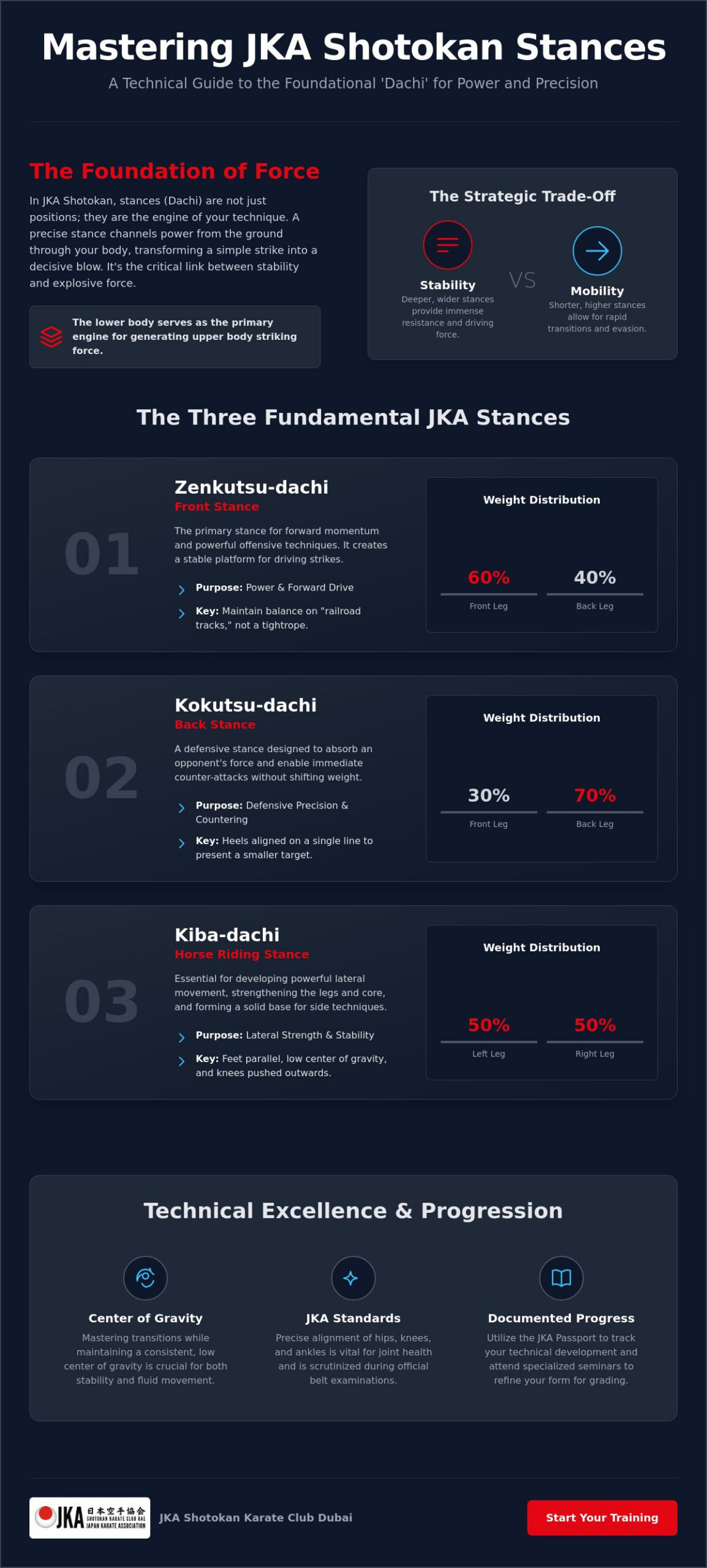
Traditional training involves a constant strategic trade-off between absolute stability and rapid mobility. A wider, deeper base offers immense defensive resistance and forward driving force, yet it requires more coordination to transition out of than a shorter, more mobile stance. Every position in the JKA curriculum prepares the body for specific offensive or defensive outcomes. Kime is the momentary intensification of a stance upon impact, where the entire body freezes into a rigid structure to maximize force delivery.
The JKA Standard for Technical Excellence
Maintaining technical precision is vital for long-term joint health and operational longevity. JKA standards require the precise alignment of the hips, knees, and ankles to prevent unnecessary strain. These technical nuances are scrutinized heavily during official belt examinations, where instructors evaluate the synergy between the feet and the floor. This rigorous adherence to the JKA curriculum ensures global training consistency. It allows a student in Dubai to demonstrate the same high-level proficiency as one in Tokyo. Mastery of these karate stances is the first step toward achieving the technical excellence required at the black belt level.
Mastering the Three Fundamental Shotokan Stances
The core of the JKA curriculum revolves around three primary karate stances. These positions are introduced at the white belt level and remain central to technical development throughout a practitioner’s journey. From the very first Heian kata to advanced black belt forms, these structures provide the necessary framework for every block and strike. As a practitioner progresses, the depth and precision of these stances directly correlate with increased muscular development and lower body endurance. Transitioning from basic white belt understanding to advanced application requires a disciplined focus on weight distribution and joint alignment.
Zenkutsu-dachi (Front Stance): Power and Drive
Zenkutsu-dachi is the primary vehicle for forward momentum and offensive drive. To achieve the correct JKA standard, you must distribute 60% of your weight on the front leg and 40% on the back leg. The front foot points directly forward, while the back foot is angled slightly forward to facilitate hip rotation. Practitioners should imagine standing on “railroad tracks” rather than a tightrope. This lateral width ensures you maintain balance during high-impact strikes and prevents the structural collapse of the stance under pressure.
Kokutsu-dachi (Back Stance): Defensive Precision
In contrast to the forward drive of Zenkutsu-dachi, the Kokutsu-dachi focuses on defensive precision and weight absorption. The distribution shifts significantly, with 70% of the weight on the back leg and only 30% on the front. Proper alignment requires both heels to sit on a single line, creating a narrow profile that makes you a smaller target. This rear-weighted position is tactically advantageous. It allows you to absorb an opponent’s force and immediately launch counter-attacks using the front leg without needing to shift your center of gravity first.
Kiba-dachi (Horse Riding Stance): Lateral Strength
Kiba-dachi is essential for developing lateral strength and a centered, immovable base. This stance requires an equal 50/50 weight distribution with both feet kept strictly parallel. A critical technical detail is the “tucking” of the pelvis, which engages the core and protects the lower back from strain. Mastering Kiba-dachi is vital for building the explosive hip power necessary for various Shotokan karate techniques. It serves as a rigorous conditioning tool that strengthens the adductors and improves overall structural stability.
Refining these fundamentals is a continuous process that demands expert guidance and consistent repetition. If you’re looking to perfect your form for upcoming grading, joining structured JKA karate classes can provide the professional feedback needed to reach the next level of technical proficiency.
Biomechanics and Movement: The Science of Stance Transitions
While many practitioners view karate stances as stationary positions, the JKA curriculum treats them as dynamic states of transition. Movement between these positions is where technical proficiency is truly tested. The “C-step” or crescent movement is a fundamental requirement for maintaining structural integrity while transitioning between various karate stances. By ensuring the feet pass through the center point of the body’s axis, you maintain a protected groin and a stable base. This central path prevents the weight from swinging outward, which would otherwise create a tactical opening for an opponent to exploit.
A hallmark of advanced technical skill is the ability to move without changing height. Avoiding the common “bobbing” mistake is essential for operational efficiency. When the head rises and falls during a step, energy is wasted in vertical motion rather than being directed forward into the strike. You’ve got to use the floor to push off, treating the ground as a strategic surface that provides the necessary friction for explosive speed. This grounded approach ensures that every ounce of kinetic energy is preserved for the final impact. It’s a precise science that separates basic movement from elite performance.
Maintaining Center of Gravity (Hara)
The “Hara,” or lower abdomen, serves as the command center for all movement. Visualizing your center of gravity as a heavy ball situated deep within the Hara helps you maintain a vertical spine even during rapid transitions. This internal focus is a core component of effective karate training. A low, stable center of gravity significantly improves balance and allows for quicker weight shifts. When the Hara is engaged, the upper body remains relaxed and ready, while the lower body provides the necessary torque for powerful execution. Don’t underestimate the role of core stability in maintaining this structural alignment.
Common Mistakes in Stance Execution
Even seasoned practitioners can fall into suboptimal habits that compromise their performance. One frequent error is leaning too far forward in Zenkutsu-dachi, which shifts the center of gravity beyond the base of support and leads to instability. Another critical failure is the “floating” heel, where the back heel loses contact with the floor. This disconnect breaks the chain of force and reduces the power of the strike. Finally, ensuring your knees track directly over the toes is vital for joint safety. Weak knees that buckle inward not only invite injury but also signal a lack of structural discipline. Correcting these errors is paramount for anyone serious about mastering karate stances at a professional level.
Just as a martial artist must address these structural issues for peak performance, vehicle owners should also prioritize mechanical health; you can explore Car Suspension Repair to see how professional alignment and shock maintenance ensure a car’s operational longevity.
Specialized Stances for Advanced Shotokan Practice
Advanced technical development requires moving beyond the foundational “Big Three” into specialized karate stances designed for complex tactical scenarios. As a practitioner reaches the brown and black belt levels, the curriculum introduces positions that prioritize rapid weight shifting and immovable stability. These advanced structures are prominently featured in higher-level katas such as Bassai Dai, Sochin, and Nijushiho. Unlike the deep, driving force of basic kihon, these karate stances often utilize shorter, more mobile bases to facilitate close-quarters kumite and multi-directional defense. This transition from formal, rigid structures to dynamic, adaptable positions marks a significant evolution in a martial artist’s tactical approach.
Neko-ashi-dachi and Sochin-dachi: Versatile Utility
Neko-ashi-dachi, or Cat Stance, is a masterclass in weight management and defensive readiness. By placing 90% of your weight on the back leg and resting only the ball of the front foot on the floor, you create an opening for immediate, explosive front-leg kicks. This stance is vital for technical precision in katas like Bassai Dai, where rapid defensive pivots are required to neutralize an attacker. Conversely, Sochin-dachi, often referred to as the “Immovable Stance,” provides a powerful hybrid of Kiba-dachi and Zenkutsu-dachi. It offers a low center of gravity with immense lateral and forward stability, making it the preferred choice for resisting heavy pressure from an opponent. Utilizing these stances correctly ensures maximum defensive reliability during high-stakes encounters.
Natural Stances (Shizentai) for Kumite Preparation
Technical mastery eventually leads back to simplicity through Shizentai, or natural stances. Positions like Heiko-dachi (parallel stance) and Hachiji-dachi (natural stance) serve as the standard “ready” positions in the dojo. These postures allow for 360-degree awareness and immediate movement in any direction without the telegraphing inherent in deeper positions. Shizentai represents the bridge between formal practice and real-world application. It’s the point where technical discipline merges with natural body mechanics to create a highly efficient fighting posture. Transitioning from formal kihon to these natural positions is a key metric of seniority within the JKA curriculum. It shows that you’ve internalized the principles of balance and can apply them without conscious effort.
To refine these advanced techniques under the guidance of senior instructors and elevate your technical standard, consider enrolling in our Teens & Adults Karate Classes today.
Progressing Through the JKA Curriculum in the UAE
Technical proficiency in the UAE is more than just a personal achievement; it’s a documented journey toward international standards of excellence. Your progress is officially tracked through the JKA Passport, which serves as a professional record of your training history, seminar attendance, and successful rank advancements. This level of organizational structure ensures that every student at JKA Shotokan Karate Club Dubai receives a consistent education that aligns with global requirements. Whether you’re refining basic karate stances or mastering advanced kata, your efforts are recognized by a worldwide network of practitioners.
Participation in specialized karate seminars is a critical component of this developmental pathway. These intensive sessions provide a platform for students to receive direct feedback from senior instructors, including Chief Instructor Sensei Ameer Adukkattil, a 6th Dan Black Belt. These workshops focus on the technical precision required to elevate your form beyond standard dojo practice. For younger students, this structured environment facilitates a seamless transition from Kids Karate Classes to the Teens & Adults program. This shift represents an evolution in training intensity, moving from foundational motor skills to the sophisticated biomechanical applications required for senior grades.
Belt Examinations and Stance Requirements
The Karate Belt Examination is the ultimate benchmark for technical growth. During these sessions, official examiners scrutinize your posture, focus, and weight distribution to ensure they meet JKA standards. The progression of karate stances from the 9th Kyu (white belt) to the 1st Dan (black belt) follows a logical increase in complexity. While a beginner must demonstrate basic stability in Zenkutsu-dachi, a black belt candidate is expected to show fluid transitions between specialized positions with zero loss of structural integrity. Utilizing dojo feedback during regular classes is the most effective way to prepare for these high-stakes evaluations.
Joining JKA Shotokan Karate Club Dubai
Choosing to train at an official JKA branch (AE-007) provides Dubai residents with a strategic advantage. You gain access to a comprehensive training system that prioritizes long-term joint health, operational efficiency, and traditional discipline. Our instructors are certified to deliver the authentic Shotokan curriculum, ensuring your techniques are effective and technically sound. This commitment to excellence creates a stable environment where practitioners can pursue their goals with confidence. If you’re ready to experience the benefits of a world-class martial arts education, register for a trial class at JKA UAE today and begin your journey toward technical mastery.
Elevating Your Technical Standard Through Structural Precision
Mastering the technical nuances of karate stances is a strategic investment in your long-term martial arts development. By refining the synergy between the Hara and the floor, you ensure that every movement is both powerful and operationally efficient. We’ve explored how these foundational structures serve as the engine for all Shotokan techniques, from basic kihon to the most advanced black belt katas. Maintaining this level of excellence requires a commitment to the standardized international JKA curriculum and regular assessment by certified professionals.
As the official UAE branch of the Japan Karate Association, we provide a structured environment led by certified instructors for kids, teens, and adults. This institutional focus on quality ensures your training remains consistent with global standards. If you’re looking to provide your family with a foundation of discipline and physical excellence, now is the time to act. Enroll your child in authentic JKA Kids Karate Classes in Dubai and join a community dedicated to technical mastery. We look forward to supporting your progress on the mats.
Frequently Asked Questions
What is the most important karate stance for beginners?
Zenkutsu-dachi, or the front stance, is the most critical position for those starting their journey in Shotokan. It serves as the primary vehicle for developing the leg strength and hip rotation necessary for all basic techniques. Mastering this foundation early ensures you have the stability required to progress through the JKA curriculum with technical precision.
How can I improve my balance in Kokutsu-dachi (Back Stance)?
Improving balance in the back stance requires a strict focus on heel alignment and weight distribution. Ensure both heels sit on a single line while maintaining 70% of your weight on the rear leg. Engaging your center of gravity in the lower abdomen prevents your torso from leaning, which is the most common cause of instability in this position.
Why do my knees hurt when I practice Zenkutsu-dachi?
Knee discomfort often results from improper alignment where the front knee buckles inward rather than tracking directly over the toes. You must ensure your front knee is bent sufficiently to cover the view of your toes while keeping the back leg straight and the heel firmly planted. Correcting these structural errors is vital for long term joint health and operational longevity during karate stances practice.
What is the difference between a ‘long’ stance and a ‘short’ stance in Shotokan?
Long stances are primarily utilized in Kihon and Kata to maximize stability, lower the center of gravity, and build explosive leg power. Short stances are more common in Kumite and advanced forms where mobility is the priority. These shorter positions allow for faster transitions and more adaptable movement in close quarters combat scenarios.
Are karate stances actually useful in a real self defense situation?
Yes, but they function as dynamic platforms for energy transfer rather than static poses. In a self defense situation, the principles of structural integrity and balance learned through formal practice allow you to deliver force effectively while remaining difficult to off-balance. The transition to natural fighting postures is a key outcome of advanced training.
How do I know if my weight distribution is correct in Kiba-dachi?
Correct distribution in Kiba-dachi is an equal 50/50 split between both legs with the feet kept strictly parallel. You can verify your form by ensuring your knees are pushed outward over your feet and your pelvis is tucked under the spine. This creates an immovable base that is essential for developing lateral power in various karate stances.
Can I practice karate stances at home without a gi?
You can certainly practice at home to build the necessary muscle memory for technical advancement. Consistency is the most important factor in mastering these positions. Ensure you have a clear space and a non slip surface to maintain the precision of your footwork and joint alignment without the restrictions of formal attire.
What is a ‘natural stance’ and when should I use it?
A natural stance, or Shizentai, is a relaxed position like Hachiji-dachi where the feet are shoulder width apart. It is used as a standard “ready” position in the dojo and represents the bridge between formal practice and real world application. These stances are ideal for maintaining 360 degree awareness and moving rapidly in any direction without telegraphing your intent.