Could a black belt earned in eighteen months actually be a disservice to your child’s character? Many parents in Dubai feel a growing sense of confusion when trying to identify the best karate style for kids amidst a sea of “sport” schools and commercialized martial arts centers. It’s a valid concern. You aren’t just looking for physical exercise; you’re seeking a strategic partnership in your child’s development that prioritizes discipline, humility, and authentic technique over rapid, unearned promotion.
We understand that choosing the right dojo is a significant decision for your family’s long-term goals. This guide provides a comprehensive look at the technical and developmental differences between traditional karate styles to choose the most beneficial path for your child. We’ll explore how a structured Japanese syllabus, dojo etiquette, and globally recognized grading standards ensure your child learns authentic techniques. You’ll discover how JKA Shotokan Karate Club Dubai integrates the Juma Al Majid legacy with world-class instruction to transform training into a complete JKA Education system that builds focus and resilience for 2026 and beyond.
Key Takeaways
- Analyze the technical distinctions between the four primary traditional styles to determine which offers the most robust foundation for long-term physical and mental progression.
- Discover why Shotokan’s emphasis on linear power and balance is widely considered the best karate style for kids during their formative years of coordination development.
- Establish a rigorous framework for evaluating local dojos by verifying official instructor credentials and a direct lineage to established Japanese standards.
- Explore the JKA Education model, which transcends basic physical training to cultivate institutional values of discipline, respect, and character excellence.
- Recognize the strategic advantage of training within an official JKA branch, where global innovation and the local prestige of the Juma Al Majid legacy converge.
Defining the Landscape: What is the Best Karate Style for Kids?
Karate is far more than a recreational activity; it’s a traditional Japanese martial art defined by the concept of “Kara” (empty) and “Te” (hand). For families in Dubai seeking a structured path for their children, identifying the best karate style for kids begins with understanding the technical roadmap, or “Ryu,” that governs their training. Choosing a specific style isn’t merely a matter of convenience. It’s a strategic decision that determines the quality of the technical syllabus and the integrity of the child’s long term progression. This foundation ensures that the time invested in training yields measurable results in both physical skill and character development.
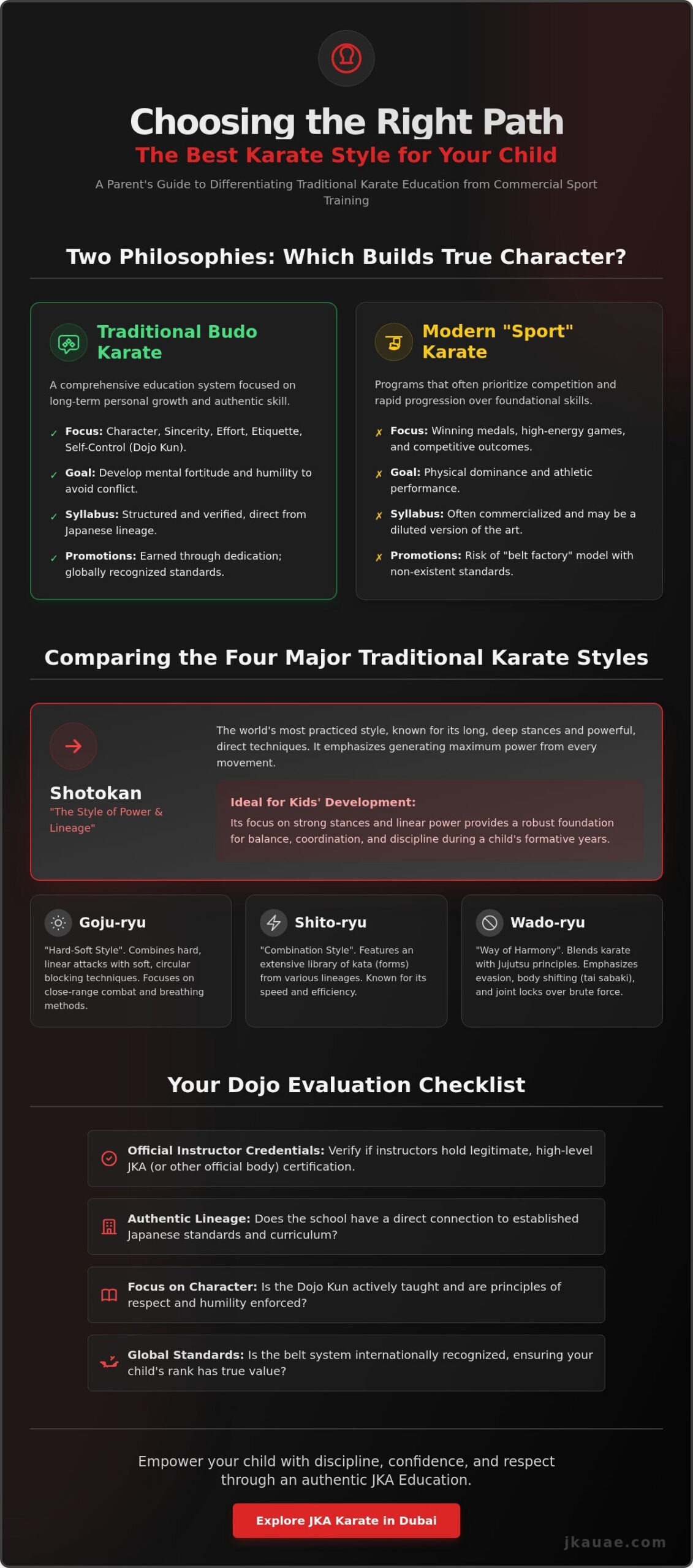
Traditional Budo karate differs significantly from modern “sport” programs that often prioritize competitive medals over personal growth. While many local centers focus on high energy games, a traditional academy functions as a comprehensive education system. This approach ensures that every technique taught is rooted in a verified lineage, maintaining the standards established by masters in Japan. By prioritizing lineage, parents can be confident that their child is receiving authentic instruction rather than a diluted version of the art. This distinction is vital for maintaining the technical excellence that characterizes the JKA legacy.
The Core Philosophy of Traditional Karate
Traditional training is anchored in the Dojo Kun, a set of five guiding principles: Character, Sincerity, Effort, Etiquette, and Self-Control. Unlike general fitness or MMA, which may prioritize physical dominance, traditional karate emphasizes a defensive first mindset. Children learn that the ultimate goal of training isn’t to win a fight, but to develop the mental fortitude and humility to avoid one. This focus on Kids Karate ensures that students develop respect for themselves and others, creating an atmosphere of trust and stability within the dojo.
Why Style Selection Impacts Early Development
The choice of style directly influences how a child develops physical coordination and balance. Different systems emphasize varying physical attributes, from the high stances of some schools to the deep, powerful movements of others. A Comparison of karate styles reveals that standardized systems provide a more reliable framework for youth. Consistency in the curriculum is essential. It ensures that if a student moves or travels, their progress remains valid. A standardized Belt System ensures that a rank earned in Dubai is recognized by international bodies, preventing the “belt factory” phenomenon where standards are non existent. This global recognition provides students with a sense of legitimate achievement and responsibility.
Comparing the Four Major Traditional Karate Styles
Understanding the technical diversity within the martial arts landscape is essential for parents who value precision and long term development. While many general programs group all “empty hand” arts together, the World Karate Federation recognizes four primary traditional styles: Shotokan, Goju-ryu, Shito-ryu, and Wado-ryu. Each style employs a distinct methodology for movement and power generation. For families evaluating the best karate style for kids, the decision often hinges on which system provides the most structured environment for a child’s maturing physical and cognitive capabilities. This choice isn’t just about physical activity; it’s about selecting a comprehensive education system that aligns with your family’s values.
Beyond the physical techniques, these highly structured systems offer significant mental and social benefits of martial arts, such as enhanced self-regulation and focus. The clarity of a traditional syllabus helps children navigate complex learning stages with confidence. This structured approach ensures that every hour spent in the dojo contributes to a child’s overall character development and resilience.
Shotokan: The Style of Power and Lineage
Shotokan is the most globally recognized style, characterized by its long, deep stances and powerful, linear techniques. It emphasizes the “Ikken Hisatsu” principle, which translates into training that builds immense lower body strength and explosive coordination. This style is frequently cited as the best karate style for kids because its movements are clear, logical, and highly effective for developing foundational athletic skills. The Japan Karate Association (JKA) maintains the highest global standards for Shotokan, ensuring that the integrity of the art remains consistent across all official branches. By training in a style with such a robust international framework, students gain access to a community that values excellence and historical continuity.
Goju-ryu, Shito-ryu, and Wado-ryu
While Shotokan focuses on linear power, other styles offer different technical perspectives. Goju-ryu, or the “hard-soft” style, incorporates circular blocks and close-range techniques, often emphasizing specific breathing patterns. Shito-ryu is known for its vast library of Katas, blending various Okinawan influences into a hybrid system. Wado-ryu, influenced by Japanese Jujutsu, focuses on body shifting and “Tai Sabaki” to avoid attacks rather than meeting them with direct force. While these styles are technically rich, Shotokan’s robust international organizational support often makes it the most accessible choice for families in Dubai. If you’re seeking a program that combines these traditional values with modern educational standards, you can explore our JKA karate classes to see how we maintain these standards in the UAE.
While many recreational centers in the region adopt a “Sun-and-Fun” model that prioritizes temporary entertainment over skill acquisition, parents seeking long term character development often find that Shotokan is the best karate style for kids. This style represents a departure from play-based programs, offering instead a structured environment where traditional discipline is the cornerstone of every lesson. By choosing a traditional path, families ensure their children aren’t just burning energy, but are participating in a comprehensive education system that builds a foundation for future success. This institutional approach is a hallmark of the JKA legacy, providing a stable framework for young minds to thrive.
The technical architecture of Shotokan is uniquely suited for the physical development of youth. Its characteristic linear movements and deep stances require students to engage their core and lower body, which significantly improves coordination and balance during formative growth years. Safety is a primary concern for any parent investigating martial arts Dubai. Traditional Shotokan training utilizes non-contact sparring, known as Kumite. This method emphasizes technical precision and self-control over raw impact. It allows children to learn effective defensive techniques in a secure environment, ensuring they develop confidence without the risks associated with full-contact sports.
Developing Discipline Through Kihon and Kata
The Shotokan curriculum is built on the pillars of Kihon (basics) and Kata (forms). Repetitive practice of Kihon is not merely a physical drill; it’s a strategic tool for developing mental stamina and focus. For children with high energy, these structured repetitions provide a productive outlet that teaches the value of perseverance. Kata training further enhances this by requiring students to memorize complex sequences of movement, improving their memory and spatial awareness. This disciplined approach to karate classes Dubai ensures that every student develops the mental fortitude required to excel both inside and outside the dojo.
The Global Standard of the Japan Karate Association
The Japan Karate Association (JKA) is recognized globally as the “Keepers of Karate’s Highest Tradition,” maintaining rigorous standards that are mirrored in our Shotokan karate Dubai programs. For the diverse expatriate community in the UAE, training under an official JKA branch offers a unique advantage: the curriculum is standardized worldwide. Whether a student is training in Dubai or eventually relocates to Tokyo or London, their rank and progress remain valid. This international recognition, coupled with the psychological benefits of the Belt System, provides children with a tangible sense of achievement. It reinforces the values of humility and responsibility, ensuring that every JKA karate Dubai student understands that a belt is a symbol of their commitment to excellence and the Juma Al Majid legacy of quality.
Key Criteria for Selecting a Karate Academy
Identifying the best karate style for kids is a vital first step, yet the efficacy of the training depends entirely on the institution’s operational standards. Parents must look beyond marketing materials to evaluate the technical credentials of the instructors. At JKA Shotokan Karate Club Dubai, we believe that a dojo should function as a strategic partner in your child’s development. This requires a commitment to excellence that is verified through official international affiliations and a clear, structured curriculum. A legitimate academy will always be transparent about its lineage, tracing its teachings directly back to the masters in Japan. This ensures that the techniques taught are authentic and maintain the integrity of the art.
The physical environment and equipment also reflect the school’s dedication to traditional Budo values. Training in an official JKA Karate Gi isn’t merely about aesthetics; it signifies a student’s entry into a globally recognized lineage. It fosters a sense of institutional pride and responsibility. When evaluating martial arts Dubai centers, check if there is a clear roadmap from white belt to black belt. A standardized syllabus prevents the “belt factory” phenomenon, ensuring that every promotion is earned through merit and technical proficiency. This structured approach is essential for developing long term discipline and focus in young practitioners.
The Importance of Official Documentation
One of the most critical yet overlooked aspects of karate classes Dubai is the provision of official documentation. A JKA Passport serves as a primary seal of quality and a permanent record of a student’s journey. It documents every grading, seminar, and workshop attended, providing a level of accountability that local certificates cannot match. If your family relocates internationally, this passport ensures that your child’s rank is recognized by JKA branches worldwide. This global portability protects the investment you’ve made in your child’s education and ensures their progress remains uninterrupted, regardless of where they train.
Evaluating the Dojo Atmosphere
The atmosphere of a dojo should be distinguished from a casual play center. Traditional etiquette, known as Reigi, is the cornerstone of Shotokan karate Dubai. It teaches children the importance of respect, humility, and dojo etiquette from the moment they bow at the entrance. While the training is rigorous, it must be balanced with a supportive learning environment where instructors act as seasoned advisors. This synergy between discipline and encouragement is what allows a child to build true confidence. To see how our structured environment supports these values, you can view our karate classes schedule and visit our official JKA branch in the UAE.
JKA UAE: Authentic Shotokan Training for the Next Generation
JKA UAE serves as the definitive bridge between Japanese tradition and regional excellence, standing as the official branch of the Japan Karate Association in the Emirates. Our institution provides a primary seal of quality for families who recognize that the best karate style for kids is one rooted in a verified, international lineage. We don’t view training as a simple extracurricular activity. It’s a strategic partnership in your child’s development, utilizing a comprehensive education system to foster character, humility, and technical precision. This commitment to traditional Budo values ensures that every student at JKA Shotokan Karate Club Dubai experiences a stable and professional environment designed for long term growth.
The structured nature of our programs for kids and teens prioritizes both discipline and safety. Unlike many martial arts Dubai centers that prioritize high impact sport, we focus on the controlled application of technique. This approach allows students to develop explosive power and coordination while maintaining absolute self-control. Participating in official JKA seminars and belt examinations provides children with a tangible sense of achievement and responsibility. These milestones are recognized globally, ensuring that the progress made in our karate classes Dubai holds its value anywhere in the world.
Our Professional Approach to Youth Karate
Instruction at our dojo is provided exclusively by certified JKA Senseis who follow the official Japanese syllabus. This ensures that the Shotokan karate Dubai training your child receives is authentic and technically sound. We maintain a strict focus on traditional karate, explicitly excluding MMA or general fitness trends to preserve the integrity of the art. Students have access to official JKA gear, including the Official JKA Karate Gi and the JKA Passport. These items are not just equipment; they represent a student’s formal entry into a global legacy of excellence and a commitment to the highest standards of dojo etiquette.
Building a Legacy of Excellence
JKA UAE is deeply rooted in the heritage of the region, serving the national community through standardized training that mirrors the Juma Al Majid legacy of trust. Being part of a global karate federation offers children a unique perspective on perseverance and international standards. This connection provides a roadmap for personal development that extends from the first white belt to the advanced ranks of the Belt System. If you are ready to provide your child with a foundation of focus and respect, the next step is simple. You can explore our Kids Karate programs or contact our team to begin their journey in the best karate style for kids today.
Empowering the Next Generation Through Traditional Excellence
Selecting the right martial arts program represents a strategic investment in your child’s character and future resilience. We’ve demonstrated that identifying the best karate style for kids requires a commitment to technical lineage and international standards rather than temporary recreational activities. Traditional Shotokan, with its logical emphasis on linear power and mental discipline, provides a stable foundation for young practitioners to cultivate focus and respect in 2026. This structured approach ensures that every hour spent in the dojo contributes to a child’s long term development and technical mastery.
As the official UAE branch of the Japan Karate Association, JKA UAE offers a comprehensive education system that integrates global innovation with the local trust of the Juma Al Majid legacy. Our certified international instructors ensure that every student benefits from globally recognized belt rankings and a structured syllabus that prioritizes technical excellence. You can enroll your child in authentic JKA Shotokan Karate classes today to begin their journey toward long term personal growth. We look forward to welcoming your family into a community where tradition and excellence converge.
<!–