Does a black belt earned in one city still hold its professional value when you step onto a mat ten thousand miles away? Many practitioners worry that their hard-earned rank might be perceived as a product of a “belt factory” or lose its technical validity across international borders. It’s a common concern because the lack of a unified global standard often leads to inconsistency in skill assessment. We understand that you seek a ranking system that reflects genuine technical proficiency and institutional stability.
This article provides a comprehensive analysis of karate belts within the JKA Shotokan system, detailing how this internationally recognized framework ensures operational excellence and technical consistency for every student. By following the Japan Karate Association standards, you gain access to a strategic progression path that transforms training into a form of high-level education. You’ll learn the specific requirements for each Kyu level, the functional benefits of the JKA Passport, and the necessary steps to prepare for a successful first examination.
Key Takeaways
- Understand the distinction between the Kyu student phase and the Dan advanced phase to clarify your long-term developmental roadmap within the association.
- Decode the technical significance of various karate belts, moving from foundational etiquette at the white belt level to the coordinated striking techniques of the orange and yellow ranks.
- Identify the rigorous evaluation criteria for JKA examinations, which utilize Kihon, Kata, and Kumite to maintain a globally recognized gold standard of proficiency.
- Discover how the JKA Passport functions as a strategic document, ensuring your technical rank remains valid and portable across more than 100 countries.
- Learn the operational steps to locate an authorized branch in the UAE and what to expect during your initial training session to ensure a professional start to your practice.
The Kyu and Dan System: A Professional Framework for Progression
The ranking structure within JKA Shotokan operates as a rigorous technical certification process designed for modern practitioners. Unlike decentralized organizations, the Japan Karate Association maintains a strictly centralized operational standard that ensures a practitioner’s skill level is consistent across any global branch. This professional framework is divided into two distinct phases: the Kyu student ranks and the Dan advanced ranks. Progression through the karate belts signifies a measurable advancement in technical proficiency and operational excellence, providing a comprehensive solution for long-term skill development.
What is a Kyu Rank?
In the current JKA system, students are assigned Kyu ranks in descending numerical order. A new student begins at the 9th Kyu (white belt) and works toward the 1st Kyu (brown belt). This phase focuses on building a robust technical foundation through specific training modules: Kihon (basics), Kata (patterns), and Kumite (sparring). The white belt represents the primary step where a beginner commits to the dojo’s current standards and rigorous training protocols. This structured approach follows Shotokan’s Kyu/Dan rank system, which is standardized internationally to ensure technical superiority and character development.
Understanding Dan Ranks and Mastery
Achieving the 1st Dan, or Shodan, marks the beginning of high-level technical exploration. The transition from 1st Kyu to 1st Dan requires passing a formal karate belt examination conducted by authorized JKA examiners. Dan ranks progress in ascending order from 1st to 10th Dan. Because the JKA operates in over 100 countries, earning these advanced karate belts at an official branch provides a globally recognized credential. This international portability is a core feature of the JKA system, ensuring operational efficiency and technical consistency across all regional branches worldwide. It ensures that your rank remains an asset regardless of your geographical location.
Decoding the Colors: What Each Karate Belt Represents
The visual hierarchy of karate belts functions as a standardized performance metric within the JKA Shotokan framework. Each color transition denotes a specific advancement in operational discipline and technical capability. These ranks aren’t merely decorative; they signify that a practitioner has successfully met the rigorous technical benchmarks established by the Japan Karate Association. This structured approach ensures that students don’t just progress through ranks but actually demonstrate the specific skill sets required at each operational level, providing a transparent record of professional development.
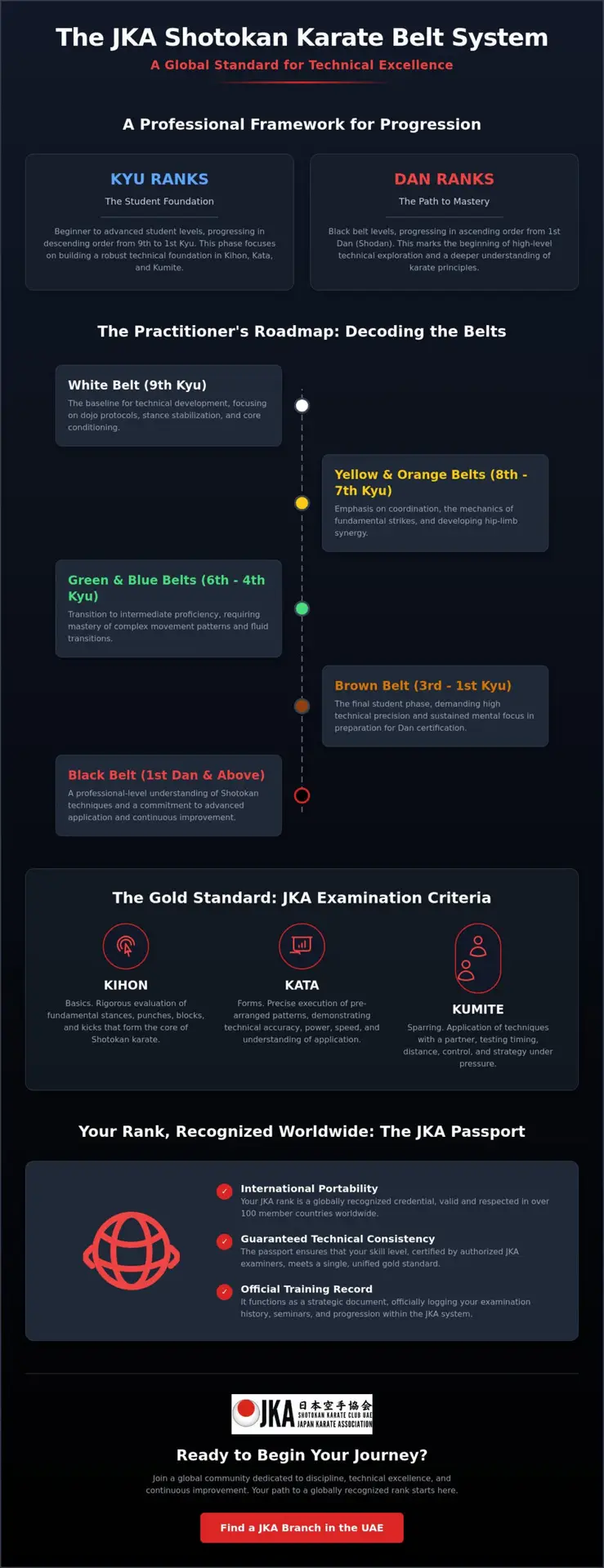
- White Belt (9th Kyu): Serves as the technical baseline, focusing on dojo protocols, initial stance stabilization, and core physical conditioning.
- Yellow and Orange Belts (8th to 7th Kyu): Emphasize the development of coordination and the mechanics of fundamental strikes, focusing on hip-limb synergy.
- Green and Blue Belts (6th to 4th Kyu): Mark the transition to intermediate proficiency, requiring the mastery of complex movement patterns and fluid transitions.
- Brown Belt (3rd to 1st Kyu): Represents the final student phase, demanding high technical precision and sustained mental focus in preparation for Dan certification.
- Black Belt (1st Dan and above): Indicates a professional-level understanding of shotokan karate techniques and a commitment to advanced technical application.
The Strategic Roadmap of the Practitioner
The JKA uses these visual markers to track a practitioner’s dedication to excellence and long-term reliability. The progression through colors provides a clear roadmap for skill acquisition, which is particularly effective in karate classes for teens in Dubai. By achieving these measurable milestones, students develop leadership skills and a sense of personal accountability that translates into broader academic and professional environments. This system creates a culture of continuous improvement and operational transparency, ensuring every student understands their current standing and future objectives.
Technical Requirements Per Color
The technical shift from an orange belt to a green belt is defined by a move from isolated mechanics to the fluid application of technical combinations. At these intermediate levels, the curriculum introduces Kumite (sparring), where students must demonstrate strategic control and effective decision-making under pressure. As the belt color darkens, the expectations for performance become significantly more demanding, focusing on technical accuracy and the efficient application of power. These standards are strictly aligned with the official JKA Dan grading requirements, ensuring that every rank earned is a verifiable reflection of current skill. If you’re ready to start your own progression, joining karate classes provides a professional path toward technical mastery.
The Path to Advancement: JKA Belt Examinations and Standards
The JKA examination process serves as a critical quality control mechanism, ensuring that the distribution of karate belts remains a true indicator of technical ability. While some organizations might prioritize participation, the Japan Karate Association treats every examination as a professional audit of a student’s progress. This rigorous approach has established the JKA as the global gold standard, where a rank earned in Dubai carries the same weight and technical expectations as one earned in Tokyo. Advancement isn’t guaranteed by time alone; it requires a demonstrated synergy of physical skill and mental discipline.
Every examination evaluates three core pillars: Kihon (basics), Kata (forms), and Kumite (sparring). This multi-faceted assessment ensures that students develop a balanced skillset, preventing the technical gaps often found in less structured systems. To maintain high levels of operational efficiency, only qualified examiners, who have undergone specialized training at the headquarters in Japan, are authorized to conduct these assessments. This centralized oversight is detailed in JKA’s official Dan ranking system, which mandates specific criteria for each level of advancement to maintain international quality control.
Preparing for Your First Examination
Success begins long before the exam date through consistent attendance and instructor approval. Instructors act as strategic advisors, ensuring that each student is technically ready to meet the association’s requirements before they step onto the mat. Mental preparation is equally vital. Students must learn to maintain composure and resilience under the scrutiny of a formal panel. Part of this professional presentation includes wearing a clean, well-fitted Official JKA Karate Gi, which reflects the student’s respect for the dojo and the standards of the art.
The Role of Kata in Rank Advancement
Kata serves as a comprehensive technical library, with specific patterns assigned to each of the student karate belts. Examiners don’t just look for memorized movements; they evaluate focus, power, rhythm, and technical accuracy. A student must demonstrate the practical application of these movements, proving they understand how the form translates into effective self-defense. This focus on functional mastery ensures that as the belt color darkens, the practitioner’s ability to navigate complex physical challenges and strategic scenarios increases proportionally.
Global Recognition: The JKA Passport and International Portability
One of the most significant advantages of the JKA system is its centralized administrative oversight. While karate belts are the visible symbols of rank, the JKA Passport serves as the official, internationally recognized record of a practitioner’s journey. This document ensures that every promotion is verified and authenticated by the headquarters in Japan. For expatriate families living in the UAE, this level of portability is essential. It provides a strategic solution for those who may relocate, ensuring that years of dedicated training are not dismissed due to a lack of verifiable documentation.
The JKA maintains an active presence in over 100 countries. This global network allows for a seamless transition between dojos. Because the JKA implements a system of “name permission” for affiliated branches, students are protected from “fraudulent organizations” that might issue ranks without proper technical authority. This security measure maintains the integrity of the system and ensures that a student’s rank is a genuine reflection of their skill level. It creates an atmosphere of trust and stability for students and parents alike, reinforcing the value of their investment in professional training.
Recording Your Progress
Every official belt examination is meticulously recorded within the passport. Each entry includes the date, the location, and the signature of an authorized JKA examiner. This makes the passport a lifelong document for the serious practitioner, serving as a comprehensive archive of their technical evolution. By strictly adhering to JKA Shotokan Karate standards, students ensure their records meet the highest levels of global scrutiny. The passport acts as a primary seal of quality, preventing the confusion often associated with varied karate belts and ranking systems in different regions.
Training Across Borders
The standardized curriculum used by the JKA means that the technical execution of a Kata in Dubai is identical to its execution in Tokyo or London. A student can walk into any affiliated dojo worldwide, present their passport, and resume training at their current rank without hesitation. This consistency is why JKA certification is frequently preferred by professional organizations and international federations. It represents a commitment to quality that transcends regional borders and cultural differences. As of June 2026, the JKA continues to prioritize the registration of all overseas members to clarify their legal status within the organization, further enhancing the value of your rank.
To secure your official ranking and start your journey with a globally recognized credential, register for your JKA Passport and begin your training today.
Starting the Journey: How to Begin Training in the UAE
Initiating your practice within the UAE requires selecting an authorized facility that aligns with the current operational standards of the Japan Karate Association. Official branches are strategically located in Dubai, Sharjah, Abu Dhabi, and Fujairah, providing a professional network for practitioners across the Emirates. JKA Shotokan Karate Club Dubai operates as a fully authorized branch, maintaining strict compliance with the UAE Karate Federation and the General Authority of Sports UAE. When you attend your first karate training session, you’ll enter a structured educational environment where technical precision and operational protocols are prioritized. This professional setting ensures that every student receives a consistent, high-quality experience from their first day on the mat.
Our curriculum prioritizes long-term character development and mental clarity, focusing on high-level educational standards rather than short-term competitive results. While some organizations may prioritize sport trophies, a professional JKA facility treats the progression through karate belts as a comprehensive educational solution. This commitment to excellence ensures that students build a foundation of discipline that enhances their personal and professional lives. The practice is managed as a strategic partnership between the instructor and the student, aimed at achieving technical mastery and operational efficiency in every movement.
Choosing the Right Program
JKA UAE provides specialized Kids Karate Classes for students as young as four, alongside dedicated Teens & Adults Karate Classes and Ladies Karate Classes. Reaching the first milestone among the karate belts typically requires a commitment to at least two sessions per week to ensure technical consistency. In Dubai, official training is available at established branches in Al Nahda-2, Silicon Oasis, and Al Furjan, each offering tailored plans to accommodate various professional and academic schedules. To begin, you’ll register for an individual membership and receive your official JKA Karate Gi, ensuring you meet the professional presentation standards required for all authorized examinations.
The JKA UAE Community
Members of the JKA UAE community benefit from a synergy of local expertise and international innovation through specialized Karate Seminars and Workshops. These sessions often feature guest instructors from the global headquarters, providing practitioners with cutting-edge technical insights and advanced training methodologies. The dojo environment is designed as a professional training facility that fosters mutual respect and a shared commitment to excellence. For parents seeking a stable developmental path for their children, scheduling a trial session is the primary step toward securing a place in our program. Visit the JKA UAE homepage to locate a branch near you and explore our total solutions for martial arts education.
Secure Your Global Technical Certification in Shotokan Karate
The progression through karate belts within the Japan Karate Association is far more than a local achievement; it is a strategic investment in a globally recognized technical standard. By adhering to a rigorous framework of Kihon, Kata, and Kumite, students ensure their proficiency is verified by the highest authorities in the art. This centralized system provides a comprehensive solution for those seeking authentic martial arts education, offering the stability of an internationally portable rank via the official JKA Passport. This administrative transparency ensures that your hard work remains valid whether you are training in Dubai or at any affiliated dojo across the globe.
As an official branch of the Japan Karate Association, we provide access to expert instructors trained in traditional Shotokan who are dedicated to your long-term success and operational discipline. This partnership ensures that every hour spent in the dojo translates into measurable growth and character development. We invite you to experience the synergy of traditional values and modern professional standards at our facilities across the UAE. Start your journey toward a black belt with JKA UAE today and join a community committed to technical excellence and global standards. We look forward to supporting your advancement on the mat.
Frequently Asked Questions
How long does it take to get a black belt in JKA Shotokan?
Achieving a black belt in the JKA system typically requires three to five years of dedicated, consistent practice. This timeline depends on the student’s technical proficiency and regular attendance at official sessions. It’s a strategic progression that ensures a practitioner has mastered the foundational Kihon and Kata before advancing to the professional Dan ranks.
Are karate belts the same for all martial arts?
No, the ranking systems and colors vary significantly across different martial arts and even within different styles of karate. While the concept of karate belts originated in Japan, other arts like Brazilian Jiu-Jitsu or Taekwondo use entirely different criteria and color sequences. The JKA Shotokan system is unique for its strict adherence to a global technical standard verified by the headquarters in Japan.
Do I have to pay for each karate belt examination?
Yes, a Karate Belt Examination typically involves specific administrative and registration fees. These costs cover the examiner’s professional assessment, the processing of international certification, and the official recording of the rank in the JKA headquarters’ database. Students should consult their local branch for the current fee structure associated with their specific Kyu or Dan level.
What happens if a student fails a belt exam?
If a student doesn’t meet the required technical standards during an exam, they’re provided with a comprehensive evaluation of their performance. This feedback allows the practitioner to focus on specific areas of improvement, such as Kata rhythm or Kumite control. They’re then encouraged to prepare for the next scheduled examination date once their instructor confirms they’ve reached the necessary level of proficiency.
Can a child earn a black belt in JKA Karate?
Children can certainly earn a black belt, but the JKA maintains specific age requirements and technical standards for junior ranks. A child’s progression focuses on developmental milestones and character growth. While they may achieve a Shodan (1st Dan) rank, the physical and mental expectations are adjusted to be age-appropriate while maintaining the integrity of the system.
Is the JKA belt recognized by other karate organizations?
JKA certification is widely regarded as the gold standard within the martial arts community and is recognized by major international federations. Because the JKA has branches in over 100 countries, a rank earned here carries significant weight. While other organizations have their own internal systems, the technical rigor of a JKA rank is respected globally by professional practitioners and instructors.
What is the order of karate belts in Shotokan?
The standard progression of karate belts in the JKA system starts at 9th Kyu (White) and moves through Yellow, Orange, Green, and Blue. Students then advance through three levels of Brown belt (3rd to 1st Kyu) before reaching the 1st Dan (Black). This descending numerical order for student ranks ensures a clear, measurable roadmap toward advanced mastery and professional certification.
Do I need an official JKA Passport to get a new belt?
Yes, an official JKA Passport is mandatory for recording all rank advancements and examination results. It serves as your primary seal of quality and ensures that your progress is documented within the association’s global infrastructure. Without this document, your rank cannot be officially recognized or transferred between international branches, which is why it’s a vital component of your professional training.