True martial arts mastery isn’t found in the chaos of a street fight; it’s forged through the surgical precision of a controlled exchange. For many, the question of what is kumite brings to mind images of high-impact combat, leading to a natural concern regarding safety and discipline. It’s common to feel a sense of hesitation when transitioning from solo practice to partner work, especially if you’re worried about the risk of injury or the lack of structure in a sparring environment.
At JKA Shotokan Karate, we view this practice as a strategic partnership between practitioners rather than a mere physical confrontation. We promise to reveal the technical depth and rigorous safety standards that define our curriculum, showing you how each movement contributes to operational excellence in your training. This comprehensive guide explores the structured progression of kumite, from fundamental pre-arranged drills to advanced free sparring. You’ll learn how this disciplined approach creates a synergy between physical skill and mental focus, providing a clear path for students to excel within a secure and professional framework.
Key Takeaways
- Gain a professional understanding of what is kumite by examining its role as the dynamic application of Kihon and Kata within a disciplined sparring environment.
- Review the structured JKA training progression that prioritizes safety and technical mastery through a series of increasingly complex partner drills.
- Distinguish between traditional Ippon Shobu and sport karate to appreciate the focus on single, decisive techniques that define the JKA standard.
- Understand the importance of official JKA certification and equipment standards in ensuring a secure and professional training experience for all age groups.
- Learn how consistent Kumite practice develops focus and respect, contributing to the overall character development of students in the Dubai branch.
Defining Kumite: The Third Pillar of Shotokan Karate
In the professional framework of JKA Shotokan Karate, understanding What is Kumite involves looking beyond the superficial lens of combat. The term literally translates to “intertwined hands” or “meeting of hands,” signifying a sophisticated and structured dialogue between two practitioners. Unlike disorganized physical confrontation, kumite serves as a controlled educational tool designed to refine a student’s technical precision and operational efficiency. It functions as the practical laboratory where the theories taught in our Karate Classes in Dubai meet the realities of physical interaction. The primary objective isn’t to defeat an opponent but to master the critical elements of timing, distance, and mental composure under pressure.
The Concept of the Three Pillars
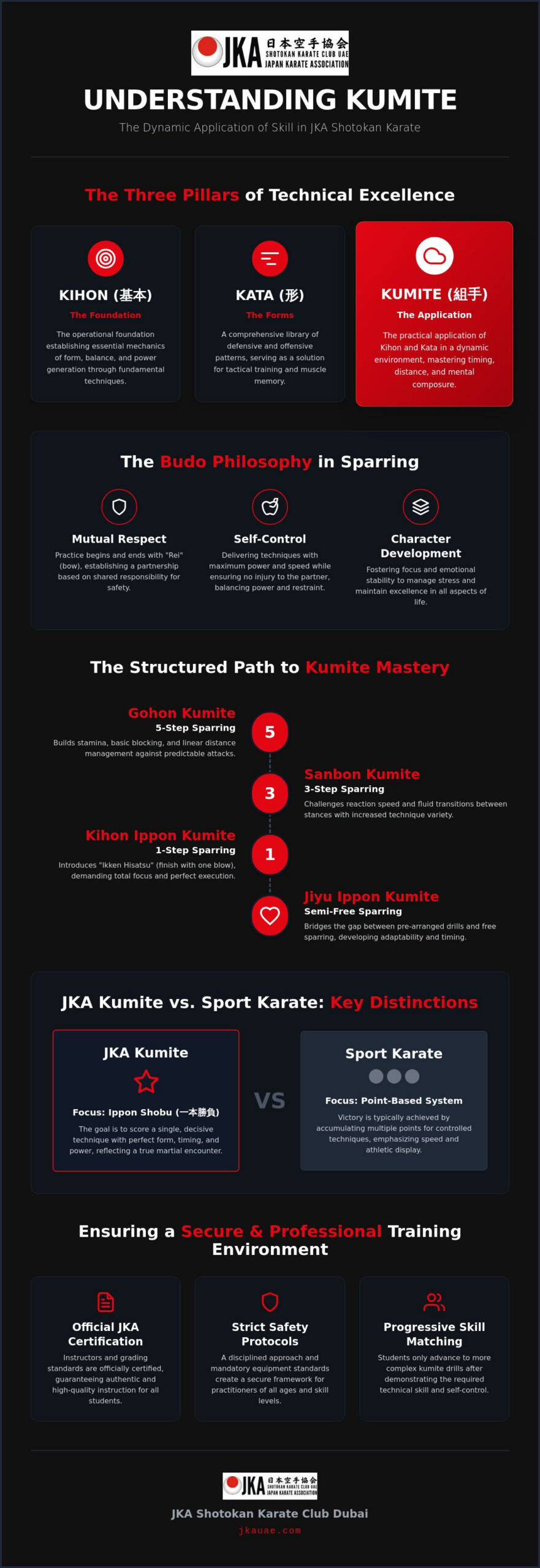
Within the JKA curriculum, technical excellence is achieved through the synergy of three fundamental pillars: Kihon, Kata, and Kumite. Kihon provides the operational foundation, establishing the essential mechanics of form, balance, and power generation. Kata serves as a comprehensive solution for tactical training, offering a structured library of defensive and offensive patterns. Kumite represents the final stage of this integrated approach. It is the ultimate test of a student’s technical and mental progress, requiring them to apply their foundational knowledge in a dynamic, unpredictable environment. Without the baseline of Kihon and the strategic depth of Kata, sparring lacks the discipline required for true martial arts mastery.
The Philosophy of Budo in Sparring
The practice of sparring at JKA Shotokan Karate Club Dubai is deeply rooted in the principles of Budo, which prioritizes the cultivation of the individual over mere competitive success. This commitment to excellence begins with “Rei,” the formal bow performed before and after every exchange. This gesture establishes a strategic partnership based on mutual respect and a shared responsibility for safety. Practitioners are trained to exhibit absolute self-control, delivering high-velocity techniques with maximum power while ensuring they don’t cause injury to their partner. This balance of power and restraint is a hallmark of our professional standards. Kumite is a mutual exercise in character development. By fostering focus and emotional stability, we provide students with the tools to manage stress and maintain excellence in all areas of their lives.
The Technical Progression: From Drills to Free Sparring
JKA Shotokan training utilizes a highly structured roadmap to guide practitioners through the complexities of partner interaction. This isn’t a random series of fights; it’s a systematic progression designed to ensure safety while fostering absolute technical mastery. When beginners ask about what is kumite, they often discover it’s a sophisticated ladder of increasing difficulty. Each stage is carefully calibrated to match a student’s rank and mental maturity. This gradual approach allows for the development of reflex and precision without the chaotic risks associated with unregulated combat. It ensures that every student builds a reliable foundation before moving into more dynamic environments.
Basic Pre-Arranged Kumite (Kihon Kumite)
Kihon Kumite represents the foundational phase of our curriculum. It provides a stable environment where students practice defensive and offensive techniques against a predictable attack. This stage is critical for building the “muscle memory” required for high-level performance. Practitioners focus on three specific formats:
- Gohon Kumite (5-step): This entry-level drill emphasizes basic blocking and counter-attacking. It builds the physical stamina and linear distance management required for more advanced work.
- Sanbon Kumite (3-step): By reducing the steps and increasing the variety of techniques, this level challenges the practitioner’s reaction speed and fluid transition between stances.
- Kihon Ippon Kumite (1-step): This is the critical juncture where the “Ikken Hisatsu” (to finish with one blow) philosophy is introduced. It demands total focus and perfect execution in a single, decisive exchange.
Advanced and Free Sparring (Jiyu Kumite)
As students progress through their Shotokan Karate Classes, they move toward more fluid interactions. This transition is only permitted once an instructor confirms the student possesses the necessary self-control and technical accuracy. Advanced training includes:
- Jiyu Ippon Kumite: In this semi-free sparring stage, the attacker announces the target, but both participants move freely within the space. This develops the ability to judge distance and timing in a non-linear fashion.
- Jiyu Kumite: This is full free sparring. It’s conducted under strict instructor supervision to maintain our rigorous safety standards. Here, the practitioner must synthesize all previous lessons into a seamless, adaptive response.
A vital component of advanced training is Zanshin, or the state of relaxed awareness. It ensures the practitioner remains focused and prepared even after a technique is completed. This mental state is what separates a martial artist from a casual athlete. Understanding what is kumite requires recognizing that the ultimate goal is not just physical victory, but the maintenance of this heightened state of awareness and composure under pressure.
JKA Kumite vs. Sport Karate: Understanding the Differences
Distinguishing between traditional JKA methods and modern sport karate is essential for anyone seeking to understand what is kumite in its most authentic form. While many contemporary organizations prioritize rapid point accumulation, the JKA maintains a commitment to technical perfection and the principle of Ikken Hisatsu, or finishing with a single blow. This approach isn’t merely a sport; it’s a strategic partnership between practitioners aimed at achieving operational excellence in both movement and spirit. In JKA competition, we typically utilize the Ippon Shobu (one-point match) system, where a single, flawlessly executed technique concludes the bout. This creates a high-stakes environment that demands absolute focus and emotional stability from the very first second.
The Philosophy of Ippon Shobu
The Ippon Shobu system serves as a practical simulation of real-life self-defense scenarios. In a genuine confrontation, there are no second chances or cumulative scores to rely upon. By valuing one decisive blow over multiple lighter strikes, we encourage students to develop a mindset of total commitment and precision. This philosophy places significant mental pressure on the practitioner, as a single tactical error can end the match instantly. It forces a level of concentration and tactical awareness that is often missing in point-heavy sport systems. This dedication to quality over quantity is a core component of our JKA Karate Classes, ensuring every strike carries the potential for maximum effectiveness.
Rules and Scoring in Traditional Competition
Scoring in traditional JKA bouts requires much more than just making contact. Judges evaluate each technique based on a comprehensive set of criteria: good form, correct attitude, strong vigor, zanshin (awareness), proper timing, and correct distance. A strike that lacks Kime (focus) or proper body mechanics won’t receive a point, regardless of its speed. According to the revised JKA tournament rules effective April 1, 2025, officials maintain an exceptionally high standard for safety and control. A scored point may be revoked if the technique is determined to have caused injury due to a lack of restraint. This ensures the spirit of the practitioner remains respectful and disciplined throughout the exchange. Penalties for discourteous behavior or excessive contact are strictly enforced to preserve the integrity of the dojo and the safety of all participants.
Safety, Equipment, and Discipline in the Dojo
Safety operates as the primary seal of quality within every session at JKA Shotokan Karate Club Dubai. When prospective students investigate what is kumite, their inquiries often center on the balance between realistic training and physical protection. We maintain an uncompromising commitment to safety through the “Sun-dome” principle, which requires techniques to be stopped just millimeters from the target with absolute control. This rigorous standard ensures that practitioners of all ages, from children to senior executives, can engage in high-level training without compromising their physical well-being. By establishing these strict contact regulations based on rank and age, we’ve created a secure environment where technical evolution can flourish.
The psychological advantages of this disciplined approach are substantial. Learning to manage the surge of adrenaline during a sparring session provides a unique form of stress-management training. This ability to remain calm and analytical under pressure translates directly into improved performance in school and corporate environments. It fosters a level of focus and emotional resilience that’s difficult to replicate in other settings. Students don’t just learn to fight; they learn to govern their own reactions in the face of a challenge.
Essential Gear for Kumite Students
Maintaining the highest safety standards requires the use of specialized, high-quality equipment. Every student is encouraged to utilize an Official JKA Karate Gi, which is specifically designed to provide the freedom of movement necessary for complex maneuvers. Beyond the uniform, the JKA requires specific protective gear to mitigate risk during karate training. This includes approved gloves, transparent mouth guards, and chest protectors, all of which must be maintained in peak condition to ensure their operational effectiveness. This equipment acts as a critical layer of defense, allowing practitioners to focus entirely on their technical progression.
The Role of the Sensei and Dojo Etiquette
The Sensei serves as the ultimate authority and safety officer during every exchange. Instructors meticulously monitor each pair to prevent excessive contact and ensure that the spirit of the Dojo Kun is upheld. This discipline is reinforced through Dojo etiquette, starting with the “Rei” or bow. This gesture is more than a tradition; it’s a formal acknowledgment of the strategic partnership between practitioners and a commitment to each other’s safety. By following the guiding principles of the Dojo Kun, such as seeking perfection of character and refraining from violent behavior, students learn that true mastery of what is kumite lies in the union of power and profound respect.
If you are ready to experience a training environment defined by discipline and excellence, we invite you to explore our Karate Classes in Dubai today.
Starting Your Kumite Journey with JKA Dubai
Transitioning from a theoretical understanding of what is kumite to active participation requires a training environment that prioritizes technical precision and personal safety. JKA Shotokan Karate Club Dubai provides this essential infrastructure, offering a comprehensive suite of programs designed for practitioners at every stage of their development. Our reach extends across the United Arab Emirates, with dedicated training centers located in Dubai, Sharjah, Abu Dhabi, and Fujairah. This regional network ensures that authentic JKA instruction is accessible to a diverse demographic of students. By joining our community, you aren’t just enrolling in a class; you’re entering a strategic partnership focused on achieving international standards of excellence.
One of the most significant advantages of training with an official branch of the Japan Karate Association is the global recognition of your progress. Every student has the opportunity to obtain an Official JKA Passport. This document serves as a verified record of your technical journey, ensuring that your belt rank and kumite achievements are recognized at any JKA dojo worldwide. This level of institutional support is complemented by frequent technical seminars and international belt examinations, providing a clear and professional path for advancement.
Kids and Teens Programs in the UAE
Our youth curriculum is specifically engineered to introduce partner work through age-appropriate drills that build confidence without fostering aggression. For younger students, the focus remains on developing the coordination and respect necessary for safe interaction. As they mature, our karate classes for teens in Dubai place a greater emphasis on leadership and self-control. We prepare these students for their first Karate Belt Examination by progressively increasing the complexity of their kumite requirements. This structured approach ensures that teens develop the emotional resilience needed to handle pressure, a skill that serves them well in their academic and social lives.
Adult and Ladies Specialized Classes
For adult practitioners, kumite offers a sophisticated solution for physical conditioning and mental clarity. It functions as a high-intensity workout that demands total engagement, making it an exceptional tool for stress relief in a fast-paced corporate environment. Beyond the fitness benefits, our curriculum emphasizes the practical self-defense applications of Shotokan techniques. Ladies and adult students learn to apply the principles of distance and timing to neutralize threats efficiently and with absolute control. We invite you to join our official karate classes in Dubai to begin your journey toward technical mastery. Whether your goal is personal safety, physical health, or a deeper understanding of what is kumite, our professional instructors are prepared to support your long-term success.
Begin Your Path to Technical Mastery
Mastering the dynamic application of karate requires more than just physical effort; it demands a structured environment where safety and precision are the highest priorities. We’ve explored how the systematic progression from basic drills to free sparring ensures that every student builds a reliable foundation. Understanding what is kumite within the JKA framework reveals a sophisticated discipline focused on finishing techniques and emotional stability rather than simple point accumulation. This commitment to technical excellence creates a unique synergy between physical skill and mental focus, providing practitioners with a clear roadmap for personal growth.
As the official UAE branch of the Japan Karate Association, we offer a training experience defined by international standards and operational excellence. Our expert instructors provide a secure atmosphere where your progress is documented through JKA Passports, granting you global rank recognition across the regional network. This professional infrastructure supports your development from the very first session. Book a trial class at JKA Shotokan Karate Club Dubai today to integrate these traditional values into your life. We’re ready to help you achieve a new level of discipline and confidence on the mat.
Frequently Asked Questions
Is Kumite dangerous for children?
Kumite is exceptionally safe for children because it follows a strictly regulated curriculum that emphasizes non-contact or light-contact techniques. Instructors at our Dubai branches prioritize safety through the use of pre-arranged drills, ensuring kids build confidence without the risk of injury. This disciplined approach helps develop focus and respect in a secure environment.
What is the difference between Kumite and Kata?
The primary difference lies in the interaction; while Kata involves practicing defensive and offensive sequences against an imaginary opponent, what is kumite represents the dynamic application of those movements against a live partner. Kata builds the technical library, and Kumite provides the laboratory where students test their timing and distance management.
When do beginners start learning Kumite?
Beginners start learning the fundamentals of partner work almost immediately through Gohon Kumite, which consists of five-step pre-arranged drills. These entry-level exercises allow new students to understand the mechanics of blocking and counter-attacking safely. Free sparring, or Jiyu Kumite, is only introduced after a student has demonstrated sufficient technical proficiency and self-control.
Do I need special equipment for Kumite?
Yes, specific protective gear is mandatory to maintain our rigorous safety standards during training. Students require an official JKA Karate Gi for optimal movement, along with approved hand guards, transparent mouth guards, and chest protectors. This equipment ensures that every session remains productive while mitigating the risk of accidental injury.
How are points scored in a Kumite match?
Points are awarded based on the technical perfection of a single, decisive technique rather than the cumulative volume of strikes. Judges evaluate criteria such as correct form, vigor, awareness, and timing to determine if a strike qualifies as an Ippon or Waza-ari. This system encourages students to focus on quality and precision in every movement.
Can I practice Kumite if I am an adult beginner?
Adult beginners are encouraged to participate in kumite as it provides an excellent high-intensity workout and stress-relief tool. The training is introduced gradually to match your fitness level and comfort, ensuring you develop defensive skills in a professional and supportive atmosphere. It’s a strategic way to build resilience and mental focus outside of the workplace.
What happens if a student hits too hard during sparring?
Excessive contact is strictly prohibited and results in immediate technical penalties or disqualification from the match. We adhere to the “Sun-dome” principle, which requires practitioners to arrest their techniques just before impact. This ensures that students learn to deliver maximum power with absolute control, fostering a culture of mutual respect and safety.
How does JKA Kumite differ from MMA?
JKA Kumite differs from MMA by prioritizing the philosophy of “one finishing blow” and the development of character over competitive combat. While MMA is a multi-discipline combat sport, our training focuses on traditional Shotokan standards where self-control is as important as physical speed. We exclude general fitness or MMA-style grappling to maintain our commitment to authentic martial arts.