Many parents mistakenly view martial arts as a simple after-school activity, yet the right karate classes for kids function as a comprehensive educational curriculum for character development. You likely recognize the growing difficulty of keeping your child focused in an era of constant digital distractions and sedentary screen time. It’s common to feel concerned about whether a local club offers genuine instruction or merely a play-based environment that lacks the structure necessary for real progress. Standards drive results.
This guide demonstrates how JKA Shotokan karate serves as a strategic partnership in your child’s upbringing, offering a globally recognized path toward discipline and physical mastery. By aligning with the rigorous standards of the Japan Karate Association, your child gains access to a sophisticated training system that prioritizes safety, technical precision, and international rank recognition. We will detail how this authentic martial art fosters mental clarity and operational efficiency in a child’s daily habits. You will discover how a structured environment, led by internationally qualified instructors, provides a comprehensive solution for parents seeking to transform their child’s focus and physical excellence into a foundation for lifelong achievement.
Key Takeaways
- Identify the core differences between standardized martial arts education and general play-based clubs to ensure your child receives authentic instruction.
- Discover how the rigorous curriculum of karate classes for kids builds the operational efficiency and mental clarity required for excellence in both academics and character.
- Learn the essential criteria for evaluating a dojo, including the verification of official JKA certifications and the assessment of a disciplined learning atmosphere.
- Understand the technical synergy of Kihon, Kata, and Kumite, and how the JKA Passport secures your child’s progress within a globally recognized framework.
- Prepare for your child’s initial engagement by understanding the professional standards of the official JKA Karate Gi and the structure of their first trial session.
What Defines Authentic Karate Classes for Kids in 2026?
In the current educational landscape, karate classes for kids must be evaluated based on their operational standards and technical depth. Authenticity today is defined by a rigorous adherence to a globally recognized syllabus that prioritizes technical mastery over general amusement. While many centers offer recreational activities, a specialized dojo provides a comprehensive solution for developing mental clarity and physical precision. This system is built on a “do,” or way of life, that serves as a modern framework for personal excellence and daily discipline.
Researching the history of karate helps parents differentiate between modern sport variations and the technically rigorous systems used today. In 2026, authentic karate classes for kids are defined by their ability to deliver current behavioral improvements through a structured curriculum. This focus on immediate operational efficiency ensures that students develop the spatial awareness and mental stamina required for modern academic environments. By prioritizing technical accuracy, we ensure that every student’s time is spent in a high-value learning environment rather than a general fitness setting.
The JKA Global Standard
The Japan Karate Association (JKA) functions as the primary international authority for technical standards across more than 100 countries. This institutional oversight ensures that every rank achieved in the UAE meets a specific global standard of proficiency. Every student’s progress is managed through an official JKA Passport, providing a portable and verifiable record of their current skills. Instructors within this system participate in ongoing professional development and technical evaluations, ensuring that the quality of instruction remains at a cutting-edge level for all practitioners. This global infrastructure ensures that your child’s education remains consistent regardless of location.
Beyond ‘Fun’ – Building Character
Modern karate training moves beyond the recreational model to deliver specific behavioral results. The Dojo Kun, or five maxims, serves as an operational code of conduct that guides students’ behavior both inside and outside the dojo. This approach is effective because it demands technical precision. When children focus on the exact execution of a punch or the stability of a stance, they’re practicing a form of mental discipline that translates directly to classroom performance. It’s not just an activity; it’s a strategic partnership designed to build the focus and resilience required for future professional success.
The Core Benefits: How Karate Training Shapes Young Minds
The transition from the dojo to the classroom is a primary objective for many parents enrolling their children in karate classes for kids. While general sports focus on seasonal competition, JKA training utilizes repetitive practice to instill a deep sense of order and operational efficiency in a child’s behavior. Each session begins and ends with formal bows, establishing a clear boundary between play and focused study. This structure helps children manage their energy levels effectively. By practicing the same blocks and punches hundreds of times, students learn that excellence results from consistent effort rather than sporadic talent. This mindset directly impacts school performance; the perseverance required to master a complex kata mirrors the patience needed to solve difficult academic problems.
Cultivating Unshakeable Discipline
Earning a new rank in the JKA system is a lesson in delayed gratification. In a world of instant digital rewards, the months of preparation required for a belt examination teach children that meaningful achievement takes time. This process builds a resilient character. Students learn to set long-term goals and maintain focus even when the initial excitement fades. It’s a strategic partnership between the instructor and the parent to develop a child who doesn’t quit when tasks become challenging. Discover how our JKA Karate Classes provide a stable environment for this growth.
Physical Coordination and Safety
Physical development in our dojo is handled with professional precision to ensure long-term wellness. Unlike high-impact MMA or unregulated combat sports, JKA Shotokan prioritizes controlled techniques and spatial awareness. For younger practitioners, the focus remains on motor skill development and core strength. We follow strict safety protocols; for example, the JKA does not allow sparring (kumite) for children until they are ten years old and in the fifth grade. This policy prevents injuries while allowing kids to build the foundational coordination necessary for advanced training later. For martial arts for kids who learn differently, this predictable structure provides a sense of security and clear expectations that can be life-changing.
Respect is the cornerstone of our methodology. Students learn to value their peers and instructors through specific dojo etiquette. This isn’t just about following rules; it’s about recognizing the expertise of others and contributing to a safe, professional environment. By integrating these values, we provide a total solution for parents who want their children to grow into disciplined, physically capable, and respectful young adults. The skills learned on the mat become permanent assets in their character development.
How to Choose the Right Martial Arts School in the UAE
Selecting from the various karate classes for kids in the UAE requires a rigorous due diligence process to ensure the program meets international professional standards. Many facilities operate as recreational clubs, but a high-level dojo functions as a strategic educational partner. Parents should prioritize schools that utilize a standardized evaluation system rather than “belt factories” that award ranks based on attendance. Quality is verified through current operational outcomes and the specific qualifications of the teaching staff. It’s about ensuring a child’s time is invested in a system that yields measurable character growth and technical proficiency. Families seeking the best kids martial arts Dubai programs will find that official JKA affiliation is the clearest indicator of a school’s commitment to global standards.
Official Branch Status and Professional Certification
A primary indicator of quality is an official branch affiliation with the Japan Karate Association. This status provides a necessary layer of technical oversight, ensuring the training remains consistent with global benchmarks. Verification of approval by the UAE Karate Federation is also essential for regulatory compliance and safety standards. Our Chief Instructor, Sensei Ameer Adukkattil, holds a 6th Dan Black Belt and maintains international certifications as an Instructor, Judge, and Examiner. These credentials guarantee that the instruction is delivered with professional precision and current technical accuracy. This level of institutional oversight protects the integrity of the student’s progress and ensures their rank is recognized globally.
Specialized Instruction vs. General Fitness
Many multi-activity centers dilute the quality of martial arts by offering it alongside dance, general fitness, or unrelated combat sports. A dedicated dojo focuses exclusively on Shotokan, creating an atmosphere of trust and stability that supports cognitive development. When evaluating a professional karate dubai environment, look for a structured classroom setting where silence and technical focus take priority over chaotic play. This specialized approach ensures that the training serves as a total solution for a child’s character growth and physical mastery. The environment should reflect a commitment to excellence and organizational scale rather than short-term entertainment.
The right choice involves looking for long-term stability and a commitment to thoroughness. If the facility feels more like a playground than a professional learning center, the developmental results will likely be superficial. Choosing a school that treats training as a serious academic pursuit provides your child with a globally recognized education that remains relevant for their future success. This strategic selection ensures that the martial arts journey is a reliable partnership between the dojo and the family, focusing on sustainable growth and operational efficiency of the mind.
The JKA Curriculum: A Structured Path for Youth Development
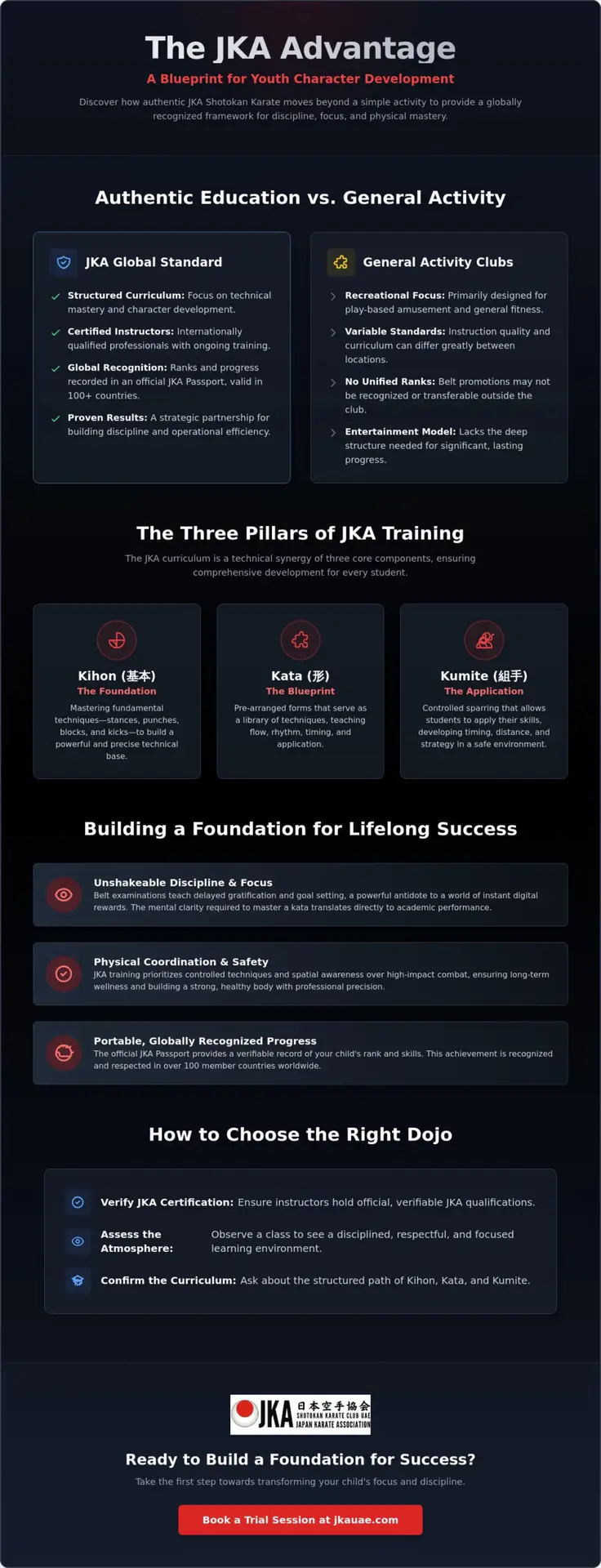
A standardized curriculum provides the operational framework necessary for a child’s technical evolution. Within our karate classes for kids, we utilize the three pillars of JKA Shotokan: Kihon, Kata, and Kumite. This integrated approach ensures that every student develops a comprehensive understanding of martial arts as both a physical discipline and a mental exercise. The progression from a white belt to advanced ranks isn’t arbitrary; it follows a precise, multi-year roadmap designed to build resilience and self-assurance. Each Karate Belt Examination serves as a performance audit, validating the student’s hard work and technical proficiency before they move to the next level.
Kihon, Kata, and Kumite Explained
The JKA Passport and International Recognition
We provide a total solution for youth development by combining these traditional pillars with modern professional standards. Your child’s growth is managed with the same level of detail and excellence found in a high-level corporate environment. To secure your child’s place in a globally recognized program, explore our JKA Karate Classes and see the difference that a structured curriculum makes.
Starting Your Journey at JKA UAE: What to Expect
Initiating your child’s enrollment in karate classes for kids marks the beginning of a deliberate journey toward physical and mental excellence. Standards drive results. At JKA UAE, we ensure the onboarding process is as structured and professional as the training itself. From the moment you step into the dojo, you’ll observe a culture of reliability and high-level discipline. The transition into this environment is designed to be seamless for the family while maintaining the solemnity required for traditional martial arts education. We view this as a strategic partnership in your child’s development.
The Official JKA Karate Gi and Equipment
The Official JKA Karate Gi is more than mere athletic apparel; it’s a symbol of membership in a global community. Wearing the Gi establishes a sense of equality among students, removing external distractions and focusing entirely on personal development. These uniforms are specifically engineered for the rigors of Shotokan training, providing the durability needed for intensive practice. When your child dons the Gi, they aren’t just attending a class. They’re adopting a professional standard of conduct that mirrors the excellence we demand in every technical movement. This uniform represents the synergy between individual effort and institutional tradition.
Locations and Accessibility in the Emirates
Our network of training centers provides comprehensive solutions for families across the region. With established dojos in Dubai, Abu Dhabi, Sharjah, and Fujairah, we offer a strategic presence that ensures accessibility for busy households. Each location adheres to the same rigorous JKA standards, ensuring consistency in instruction regardless of where you train. Class schedules are optimized to accommodate the academic and professional commitments of UAE families. You can find detailed schedules and specific timings by reviewing our guide to the Best Karate Classes in Dubai.
A child’s first trial class is a structured introduction to dojo etiquette and basic techniques. During this session, your child will learn the fundamental bow and the initial standing positions. This immediate immersion in etiquette sets the tone for future growth. Our instructors provide bespoke support to ensure new students feel confident while understanding the expectations of the dojo. Following the initial trial, parents can easily coordinate through our administration to register for upcoming Karate Belt Examinations and Karate Seminars and Workshops. These events are essential milestones that validate progress and ensure your child remains on the path toward long-term character growth and international rank recognition. Visit jkauae.com to begin the registration process today.
Invest in Your Child’s Global Future
Choosing a reputable martial arts education is a strategic decision that shapes a child’s character for a lifetime. Authentic karate classes for kids provide far more than a physical outlet; they offer a structured framework for developing mental clarity and operational efficiency. By selecting a program rooted in the Japan Karate Association’s global standards, you ensure your child’s achievements carry weight in any dojo worldwide. This isn’t merely about a hobby. It’s about instilling unshakeable discipline and focus through a proven, technical curriculum.
As the official UAE branch of the Japan Karate Association, our dojo provides a safe and professional environment led by qualified instructors who strictly follow global JKA standards. Your child’s growth is documented through internationally recognized belt examinations, ensuring their rank is a true marker of technical excellence. We provide a total solution for parents who value long-term stability and character growth over temporary fitness trends.
Take the first step toward building your child’s foundation for excellence. Book a Free Trial Class for Your Child at JKA UAE Today. We look forward to supporting your child’s journey toward physical and mental mastery.
Frequently Asked Questions
At what age can my child start karate classes at JKA UAE?
Children can begin their training at JKA UAE at the minimum age of 4 years old. This early start allows for the development of fundamental motor skills and spatial awareness within a highly structured environment. Our curriculum for young practitioners focuses on basic discipline and listening skills. It’s a strategic investment in their early character growth and physical coordination.
Is karate safe for young children, or is it too violent?
Traditional karate is a safe and highly regulated discipline that prioritizes self-control over aggression. We maintain strict safety protocols to protect our students. For example, the JKA doesn’t permit sparring for children until they are ten years old and in the fifth grade. This policy ensures that students develop the necessary maturity and technical precision before they engage in partner training.
How many times a week should my child attend karate classes for best results?
We recommend that students attend karate classes for kids at least two to three times per week to achieve consistent results. Regular attendance ensures that the technical synergy between Kihon and Kata is maintained. This frequency allows for steady progress through the kyu levels while balancing academic responsibilities. It’s about building a sustainable habit of physical and mental excellence.
Are JKA karate belts recognized by other martial arts schools?
Yes, belts earned through JKA UAE are recognized globally due to our status as an official branch of the Japan Karate Association. Every student receives a JKA Passport that serves as a permanent record of their rank and seminars. This international portability ensures that your child’s progress is respected by any JKA dojo in over 100 countries. It provides a primary seal of quality for their martial arts education.
What is the difference between JKA Shotokan and other styles like Taekwondo?
JKA Shotokan is a traditional Japanese martial art characterized by deep stances and powerful, linear techniques. While styles like Taekwondo often emphasize high, flashy kicks, Shotokan focuses on a balance of hand and foot techniques. Our approach is rooted in technical precision and operational efficiency. We provide a total solution for self-defense and character building that emphasizes stability and power over purely athletic display.
Do I need to buy a uniform before my child’s first trial class?
You don’t need to purchase an official JKA Karate Gi before your child’s first trial class. Comfortable athletic wear like a t-shirt and leggings is perfectly suitable for the initial session. Once a student officially enrolls, we provide guidance on obtaining the correct professional uniform. This ensures every child feels fully integrated into our community and ready to follow the dojo’s disciplined standards.
How long does it typically take for a child to earn their first belt?
A student typically prepares for their first belt examination after approximately three to four months of regular training. This timeline depends on the child’s attendance and technical consistency. We prioritize thoroughness and quality over speed. Our instructors ensure every child is fully prepared to meet the JKA’s rigorous global standards before they are invited to test for their next rank.
Can parents watch the karate classes at the dojo?
Parents are welcome to observe the sessions from our designated viewing areas to witness their child’s progress firsthand. We believe in a transparent, strategic partnership with families. Watching a session allows you to see the discipline and focus our instructors maintain during every karate classes for kids session. It helps you understand the high standards we expect and the supportive environment we provide for every student.