What if the most sophisticated method for developing combat proficiency isn’t found in a sparring ring, but within a meticulously structured sequence of solo movements? Many practitioners initially struggle to see the value in karate kata, often viewing these traditional forms as a choreographed performance rather than a practical tool for self-defense. It’s understandable to feel frustrated when memorizing complex patterns feels secondary to the physical intensity of live training.
We’re here to bridge that gap by demonstrating how kata functions as a comprehensive technical blueprint within the JKA Shotokan curriculum. You’ll discover the strategic logic behind these movements and learn how they cultivate the precision, power, and discipline required for long-term success. This guide outlines the essential forms for beginners and provides a clear pathway to finding an elite dojo in Dubai where you can achieve technical mastery through our professional karate classes. By understanding the synergy between form and function, you’ll transform your practice from simple repetition into a powerful foundation for martial arts excellence.
Key Takeaways
- Understand how karate kata serves as a strategic technical blueprint, moving beyond simple choreography to develop practical muscle memory against virtual opponents.
- Discover the essential synergy between Kihon and Kata, ensuring that every movement is rooted in foundational precision and operational efficiency.
- Identify the specific technical focus of the introductory Heian katas, from mastering the zenkutsu-dachi stance to introducing advanced upper-level defensive maneuvers.
- Learn a structured, two-step methodology for practicing forms that prioritizes sequence accuracy and postural integrity before introducing power and speed.
- Access comprehensive training solutions across the UAE, where certified instructors deliver the official JKA curriculum to ensure long-term technical excellence.
What is Karate Kata? Understanding the “Living Textbook”
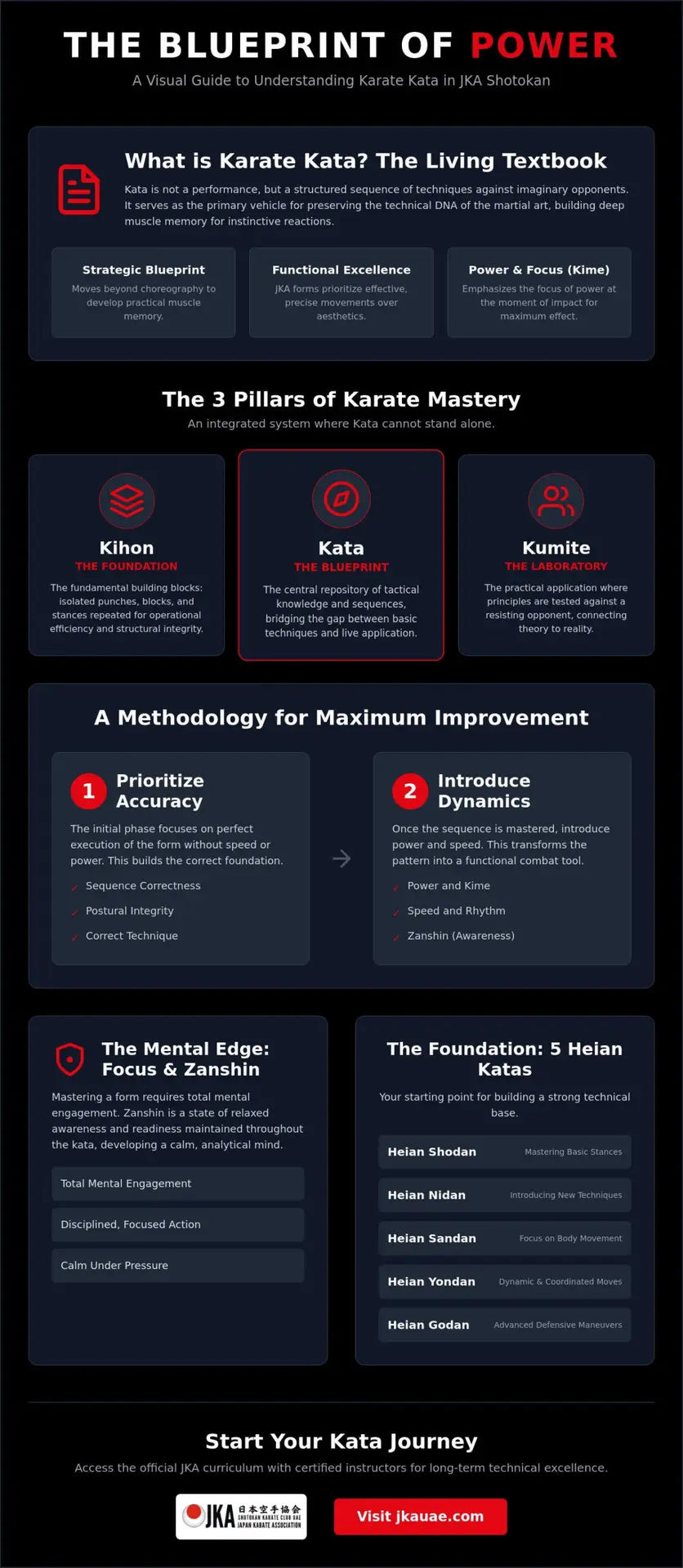
To the uninitiated observer, a practitioner performing a form might appear to be engaged in a complex dance. However, this is a profound misunderstanding of the discipline. At its core, What is Karate Kata? It’s a structured sequence of offensive and defensive techniques executed against a series of imaginary opponents. This “living textbook” serves as the primary vehicle for preserving the technical DNA of the martial art. By repeating these movements, students build deep muscle memory that allows them to react instinctively in high-pressure situations. The goal isn’t simple memorization; it’s the internalisation of tactical principles that define effective combat.
Within our standardized curriculum, karate kata serves as the bridge between basic techniques and live application. Unlike modern “performance” kata, which often prioritizes athletic aesthetics for competition, traditional JKA forms focus on functional excellence. Every punch, block, and shift in stance carries a specific purpose. We emphasize Kime, or the focus of power at the moment of impact, ensuring that each movement is as effective as it is precise. This commitment to technical integrity is why kata remains the cornerstone of our professional training programs.
The Origins of Kata in Traditional Karate
Before written manuals or video recordings existed, these forms were the only way to archive sophisticated defensive strategies. They evolved from secret training methods into a modern educational standard that allows for global technical consistency. The Japan Karate Association maintains strict uniformity across all branches to ensure that karate kata is performed with the same precision in Dubai as it is in Tokyo. This global synergy ensures that our students receive a world-class martial arts education, rooted in operational efficiency and technical mastery.
The Mental Side: Focus and Zanshin
Mastering a form requires more than physical strength; it demands total mental engagement. We teach the concept of Zanshin, a state of relaxed awareness and readiness that must be maintained from the first bow to the final movement. This level of concentration is particularly beneficial in our karate for kids programs, where students learn to channel their energy into disciplined, focused action. By mastering the rhythm and breathing associated with each form, practitioners develop a calm, analytical mind that serves them well both inside and outside the dojo. This mental discipline is a key component of the comprehensive solutions we provide for personal development.
The 3 Pillars of Karate: Why Kata Cannot Stand Alone
Traditional training is structured around a tripartite system that ensures no element of a practitioner’s development is neglected. While karate kata serves as the central repository of tactical knowledge, it can’t function effectively without the support of Kihon and Kumite. This integrated approach, strictly governed by the technical standards of the Japan Karate Association (JKA), ensures that every student develops a robust and versatile skillset. By treating these three pillars as a unified system, we provide a comprehensive framework for martial arts mastery.
Kihon represents the fundamental building blocks of the art. These are the isolated punches, blocks, and stances that require thousands of repetitions to achieve operational efficiency. Without strong Kihon, the movements within a form lack the necessary power and structural integrity. Kumite, on the other hand, is the practical laboratory where these principles are tested against a resisting opponent. It’s the transition from theory to reality, where the precision of the form meets the unpredictability of live combat.
Bunkai: Making Kata Movements Practical
Many beginners view the movements within a form as abstract or purely ornamental. This is where Bunkai becomes essential. Bunkai is the rigorous process of deconstructing each sequence to reveal its practical application. A technique that appears to be a simple “block” might actually be a strike to a vital point or a joint lock used to neutralize an aggressor. By understanding these applications, students transform their karate kata practice into a viable self-defense tool. We prioritize this analytical depth in our Adults Karate Classes to ensure every movement is understood as a functional combat strategy rather than just a performance.
Embusen: The Line of Movement
Every form follows a specific floor pattern known as the Embusen. This isn’t a random path; it’s a strategic layout that dictates the direction of attacks and defenses. Mastering the Embusen requires precise spatial awareness and technical control. A practitioner must return exactly to their starting point upon completion. This serves as a primary indicator of technical precision and balance. It proves that the student has maintained their center and controlled their environment throughout the entire sequence. At JKA UAE, our certified instructors balance these three pillars in every session to ensure our members achieve the highest levels of technical excellence.
The 5 Heian Katas: The Foundation for Dubai Beginners
The Heian series represents a strategic roadmap for technical development within our curriculum. These five forms are designed to transition a student from basic movements to complex tactical sequences. The name Heian translates to “Peaceful Mind,” signifying that a practitioner who has mastered these techniques can face any situation with composure and confidence. For those beginning their journey in karate kata, these forms provide the essential structural integrity required for all future advancement. Each form builds upon the last, ensuring a logical progression of skill and physical conditioning.
- Heian Shodan: This initial form focuses on the zenkutsu-dachi (front stance). It emphasizes large, powerful movements and basic blocks to establish a strong foundation.
- Heian Nidan: Students are introduced to kokutsu-dachi (back stance) and upper-level defensive maneuvers. This form also incorporates the first instances of kicks, requiring improved balance and coordination.
- Heian Sandan: This kata shifts the focus toward short-range techniques. It involves rapid stance transitions and the use of joint locks and elbow strikes.
- Heian Yondan: The complexity increases with more sophisticated timing and the introduction of kiba-dachi (horse stance). It requires greater flow and technical maturity.
- Heian Godan: As the final form in the series, it introduces a jump and highly advanced defensive sequences, preparing the student for the more technical brown and black belt katas.
Progression and Belt Examinations
At JKA UAE, technical milestones are marked by a rigorous Karate Belt Examination process. Heian Shodan is typically the primary requirement for your first grading to reach the 9th Kyu level. As you progress, the difficulty of the required karate kata increases, demanding greater precision and power. We utilize the official JKA Passport to document every successful examination. This document serves as a globally recognized record of your technical achievements, ensuring your rank is respected at any JKA dojo worldwide. It’s a vital tool for maintaining technical accountability and tracking long-term growth.
Mastering the Basics First
Our instructors often dedicate several months to perfecting Heian Shodan before allowing a student to move forward. This isn’t a delay; it’s a commitment to excellence. Deep, stable stances are required to build the leg strength and core stability necessary for advanced training. Without this foundational strength, more complex forms will lack the necessary impact and stability. We prioritize this operational efficiency to ensure that every student develops the physical capabilities required for a lifelong pursuit of martial arts mastery. By focusing on these basics, we provide the comprehensive solutions needed for a successful transition into more advanced JKA Shotokan training.
How to Practice Kata for Maximum Technical Improvement
Achieving technical excellence in karate kata is a process of layered refinement rather than simple repetition. We recommend a structured five-step methodology to ensure every movement reaches professional standards. First, practitioners must internalize the sequence without applying power. This allows the brain to map the steps accurately and prevents the development of tension-based errors. Second, the focus shifts to structural integrity, ensuring stances and posture are perfectly aligned to the JKA standard. Only after these foundations are set should you introduce Kime, which is the synergy of correct breathing and momentary muscle tension at the point of impact. The fourth stage involves functional visualization; you must ‘see’ the opponent to master timing, distance, and the intent of the technique. Finally, seek external verification. Recording your performance or receiving direct feedback from a JKA Sensei is the most efficient way to identify technical deviations and ensure operational efficiency in your practice.
Common Mistakes Beginners Make
Rushing through the form is the most frequent error we observe. Slow practice is superior because it forces you to maintain control during every micro-movement. Many students also lose their connection to the floor, resulting in compromised balance. Your feet must remain rooted to provide the leverage needed for powerful techniques. Lastly, a loss of focus, or looking in the wrong direction, breaks the tactical narrative of the kata. Every look must precede the movement to maintain situational awareness. This mental discipline is as vital as physical strength.
Training at Home vs. The Dojo
While a Dubai apartment might offer limited space, you can still practice effectively by focusing on stationary techniques or shorter sequences. However, the professional environment of a dojo remains irreplaceable. The specialized wooden floors and full-length mirrors provide the feedback necessary for technical self-correction. More importantly, traditional karate training requires the watchful eye of an expert to prevent the development of bad habits. Personal discipline at home is a great supplement, but it cannot replace the strategic partnership between a student and a certified instructor. To experience this level of professional support firsthand, we invite you to join our Karate Classes in Dubai.
Start Your Kata Journey with JKA Shotokan Karate Club Dubai
JKA Shotokan Karate Club Dubai provides the essential bridge between international technical innovation and regional requirements for high-level martial arts education. As an official branch of the Japan Karate Association, we operate under the strict approval of the UAE Karate Federation and the General Authority of Sports UAE. This ensures that every student receives instruction that meets the highest global standards. Our Chief Instructor, Sensei Ameer Adukkattil, holds a JKA 6th Dan Black Belt, representing a level of professional expertise that is rare in the region. By joining our club, you aren’t just taking a class; you’re entering a strategic partnership dedicated to your long-term technical excellence.
We provide a comprehensive suite of training solutions designed to accommodate practitioners at every stage of their development. Our curriculum is standardized to ensure that the karate kata you learn in Dubai is identical to the forms taught at the JKA headquarters in Tokyo. This commitment to uniformity is what defines our brand and ensures our students are prepared for international success.
- Official JKA curriculum delivered by certified Japanese and international instructors.
- Comprehensive training centers located in Dubai, Sharjah, Abu Dhabi, and Fujairah.
- Specialized kids karate classes and structured programs for teens and adults.
- Direct access to official Karate Belt Examinations and high-level international JKA seminars.
Why Lineage Matters for Kata
Technical lineage is the primary seal of quality in traditional martial arts. Learning the standardized JKA forms means your rank and skills are recognized in over 100 countries worldwide. This global synergy allows our members to train with confidence, knowing their foundation is built on operational efficiency and proven tactical principles. Our instructors focus on the minute details of every karate kata to ensure that every block, strike, and stance meets the exacting standards of the association. Preparing for your first shotokan karate classes dubai requires a commitment to this level of detail, which we support through bespoke professional guidance.
Join a Trial Class Today
The Dubai Sports Council has reported a 45% increase in combat sports facility registrations since 2023, reflecting a massive surge in local interest in disciplined training. We invite you to experience our professional environment firsthand by booking a trial session at our Dubai or Abu Dhabi locations. During your first visit, you’ll witness our commitment to discipline, focus, and technical mastery. We also facilitate the acquisition of your official JKA Karate Gi and JKA Passport, ensuring you have the necessary infrastructure for a successful journey. Don’t settle for generic training when you can access the total solutions provided by an industry leader.
Elevate Your Technical Proficiency with JKA Shotokan
Mastering the complexities of karate kata is a transformative process that requires both physical discipline and strategic insight. By understanding these forms as a technical blueprint for combat, you move beyond simple repetition and toward true operational excellence. We’ve established how the Heian series provides a vital foundation and how a layered practice methodology ensures every movement achieves professional standards. This systematic approach is what distinguishes a casual practitioner from a dedicated martial artist within the global JKA community.
As an Official Branch of JKA Japan, we offer the institutional infrastructure necessary for your long-term success. Our certified international instructors provide the expert correction required to maintain technical integrity, while our official JKA belt examinations offer a recognized pathway for your advancement. We’re committed to your growth and technical mastery within the region’s thriving martial arts landscape. Take the next step in your development and Book Your First Traditional Karate Class at JKA UAE. We look forward to supporting your journey toward excellence in a professional and disciplined environment.
Frequently Asked Questions
What is the first kata a beginner learns in Shotokan Karate?
The first form most beginners learn is Heian Shodan. This foundational karate kata establishes the technical groundwork for all future training by focusing on the zenkutsu-dachi stance and basic blocking techniques. It’s designed to build the leg strength and structural integrity required for your initial 9th Kyu belt examination. Mastering this form is essential before moving toward more complex tactical sequences.
How many katas are there in the JKA Shotokan style?
There are 26 standard katas recognized within the official JKA Shotokan curriculum. This structured progression ensures that practitioners move logically from the foundational Heian series to advanced forms like Bassai Dai and Kanku Dai. Each form serves as a strategic technical blueprint designed to enhance a student’s combat proficiency and technical mastery over many years of dedicated, professional study.
Can I learn karate kata from YouTube videos?
Learning from online videos isn’t recommended because it lacks the expert correction necessary for technical excellence. Without a certified JKA instructor to provide real-time feedback, students often develop poor posture and incorrect muscle memory. This compromises the operational efficiency of the techniques and can lead to injury. True mastery requires the strategic partnership found only in a professional dojo environment.
Why is kata important for children’s development?
Practice is vital for children because it cultivates focus, discipline, and spatial awareness in a structured environment. By memorizing complex sequences, kids develop the cognitive skills needed for academic success while improving their physical coordination. It’s a comprehensive solution for personal development that helps them channel their energy into a productive activity that builds both confidence and physical resilience.
Do I need a special uniform to practice kata?
Yes, practitioners should use an Official JKA Karate Gi to ensure they can move with the required range of motion. A professional uniform isn’t just for appearance; it’s designed to withstand the rigors of intense training while providing the technical feedback of sound during sharp movements. This equipment is a standard requirement for all our formal classes and official belt examinations.
How long does it take to memorize a single kata?
Memorizing the basic sequence of a form usually takes between two to four weeks for most beginners. However, achieving true technical mastery is a lifelong pursuit that goes far beyond the steps. Students must move beyond the basic movements to master the timing, breathing, and Kime that define a high-level performance. This refinement process requires consistent practice under the guidance of a Sensei.
What is the difference between kata and kumite?
The primary difference lies in the application of techniques within the tripartite system of karate. Kata involves a solo performance against imaginary opponents to build technical precision, while kumite is the practical application of those movements against a live, resisting partner. Both are essential pillars that create a synergy of skills, ensuring a practitioner is well-rounded and capable of effective self-defense.
Is kata used in karate competitions in Dubai?
Yes, karate kata is a major component of regional martial arts events approved by the UAE Karate Federation. For instance, the Karate Youth World League held in Fujairah in February 2026 featured nearly 3,000 participants from 93 countries. These prestigious competitions provide a platform for students to demonstrate their technical mastery and represent their dojo on a global stage while maintaining high standards.