What if the quest for the perfect starting point is less about the date on a birth certificate and more about the alignment of motor skills with professional instruction? Many parents and aspiring practitioners frequently ask what is the best age to start karate to ensure they maximize the benefits of discipline without risking injury or burnout. It’s natural to feel concerned that a young child might lack the necessary focus for a structured environment, or that starting as an adult might be too physically demanding for a beginner. We understand these hesitations and prioritize a reliable, long term approach to your personal development.
This guide provides a comprehensive solution by identifying the scientifically optimal stages for training and demonstrating how our JKA Shotokan programs provide the synergy needed for success at any age. You’ll discover how our curriculum adapts to various life stages to foster operational efficiency in your physical and mental growth. We will examine specific developmental milestones from early childhood through adulthood and explain how international standards, such as the JKA Passport, ensure a consistent and prestigious partnership throughout your martial arts journey.
Key Takeaways
- Learn how to distinguish between chronological age and neurological maturity to identify exactly what is the best age to start karate for sustainable progress.
- Discover why age-segregated classes are a prerequisite for maintaining high instructional standards and ensuring the physical safety of all participants.
- Access a professional assessment framework designed to evaluate student readiness through key indicators like spatial orientation and motor skill development.
- Understand the strategic importance of the JKA Passport in providing a globally recognized record of achievement for students who value international mobility.
Determining the Optimal Age to Begin Traditional Karate Training
Determining the specific moment to enroll in a martial arts program requires a sophisticated understanding of a student’s biological and psychological maturity. While many parents ask what is the best age to start karate, the answer depends more on developmental readiness than a specific birth year. Traditional training relies on early neuroplasticity. The brain’s ability to form new connections is at its peak during early childhood, enabling young practitioners to absorb complex movement patterns that become permanent cognitive assets. By referencing the History of Karate, we see that the discipline has always prioritized the synchronization of mind and body, a process that begins with refined motor control.
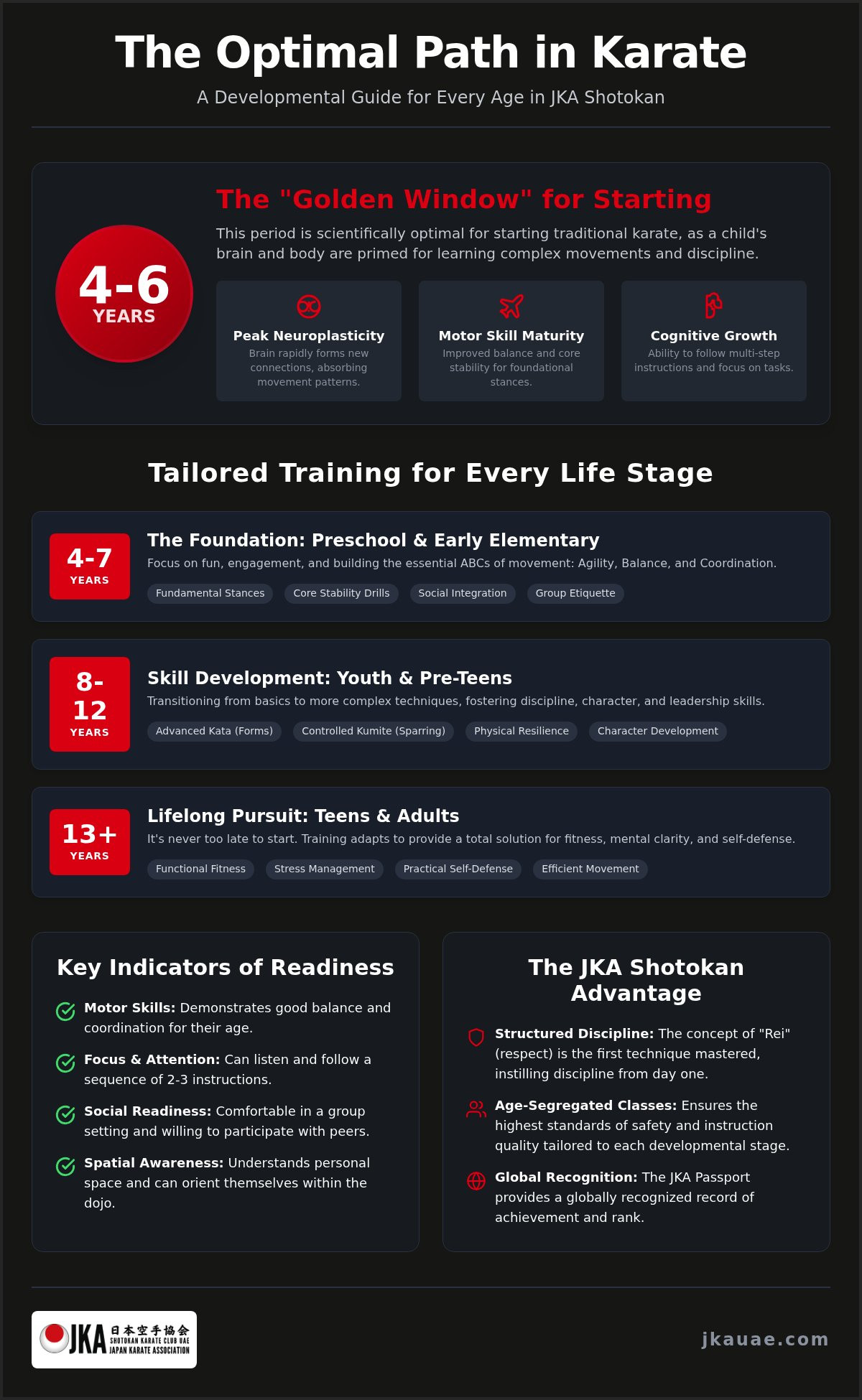
The “Golden Window” for starting karate typically opens between ages 4 and 6, when children achieve the pediatric motor skill benchmarks required for foundational stance work and unilateral balance.
The Science of Early Childhood Development
Between the ages of 4 and 6, children undergo significant physiological shifts. Their core stability and balance improve, allowing them to execute the precise movements required in JKA Shotokan Karate. This period also marks the maturation of the prefrontal cortex. This brain region governs the ability to follow multi-step instructions, which is vital for learning traditional kata. Engaging in these structured movements early provides a comprehensive solution for physical literacy, serving as a foundational pillar for all future athletic endeavors.
Why Traditional Shotokan Focuses on Discipline Early
Unlike general activities, a JKA-affiliated dojo emphasizes structured discipline from the very first session. The concept of “Rei,” or respect, is the foundational technique every student masters before they ever throw a punch. This early exposure to a rigorous hierarchy and clear expectations prevents the development of behavioral issues by channeling energy into productive, goal-oriented tasks. It’s a strategic partnership between the instructor and the student that prioritizes the perfection of character. Establishing these standards early ensures that the student’s journey is rooted in stability and long term growth.
Karate for Different Life Stages: From Early Childhood to Adulthood
Effective martial arts instruction requires a pedagogical approach that evolves alongside the practitioner. A professional academy does not apply a universal teaching method; instead, it utilizes age-segregated classes to maintain instructional quality and student safety. This structure ensures that the curriculum transitions logically from developing gross motor skills in toddlers to refining technical precision in adults. Determining what is the best age to start karate often involves evaluating how these specific programs align with an individual’s current physical and cognitive capabilities.
Preschool and Early Elementary (Ages 4-7)
For our youngest students, the focus remains on fundamental stances and basic coordination. We utilize repetitive, engaging drills to build core stability. Ensuring that children participate in Age-Appropriate Physical Activities is essential for preventing injury and fostering long term engagement. Students learn social integration and group etiquette while being introduced to basic Shotokan terminology in a highly supportive environment. This stage prioritizes the synergy between physical movement and the ability to follow structured classroom protocols.
Youth and Pre-Teens (Ages 8-12)
As students enter this stage, the largest demographic in global martial arts participation, the training shifts toward complexity. We introduce advanced Kata (forms) and controlled Kumite (sparring) to challenge their growing spatial awareness. This is a critical period for building leadership skills as practitioners advance through the belt ranks. Enrolling in authentic JKA Shotokan training during these years provides a comprehensive solution for character development and physical resilience.
Teens and Adults: It is Never Too Late
A common misconception suggests that karate is exclusively a youth activity. In reality, our adult curriculum offers a Total Solution for functional fitness, stress management, and practical self-defense. The JKA curriculum is designed to adapt to the physical capabilities of adult beginners, focusing on operational efficiency in movement rather than raw athleticism. Whether you’re seeking mental clarity or a strategic partnership in your health journey, you can explore our full range of Shotokan Karate Classes to find the right fit for your lifestyle. We provide a steady, deliberate path to mastery that respects the unique requirements of the adult learner.
Key Indicators of Readiness for Martial Arts Instruction
Determining the precise moment for enrollment requires a sophisticated evaluation of a student’s current capabilities. While many search for what is the best age to start karate, chronological age is merely a baseline. A comprehensive assessment of physical and emotional readiness ensures that the student can engage with the curriculum effectively. This strategic approach prevents frustration and builds a foundation for long term success within the dojo environment.
Assessing Physical Readiness and Coordination
Physical maturity is a primary driver of early success in Shotokan. Parents should look for specific motor skill milestones that indicate a child is ready for structured training. Key indicators include:
- Static Balance: The ability to stand on one leg for 5 to 10 seconds without significant swaying.
- Spatial Orientation: A consistent ability to distinguish between left and right directions during movement.
- Sustained Stamina: The physical capacity to remain active and engaged throughout a 45 minute structured session.
These benchmarks are essential because traditional karate requires precise body awareness. Without these foundational skills, a student may struggle with the basic stances that form the core of our technical instruction. This physical literacy is the synergy required to transition from play based movement to technical martial arts.
Evaluating Social and Emotional Maturity
A student’s ability to navigate the social hierarchy of a dojo is just as critical as their physical coordination. We look for signs of emotional maturity, which allows for better impulse control and focus. A child is likely ready if they can follow two or three step instructions without constant redirection from an adult. They should also demonstrate a willingness to participate in a group setting independently, showing respect for both peers and authority figures. This emotional stability ensures a safe environment for all practitioners and maintains our commitment to excellence.
The ultimate diagnostic tool for assessing this fit is the trial class. This session allows our instructors to observe the student’s interaction with the curriculum in real time, providing a multi-faceted solution for parents seeking clarity. To begin your assessment, you can enroll in our Kids Karate Classes to experience our international standards firsthand. This initial step establishes a strategic partnership between the academy and the family, ensuring the student is positioned for excellence from day one.
The Advantages of JKA Shotokan Training for All Ages
Choosing a martial arts academy involves more than just selecting a convenient location. It’s a strategic partnership in an individual’s personal and physical development. While parents often deliberate over what is the best age to start karate, the true value lies in the institutional standards of the chosen program. JKA Shotokan Karate Club serves as the official UAE branch of the Japan Karate Association, providing a comprehensive solution for those seeking authentic instruction that meets global benchmarks. This institutional stability ensures that every student receives a consistent education, whether they begin at age four or forty.
International Recognition and the JKA Passport
One of our primary differentiators is the JKA Passport. This document serves as a global training record, recognized in over 100 countries. It ensures that a student’s rank remains valid even if they relocate or travel internationally. Training under certified instructors is vital to maintain this validity, as it connects the student to a worldwide network of excellence. You can explore our traditional karate training guide to understand how this global lineage provides a distinct advantage over localized, non-affiliated programs.
Standardized Excellence: From Gi to Black Belt
The psychological impact of wearing an official JKA Karate Gi shouldn’t be underestimated. It fosters immediate focus and a sense of belonging to a professional organization. Our structured belt examination process provides measurable benchmarks that allow students of all ages to track their progress with precision. These examinations aren’t merely tests of physical skill; they’re assessments of discipline and mental fortitude. Beyond weekly classes, we offer specialized seminars and workshops that enhance technical skills and maintain operational efficiency in training. We invite parents and adults to visit the JKA Shotokan Karate Club for a professional evaluation of their readiness. Our commitment to the perfection of character ensures that every student achieves a standard of excellence that transcends the dojo and impacts their professional and personal lives.
Securing Your Path to Martial Arts Excellence
Determining what is the best age to start karate involves aligning physical readiness with a commitment to long term development. We’ve explored how pediatric motor skill benchmarks and cognitive focus serve as the primary indicators for a successful beginning. Whether you’re enrolling a child to build discipline or starting as an adult to improve functional fitness, the synergy between traditional discipline and standardized instruction creates a reliable foundation for growth. Our approach ensures that every student’s journey is rooted in stability and professional rigor.
As the official branch of the Japan Karate Association World Federation, we provide a comprehensive solution for martial arts education. Our instructors are certified by JKA headquarters in Japan, ensuring your training meets the highest international standards. With a standardized curriculum and the globally recognized JKA Passport, your achievements are documented for a lifetime of international mobility and recognition. This strategic partnership between the student and the academy guarantees a consistent path toward technical mastery.
Don’t wait for the perfect moment to begin your journey toward character development and physical excellence. Book a trial class at JKA Shotokan Karate Club UAE today to experience our elite training environment firsthand. We look forward to supporting your progress as you master the art of Shotokan.
Frequently Asked Questions
What is the absolute youngest age a child can start karate at JKA?
The youngest age to begin training at our academy is four years old. At this developmental stage, our curriculum focuses on foundational motor skills and basic classroom etiquette to ensure a safe environment. We prioritize the development of core stability and the ability to follow simple, structured instructions. This early introduction establishes a reliable foundation for long term success and physical literacy.
Is 7 or 8 years old considered “late” to start martial arts?
Starting at seven or eight years old is not late; it is actually considered an ideal time for many practitioners. Children in this age group possess the cognitive maturity to grasp complex Kata and the physical coordination for controlled Kumite. Many students who begin at this stage find that their ability to set and achieve goals aligns perfectly with our standardized belt examination process.
Can I start karate as an adult if I am not fit or flexible?
You can certainly begin karate as an adult regardless of your current fitness or flexibility levels. Our instructors provide a comprehensive solution by adapting techniques to suit your physical capabilities while gradually improving your functional fitness. The JKA curriculum is designed to enhance operational efficiency in movement, ensuring that beginners of all ages can progress safely and effectively without the fear of injury.
How do I know if my 4-year-old is mature enough for a dojo?
Look for indicators such as the ability to follow two step instructions and a willingness to engage in a group setting without parental assistance. When parents ask what is the best age to start karate, we recommend evaluating whether the child can maintain focus for a 45 minute session. A trial class serves as a diagnostic tool to confirm if their emotional maturity matches the requirements of a structured dojo.
Will starting karate at a young age make my child more aggressive?
Traditional karate training reduces aggression by teaching students impulse control and respect for others. The first technique every student learns is “Rei,” or respect, which establishes a professional atmosphere centered on the perfection of character. By channeling energy into repetitive, disciplined drills, children learn to manage their emotions and interact respectfully with peers and authority figures in a strategic partnership for growth.
What are the main benefits of starting karate as a teenager?
Teenagers benefit from leadership opportunities, stress management, and a sense of global belonging through the JKA Passport. Determining what is the best age to start karate for a teenager involves recognizing their need for a structured environment that provides measurable milestones. Training at this stage builds resilience and provides a prestigious record of achievement that is recognized by international institutions in over 100 countries.