With an estimated 100 million practitioners worldwide, how do you ensure your specific rank holds weight beyond the walls of your local dojo? Stepping onto the mat for a karate belt test often triggers a mix of technical anxiety and confusion regarding advancement criteria. It’s natural to feel the weight of expectation when preparing for an official Japan Karate Association examination. We understand that your goal is not just a new color around your waist, but a validated achievement that carries international prestige and professional recognition.
This guide provides a comprehensive solution to your preparation needs, ensuring you master the technical requirements and mental focus necessary to succeed. You’ll gain a clear understanding of the specific Kihon, Kata, and Kumite benchmarks required for your next kyu level under the 2026 standards. We also explain how the JKA Passport serves as a strategic asset for your global rank portability. By aligning your training with Tokyo HQ standards, you’re securing a structured path toward your Black Belt within a framework of excellence and technical precision.
Key Takeaways
- Master the standardized technical criteria for Kyu and Dan levels to ensure your performance aligns with official Tokyo HQ benchmarks.
- Develop a complete command of the three technical pillars—Kihon, Kata, and Kumite—essential for successfully navigating your next karate belt test.
- Integrate consistent physical training with mental discipline and dojo etiquette to achieve a holistic state of readiness for examination.
- Utilize the JKA Passport as a strategic document to facilitate global rank portability and secure international professional recognition.
Understanding the JKA Karate Belt Test Standards
The karate belt test serves as a rigorous technical audit designed to evaluate a student’s commitment to the art and their command of the curriculum. This is not a mere participation award; it’s a strategic benchmark that measures both physical execution and mental fortitude. By adhering to the standards set by the Tokyo headquarters, these examinations provide a comprehensive solution for practitioners seeking authentic advancement. Every session is conducted by authorized examiners who maintain high technical integrity, ensuring that each promotion is earned through merit and consistency.
The Significance of Kyu and Dan Ranks
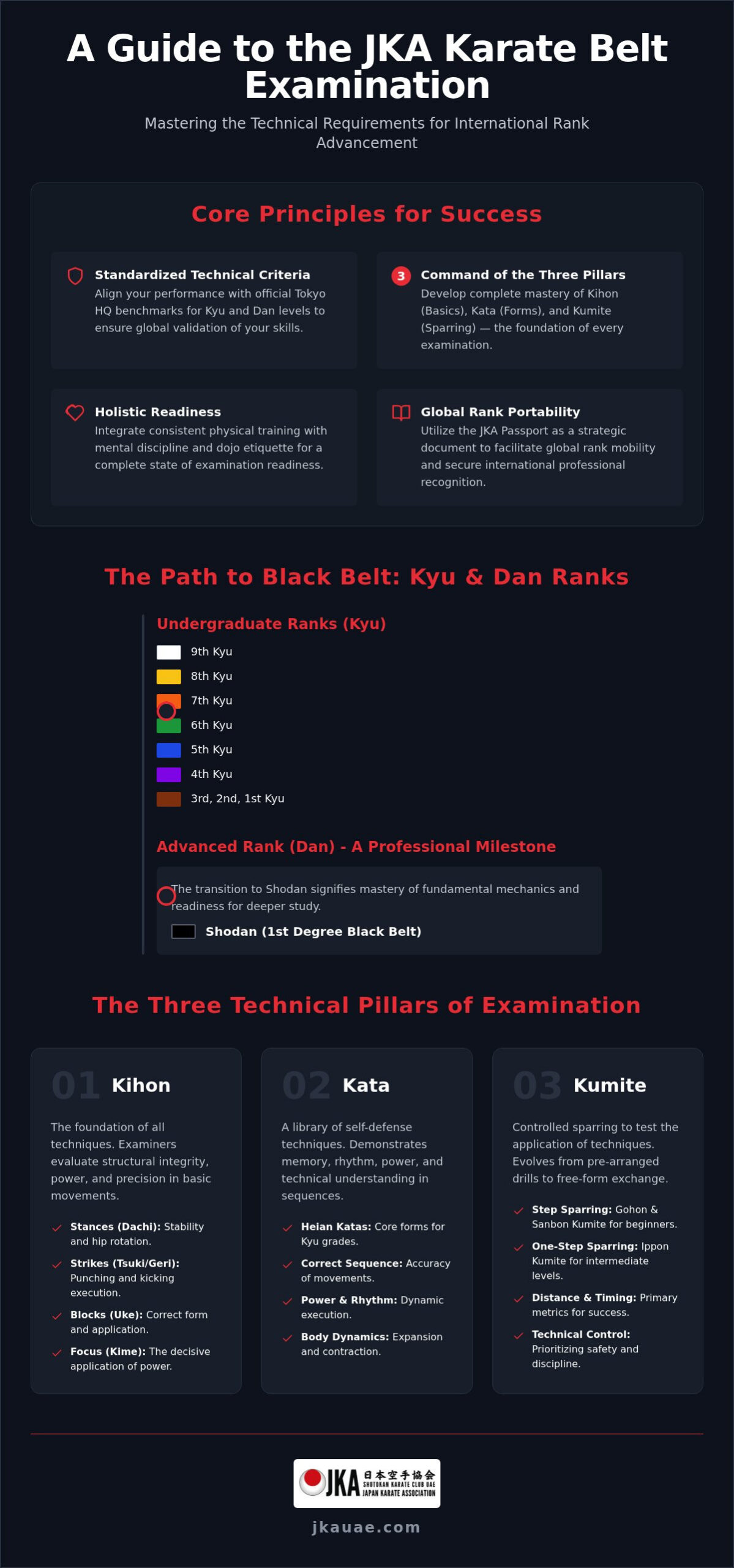
Progression within the JKA system follows a logical, structured hierarchy that divides practitioners into undergraduate and advanced levels. Students begin at the 9th Kyu level and work through a series of colored belts until they reach the 1st Kyu, which is the final brown belt rank. Each color change represents a specific stage of development, moving from the initial potential of a white belt to the refined technical depth of a senior student.
The transition to Shodan, or first-degree black belt, marks a significant professional milestone. This shift signifies that the practitioner has mastered the fundamental mechanics and is ready for deeper study. This journey is deeply rooted in Shotokan karate history and principles, ensuring that every rank reflects a genuine mastery of the standardized syllabus. The system prioritizes technical excellence over rapid promotion, fostering a culture of long-term growth and stability.
Why Standardized Testing Matters
Standardization is a critical pillar of the JKA operational model, creating a synergy between local training and international recognition. Unlike non-affiliated sport karate schools that may prioritize competition points or localized criteria, the JKA maintains a strict global curriculum. This uniform approach prevents rank inflation and ensures that the quality of instruction remains consistent across all borders.
For students at JKA Shotokan Karate Club Dubai, this means their achievements are portable. A rank earned in the UAE is recognized at JKA dojos in over 100 countries, providing a global resume of their skills. This international certification is essential for students who may eventually move abroad or wish to participate in global seminars. By maintaining these high standards, the association ensures that every practitioner belongs to an elite group of martial artists recognized for their technical precision and discipline.
The Technical Core: Kihon, Kata, and Kumite Requirements
Every JKA examination evaluates the student across three essential pillars: Kihon, Kata, and Kumite. These technical components represent a holistic approach to martial arts proficiency, ensuring that practitioners develop a balanced skill set. The progressive difficulty inherent in the JKA’s official ranking system ensures the student is physically and mentally prepared for the next level. This methodical evaluation prevents technical gaps and prepares the student for the rigors of higher-level training.
Mastering Basic Techniques (Kihon)
Kihon is the foundation of all karate techniques. During a karate belt test, examiners look for more than just the correct movement; they analyze the structural integrity of your stances. Practitioners must demonstrate stability in Zenkutsu-dachi (front stance) and Kokutsu-dachi (back stance) while maintaining fluid hip rotation. The execution of Tsuki (punching), Geri (kicking), and Uke (blocking) requires a precise combination of Kime (focus) and controlled breathing. Achieving this technical synergy is vital for operational efficiency in more advanced combinations.
Performance of Forms (Kata)
Kata performance demonstrates the ability to execute complex sequences with rhythm and power. In the early Kyu grades, students focus on the five Heian Katas, which establish the core mechanics of the Shotokan style. Evaluation criteria are strict, focusing on the correct sequence, the application of power, and the expansion or contraction of the body. Beyond the performance aspect, Kata serves as a comprehensive library of self-defense techniques. Mastering these forms allows students to internalize the technical logic of the art while preparing for the higher demands of Dan examinations.
Controlled Sparring (Kumite)
Kumite testing evolves from basic pre-arranged sparring to free-form technical exchange. Beginners start with Gohon (five-step) and Sanbon (three-step) Kumite to build a foundation of defensive awareness. As students reach intermediate levels, the focus shifts to Ippon (one-step) Kumite, where distance and timing become the primary metrics of success. The JKA framework prioritizes technical control and safety, ensuring that sparring remains a disciplined exercise. For those looking to refine these skills, joining Shotokan karate classes provides the structured environment needed to excel in these practical applications.
How to Prepare for Your Karate Belt Examination
Achieving success in a karate belt test requires a strategic approach that begins months before the official examination date. Consistent dojo attendance is the primary driver of technical proficiency; it allows for the gradual refinement of movement and the correction of subtle errors. Practitioners must move beyond casual practice to adopt a rigorous training schedule that aligns with the official JKA syllabus. This disciplined timeline ensures that every technique is understood and executed with the precision expected by international examiners. It’s essential to maintain a clean, pressed JKA Karate Gi for the exam as a sign of respect and professional discipline.
Physical Conditioning and Practice
Effective preparation involves integrating specific shotokan karate techniques into your daily practice routines. Focus on building core strength and flexibility, as these physical attributes directly impact stance depth and technical stability. Repetitive drilling is the most reliable method for building the muscle memory required for the exam. Consistency is key; don’t underestimate the power of daily repetition to ensure your body reacts instinctively under the pressure of a live evaluation. This commitment to physical excellence creates the technical synergy needed to execute complex Kihon and Kata sequences flawlessly.
Mental Focus and Dojo Etiquette
Technical skill alone is insufficient without the proper mental focus and adherence to dojo etiquette. The concept of Zanshin, or total awareness, must be maintained before, during, and after the test. Examiners observe how you enter the mat, your show of respect through proper bowing (Rei), and your composure when facing partners. Managing “test nerves” is a vital part of the process. You can achieve this through focused breathing and visualization techniques that reinforce your technical knowledge. A calm, authoritative presence often distinguishes a prepared student from one who is merely physically capable.
The Pre-Exam Checklist
Before arriving at the national branch, complete a thorough pre-exam audit to ensure all administrative requirements are met. Your JKA Passport must be up to date with all training records and previous rank certifications. This document is your professional resume within the karate world and is essential for official recognition. Confirm the following details to ensure a smooth examination day:
- Verify that your Gi is properly fitted and the JKA crest is clearly visible on the left chest.
- Review the examination schedule to ensure arrival at least 30 minutes before the start time.
- Ensure all local registration forms and fees are processed according to the branch’s operational guidelines.
If you’re ready to take the next step in your martial arts journey, consider enrolling in our karate belt examination preparation sessions to fine-tune your performance.
Post-Examination: Advancing Your Rank with a JKA Passport
Success in a karate belt test marks the beginning of a new phase in your martial arts career. Once the examiners confirm your proficiency, your new rank is officially recorded in your JKA Passport. This document serves as a global resume of your karate training, providing a verified history of your technical evolution. For those achieving Dan grades, the recognition is even more significant; official certificates are issued directly by the JKA Headquarters in Tokyo. This centralized certification process ensures that your rank holds weight in any JKA dojo worldwide, reflecting our commitment to international excellence and technical stability.
Recording Progress in Your JKA Passport
The JKA Passport is a strategic asset that tracks more than just exam results. It functions as a comprehensive log for seminars, workshops, and international training sessions. If you travel or attend global events, this passport provides immediate proof of your standing within the association. Maintaining this document is essential for operational continuity in your training. If your passport is full or needs updating, the UAE branch provides a streamlined replacement service to ensure your records remain current. It’s your responsibility to ensure every milestone is captured accurately, as this data forms the basis for future eligibility in higher-level examinations.
Continuing the Journey to Black Belt
Advancement is a commitment to continuous improvement, not just reaching a destination. As you progress through the Kyu levels, the focus shifts from learning basic mechanics to understanding the strategic application of techniques. Reaching Shodan (1st Dan) is a primary objective for many, but it’s merely the entry point into advanced study. This transition requires a deeper level of dedication and a more sophisticated approach to training. We invite practitioners to join our specialized karate classes for teens and adults to refine these skills. By setting long-term goals and maintaining consistent dojo attendance, you’ll find that each successful karate belt test is a stepping stone toward a lifetime of technical mastery.
Secure Your International Rank Recognition
Transitioning from consistent training to a formal evaluation is a strategic milestone in your martial arts development. Mastering the three technical pillars ensures you meet the rigorous benchmarks required to pass your next karate belt test. By maintaining an official JKA Passport, you’ll secure a portable record of achievement that’s recognized across the globe. This professional approach to ranking provides a clear, structured path from your current kyu level toward the prestigious black belt.
As the official UAE branch of JKA Japan, we provide an environment rooted in technical precision and institutional pride. Our examinations are conducted by expert examiners certified by the Tokyo HQ, ensuring that your international rank certification is earned through authentic merit. We invite you to Register for the Next Official JKA Belt Examination and take the next step in your professional karate journey. Your commitment to excellence on the mat today builds the foundation for your success as a future Dan grade.
Frequently Asked Questions
How often are karate belt tests held in the UAE?
JKA Kyu examinations are conducted twice annually within the UAE to maintain technical consistency and student progress. This schedule allows practitioners sufficient time to master the required Kihon, Kata, and Kumite syllabus before their scheduled evaluation. Dan examinations for black belt levels may follow a different cadence, often aligning with regional seminars or international workshops hosted by senior JKA examiners from the Tokyo headquarters.
What happens if a student does not pass their belt examination?
If a student doesn’t meet the required standards during a karate belt test, they receive specific feedback from the examiners regarding their technical deficiencies. This outcome isn’t a failure but a strategic assessment designed to ensure the practitioner’s foundation is secure before advancing. Students are typically encouraged to refine their techniques and re-apply for the next examination cycle once their instructor confirms they’ve addressed the identified gaps.
Is there a minimum age requirement for the JKA black belt test?
The Japan Karate Association maintains specific age prerequisites for Dan rankings to ensure emotional and physical maturity. While Kyu ranks are open to all active practitioners, candidates for Shodan (1st Dan) must typically be at least 12 years old. This standard ensures that individuals holding a black belt possess the discipline and technical depth required to represent the association’s international values and high operational standards.
Can I take a belt test if I started training in a different karate style?
Practitioners from other karate styles can participate in a JKA examination after transitioning to our standardized curriculum. Because the JKA follows a specific technical pillar system, you’ll need to demonstrate proficiency in our unique Kihon and Kata requirements. Your instructor will evaluate your current skill level and determine the appropriate entry point within the JKA Kyu system to ensure your ranking is recognized globally.
How long does it typically take to progress between Kyu ranks?
Progression between Kyu ranks generally requires four to six months of consistent dojo attendance and technical development. This timeline isn’t fixed; it depends on the student’s ability to internalize the curriculum and demonstrate the required focus. Higher Kyu levels and Dan ranks often require longer intervals between tests to accommodate the increased technical complexity and the depth of understanding necessary for international certification.
Do I need an official JKA Passport to participate in the belt test?
An official JKA Passport is mandatory for any student participating in a karate belt test. This document serves as your professional record, ensuring that your rank is registered with the Tokyo headquarters and remains portable across all international branches. Without this passport, the association cannot certify your advancement or provide the global recognition that defines our standardized ranking system and ensures long-term rank portability.