Mastering dojo etiquette rules is the foundational technical requirement that separates a casual practitioner from a dedicated student of the Japan Karate Association. You likely feel a strong sense of responsibility to uphold the high standards of our club, yet the fear of making a social error or misunderstanding complex Japanese terminology can be daunting when you’re first starting. At JKA Shotokan Karate Club Dubai, we prioritize a structured environment where professional conduct is as vital as physical technique.
This guide will equip you with the knowledge to enter the training area with absolute confidence, ensuring you’ll contribute to the disciplined and elite atmosphere we maintain across the UAE. We’ll detail the specific standards for your official JKA Karate Gi, the logistical importance of the JKA Passport for your international progression, and the professional hierarchy that defines our global organization. By understanding these protocols, you ensure your training journey is built on a framework of reliability and excellence that reflects our commitment to the highest martial arts standards.
Key Takeaways
- Understand how mastering dojo etiquette rules creates a high-performance environment that ensures safety and technical precision for every student.
- Gain clarity on traditional Japanese hierarchy, including the roles of the Sensei and Sempai, to navigate the training area with professional poise.
- Learn the rigorous standards for the Official JKA Karate Gi and why maintaining a pristine uniform is essential for institutional excellence.
- Implement disciplined behavioral standards such as punctuality and respectful partner engagement to foster a culture of mutual growth and leadership.
- Discover the advantages of training at an official JKA branch in Dubai where international standards provide a clear path for your martial arts progression.
Understanding the Foundation of Dojo Etiquette
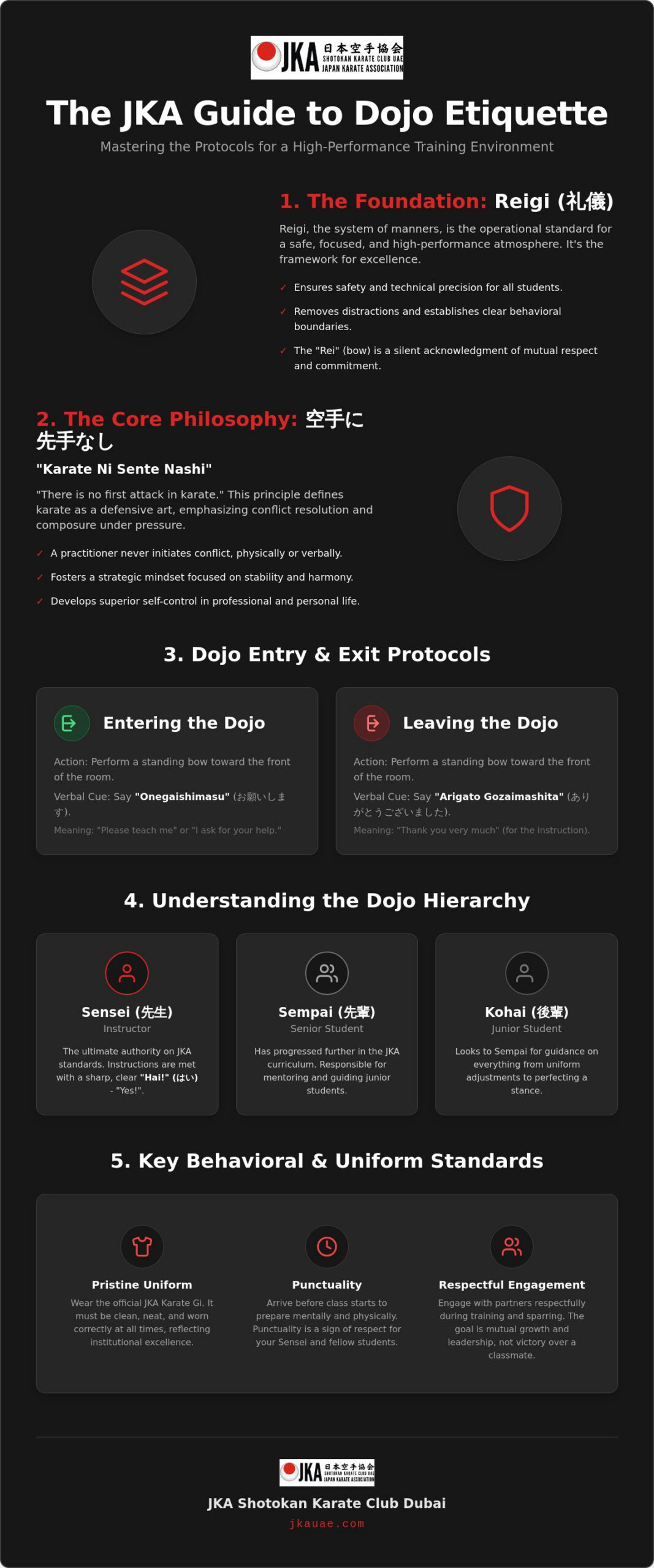
At JKA Shotokan Karate Club Dubai, we view the training environment as a professional space where technical excellence and mutual respect intersect. Understanding the Foundation of Dojo Etiquette begins with the concept of Reigi, a comprehensive system of manners that governs every interaction within our facility. These dojo etiquette rules aren’t merely historical formalities; they’re operational standards that ensure a safe, focused, and high-performance atmosphere. By removing distractions and establishing clear behavioral boundaries, we create a synergy between students that allows for maximum training efficiency. The “Rei”, or bow, serves as the primary instrument of this respect, functioning as a silent Japanese handshake that acknowledges the shared commitment to growth between practitioners.
This disciplined framework provides unique benefits across all age groups. For children, these protocols instill a sense of order and leadership that translates directly to academic success. For adults, the structured environment offers a professional focus that clears the mind of daily corporate stressors. Reigi serves as the essential bridge between physical technique and the development of professional character.
The Concept of ‘Karate Ni Sente Nashi’
A fundamental pillar of our organization is the principle of “Karate Ni Sente Nashi”, which translates to “there is no first attack in karate.” This philosophy dictates that a karate practitioner never initiates conflict, either physically or verbally. Within our dojo etiquette rules, this concept emphasizes that karate is a defensive art intended for the protection of oneself and others. In a modern UAE context, this translates to superior conflict resolution skills and the ability to maintain composure under pressure in professional settings. It fosters a strategic mindset where practitioners seek stability and harmony rather than aggression.
Entering and Leaving the Dojo
The transition from the outside world to the training area is marked by specific protocols that signal a shift in mental state. Upon entering or leaving the dojo, students must perform a standing bow toward the front of the room. When entering, it’s customary to use the phrase “Onegaishimasu”, which translates to “please teach me” or “I ask for your help.” This verbal commitment establishes a humble and receptive mindset. Conversely, as we conclude a session, we use “Arigato Gozaimashita” to express profound gratitude for the instruction and the opportunity to train. These rituals ensure that every student, from beginner to advanced, maintains a consistent level of institutional pride and professional awareness throughout their journey with JKA Shotokan Karate.
Essential Terminology and Addressing Instructors
Effective communication within the training hall is a core component of dojo etiquette rules, ensuring that instructions are executed with precision and without delay. Central to this system is the term “Sensei,” which refers to your instructor. A Sensei is more than a teacher; they’re a seasoned advisor and the ultimate authority on JKA standards within the dojo. When a Sensei provides feedback or a command, the only appropriate response is a sharp, clear “Hai,” meaning “Yes.” This response signals that you’ve fully understood the instruction and are ready to implement it immediately. This level of responsiveness mirrors the high-stakes communication required in top-tier corporate environments where clarity and promptness are essential for operational success.
Beyond the instructor, the relationship between students is governed by the senior-junior dynamic of Sempai and Kohai. A Sempai is a senior student who has progressed further in the JKA curriculum, while a Kohai is a junior student. This relationship is a cornerstone of traditional training, as outlined in JKA of California’s Dojo Protocol, which emphasizes the structured nature of progression. Understanding the specific terminology for the “Dojo” (training hall), “Kihon” (basics), and “Kata” (forms) is vital for your seamless integration into our community. If you’re looking to begin this journey, our JKA Karate Classes provide the perfect environment to learn these nuances firsthand.
Hierarchy in the JKA Framework
The hierarchy within our dojo is designed to facilitate rapid skill acquisition and maintain safety, which is a key pillar of our dojo etiquette rules. Beginner students must look to their Sempai for guidance on everything from adjusting their uniform to perfecting a stance. Conversely, senior students bear a professional responsibility to mentor their juniors with patience and technical accuracy. This structure creates a strategic partnership between all levels of practitioners. Much like the organizational charts of leading UAE conglomerates, this hierarchy ensures that expertise flows efficiently from the top down, fostering a culture of excellence and mutual respect.
The Dojo Kun: Five Rules to Live By
At the conclusion of every session, we recite the Dojo Kun, five fundamental principles that define the character of a JKA practitioner. These rules are not just for the training mat; they’re professional standards for life. They include:
- Character: To seek perfection of character.
- Sincerity: To be faithful.
- Effort: To endeavor.
- Etiquette: To respect others.
- Self-Control: To refrain from violent behavior.
Adhering to these principles is what distinguishes our students in the region. You can learn more about how these values are integrated into our curriculum in Traditional Karate Training: The Definitive Guide to JKA Shotokan in the UAE.
Uniform Standards and Official JKA Gear
The visual identity of a JKA practitioner is defined by a commitment to cleanliness and absolute uniformity. Adhering to strict dojo etiquette rules regarding your attire is the first step in demonstrating respect for the art and your peers. The Karate-gi, or uniform, must always be crisp, white, and meticulously maintained. A neglected or stained uniform suggests a lack of mental focus, which is contrary to the professional excellence we demand at JKA Shotokan Karate Club Dubai. While generic martial arts gear is widely available, our members are expected to utilize the Official JKA Karate Gi. This specific equipment ensures global standardization and reflects our status as the official UAE branch of the Japan Karate Association.
Personal hygiene is an equally critical component of our operational safety protocols. As highlighted in this University Dojo Etiquette Guide, maintaining trimmed nails and clean hands isn’t just about appearance; it’s a fundamental safety requirement for sparring and partner drills. Long nails can cause avoidable injuries during high-intensity training, and maintaining high hygiene standards reflects the professional focus we expect from every student. This attention to detail ensures that the training environment remains safe and productive for everyone involved.
Caring for Your JKA Karate Gi
Maintaining your uniform is a daily ritual of discipline that starts long before you reach the training mat. You should wash your Gi after every session to ensure it remains hygienic and bright white. Once dry, pressing the uniform with an iron removes wrinkles, projecting an image of readiness and institutional pride. Tying the karate belt, or Obi, is the final step in your preparation; both ends of the belt should be of equal length to symbolize the balance between physical skill and mental discipline. For those just starting their journey, detailed guidance on selection can be found in our resource on Choosing Your First Official JKA Karate Gi in Dubai.
The Role of the JKA Passport
The JKA Passport serves as your professional credential within our global network, functioning much like a corporate certification record. This document is mandatory for all students participating in a Karate Belt Examination in Dubai, as it provides a verified record of your technical progress. The JKA Passport acts as a lifetime record of technical progress and international certification, ensuring that a rank earned in the UAE is recognized at any JKA dojo across the world. This global portability is a strategic advantage of our structured curriculum, allowing you to maintain your progress regardless of where your career or personal life takes you. Without this passport, official grading and participation in international seminars are not permitted, making it a cornerstone of our dojo etiquette rules.
Behavioral Standards During Training and Sparring
Maintaining behavioral standards is the practical application of dojo etiquette rules during active training sessions. Punctuality serves as the first benchmark of a serious student’s commitment. Arriving at least ten minutes before the scheduled start allows for the mental transition required for high-intensity instruction and personal preparation. Once on the mat, silence is the mandatory professional standard. Talking during class disrupts the collective focus and is considered a significant breach of protocol that affects the synergy of the entire group. Every partner drill begins and ends with a bow, acknowledging the strategic partnership between you and your fellow student in the pursuit of technical mastery. This ritualized respect ensures that even during high-pressure drills, the environment remains constructive and disciplined.
Safety Protocols and Physical Contact
In JKA Shotokan, we adhere to the rigorous principle of “Sun-dome,” which requires absolute control of techniques. This standard dictates that a strike must be executed with full speed and power but stopped just millimeters before contact. It’s a sophisticated demonstration of physical and mental coordination that ensures the safety of all participants while maintaining technical integrity. If you arrive late, do not simply join the ranks. You must sit in “Seiza” at the edge of the mat and wait for the Sensei’s explicit signal to enter. This protocol ensures the ongoing session’s operational efficiency remains intact. If you experience an injury or significant discomfort, you should notify the Sensei immediately with a bow, rather than leaving the training area without acknowledgment. This allows for proper professional support and maintains the safety of the entire class.
Parent and Visitor Etiquette in the UAE
Our dojos in Dubai and across the UAE provide dedicated seating for observers, yet this area must remain a zone of quiet observation to prevent distractions. Parents play a vital role in supporting their children’s growth, but coaching from the sidelines is strictly prohibited. Such actions undermine the Sensei’s authority and create confusion for the student, hindering their ability to develop self-reliance and focus. Maintaining this professional distance allows students to fully immerse themselves in our comprehensive training solutions. For more on how we foster this environment for younger practitioners, explore our Karate Classes for Teens in Dubai: Building Discipline and Global Excellence.
If you’re seeking a training environment that prioritizes safety and professional conduct, we invite you to enroll in our JKA Karate Classes to begin your journey toward excellence.
Joining the JKA Shotokan Community in Dubai
Becoming a member of JKA Shotokan Karate Club Dubai signifies a commitment to international excellence and professional development. As the official UAE branch of the Japan Karate Association World Federation, we provide an integrated solution for martial arts education that adheres to the highest global standards. Our instructors are certified professionals who ensure that the dojo etiquette rules established in Tokyo are maintained across all our regional facilities, including Dubai, Sharjah, Abu Dhabi, and Fujairah. This standardization ensures that the technical proficiency you acquire here is recognized in over 100 countries, offering a level of international recognition that non-affiliated clubs cannot provide. By joining our community, you’re entering a strategic partnership with a global organization dedicated to technical precision and character development.
The journey from a white belt to a Shodan, or first-degree black belt, is a structured process designed to build leadership and operational efficiency within the individual. Typically, students train for two to five months between kyu ranks, with a minimum of six months required after achieving the 1st kyu before challenging for a black belt. This progression isn’t based on attendance alone; it requires the Sensei’s recommendation and a successful Karate Belt Examination. By training within this rigorous framework, you benefit from a clear roadmap for advancement that mirrors the strategic planning found in top-tier business organizations. It’s a path that demands dedication but offers unparalleled rewards in discipline and skill.
The JKA UAE Training Experience
Our curriculum is built on the three pillars of Kihon, Kata, and Kumite, providing a multi-faceted approach to physical and mental conditioning. We offer specialized Karate Seminars and Workshops throughout the year, allowing students to learn directly from international experts and senior JKA examiners. These events are crucial for refining technique and deepening your understanding of the philosophy behind the art. You can learn more about our pedagogical approach by reading Why JKA Karate Education Is Important for Karate Training in Dubai.
How to Get Started Today
Initiating your journey with us is a straightforward process designed for maximum convenience. We invite prospective students to participate in a trial class at our Dubai locations to experience our professional atmosphere firsthand. Upon enrollment, we’ll facilitate the acquisition of your official JKA Karate Gi and your JKA Passport, both of which are essential for maintaining dojo etiquette rules and tracking your global progress. Whether you’re interested in Kids Karate Classes or Adults Karate Classes, our team is ready to provide the bespoke professional support you need to succeed. Join the JKA Shotokan Karate Club Dubai today to secure your place in our next session and begin your path toward technical mastery.
Elevate Your Training Through Disciplined Standards
Mastering the protocols of the training hall is a definitive step toward achieving technical excellence within the Japan Karate Association. By internalizing these dojo etiquette rules, you contribute to a high-performance environment where safety and mutual respect are the primary operational standards. You’ve learned that every bow, response, and uniform requirement serves as a technical foundation for your growth. These standards ensure that your progress is recognized globally, providing a strategic advantage for students seeking international belt recognition.
As the official UAE branch of the Japan Karate Association World Federation, we offer exclusive access to certified JKA instructors and a curriculum that mirrors the highest standards in Tokyo. Our commitment to quality ensures that every session at JKA Shotokan Karate Club Dubai is an opportunity to develop leadership and professional focus. Whether you’re a beginner or an advanced practitioner, the path to mastery is clearly defined through our structured training solutions. We invite you to step onto the mat and experience the synergy of traditional discipline and modern excellence.
Start Your Traditional JKA Karate Journey in Dubai today. We look forward to supporting your long-term success and welcoming you into our community of dedicated practitioners.
Frequently Asked Questions
What should I do if I am late for a karate class?
If you arrive late, you must sit in seiza at the edge of the training area and wait for the Sensei to acknowledge you. Walking directly onto the mat disrupts the session’s operational efficiency and is a breach of protocol. Once the instructor gives the signal, perform a standing bow and join the class quietly. This ensures the training flow remains professional for all participants.
How do I address a karate instructor correctly?
You should address your instructor as “Sensei” at all times within the facility. This title acknowledges their expertise and position as a seasoned advisor within the JKA framework. Using proper titles is a core part of dojo etiquette rules, fostering a culture of respect and organizational hierarchy. It ensures that communication remains formal and focused on technical development.
Can I wear jewelry or watches during karate training?
Jewelry, watches, and accessories are strictly prohibited during training to ensure the safety of all students. Hard objects can cause lacerations or injuries during partner drills and high-intensity sparring. Students must remove these items before entering the training area. This policy maintains a professional and hazard-free environment, allowing everyone to focus entirely on their technical progression without unnecessary risk.
Do I need an official JKA Gi to start training in Dubai?
While beginners may start in comfortable athletic wear, an Official JKA Gi is required for all formal training and examinations. Wearing the association’s recognized uniform demonstrates institutional pride and ensures you meet global standardization requirements. It’s a prerequisite for participating in official JKA Karate Classes and signifies your commitment to the club’s professional standards.
What is the meaning of bowing (Rei) in the dojo?
Bowing, or Rei, is a silent acknowledgement of mutual respect between practitioners and their instructors. It serves as a mental reset, signaling your readiness to train with focus and sincerity. In our dojo etiquette rules, the bow is performed when entering the dojo, starting a drill, and concluding a session. It builds a foundation of discipline that is essential for long-term success in martial arts.
How should parents behave while watching their child’s karate class?
Parents should remain quiet in the designated seating area and avoid any form of sideline coaching. Directing a child from the sidelines undermines the instructor’s authority and distracts the student from their training. This professional distance allows children to develop self-reliance and leadership skills. We maintain a focused atmosphere to ensure every student receives the full benefit of our structured curriculum.
What are the five rules of the Dojo Kun?
The Dojo Kun consists of five fundamental principles: to seek perfection of character, be faithful, endeavor, respect others, and refrain from violent behavior. These rules are recited at the end of each session to reinforce the ethical framework of our training. They serve as a guide for professional conduct both inside the dojo and in your daily life across the UAE.
Is it mandatory to have a JKA Passport for belt exams?
Yes, a JKA Passport is mandatory for all students who wish to participate in a Karate Belt Examination. This document serves as your official international record, tracking every grading and seminar you attend globally. It ensures your rank is recognized at any JKA branch worldwide, providing a verified history of your technical progress and dedication to the art.