What if the most effective strategy for navigating a high-pressure boardroom in Dubai wasn’t a leadership seminar, but a traditional framework designed for operational excellence? Many professionals and parents today find themselves caught between the fleeting rewards of competitive sports and the search for a sustainable method of self-mastery. This is where a sophisticated understanding of shotokan karate philosophy becomes a vital asset rather than just a physical exercise. You likely recognize that physical activity alone doesn’t resolve the lack of focus in children or the stress of modern corporate environments. We promise to show you how the Japan Karate Association (JKA) standardizes character development to build elite discipline and mental clarity for practitioners across the UAE. This exploration details how our standardized curriculum, which includes Kyu level examinations held twice a year, creates a synergy between physical precision and strategic mental focus. It provides a clear path toward international certification through the JKA Passport and a more resilient, focused lifestyle in 2026.
Key Takeaways
- Learn how the core principles of shotokan karate philosophy prioritize the perfection of character over sporting victory to foster long-term mental resilience.
- Discover how the five pillars of the Dojo Kun serve as a professional code of conduct, enhancing operational focus in both educational and corporate environments.
- Understand how the 20 precepts of the Niju Kun provide a strategic framework for applying martial arts discipline to daily leadership challenges in Dubai.
- Explore the importance of the JKA Passport and official JKA Karate Gi in maintaining international training standards and ensuring global rank recognition.
- Identify how traditional JKA training builds a clear path for character development, supporting the UAE’s vision for excellence and youth leadership.
Character Over Combat: The Core Purpose of Traditional Shotokan
Traditional training at JKA Shotokan Karate Club Dubai isn’t about collecting trophies or winning matches. It’s about refining the self through a rigorous, standardized process. The core of shotokan karate philosophy dictates that the ultimate goal isn’t victory or defeat, but the perfection of the practitioner’s character. In a high-pressure environment like Dubai, this shift from external competition to internal mastery provides a stable foundation for personal growth. Unlike modern combat sports that prioritize entertainment and aggressive scoring, the Japan Karate Association (JKA) emphasizes a non-violent approach where physical technique serves as a vehicle for mental stillness. It’s a commitment to excellence that extends far beyond the dojo walls.
We teach the concept of “Ikken Hissatsu,” often translated as the “Single Blow.” While it sounds aggressive in a literal sense, its modern application is about extreme focus and the weight of responsibility. It means every action counts. In an operational context, this translates to doing things right the first time; it’s a principle that builds immense discipline in both children and corporate leaders. For those researching the broader context of Shotokan karate history and philosophy, it’s clear that this system was never intended for mere brawling. It’s a strategic framework for developing a reliable, high-functioning individual who remains calm under pressure.
The Inseparable Trinity: Kihon, Kata, and Kumite
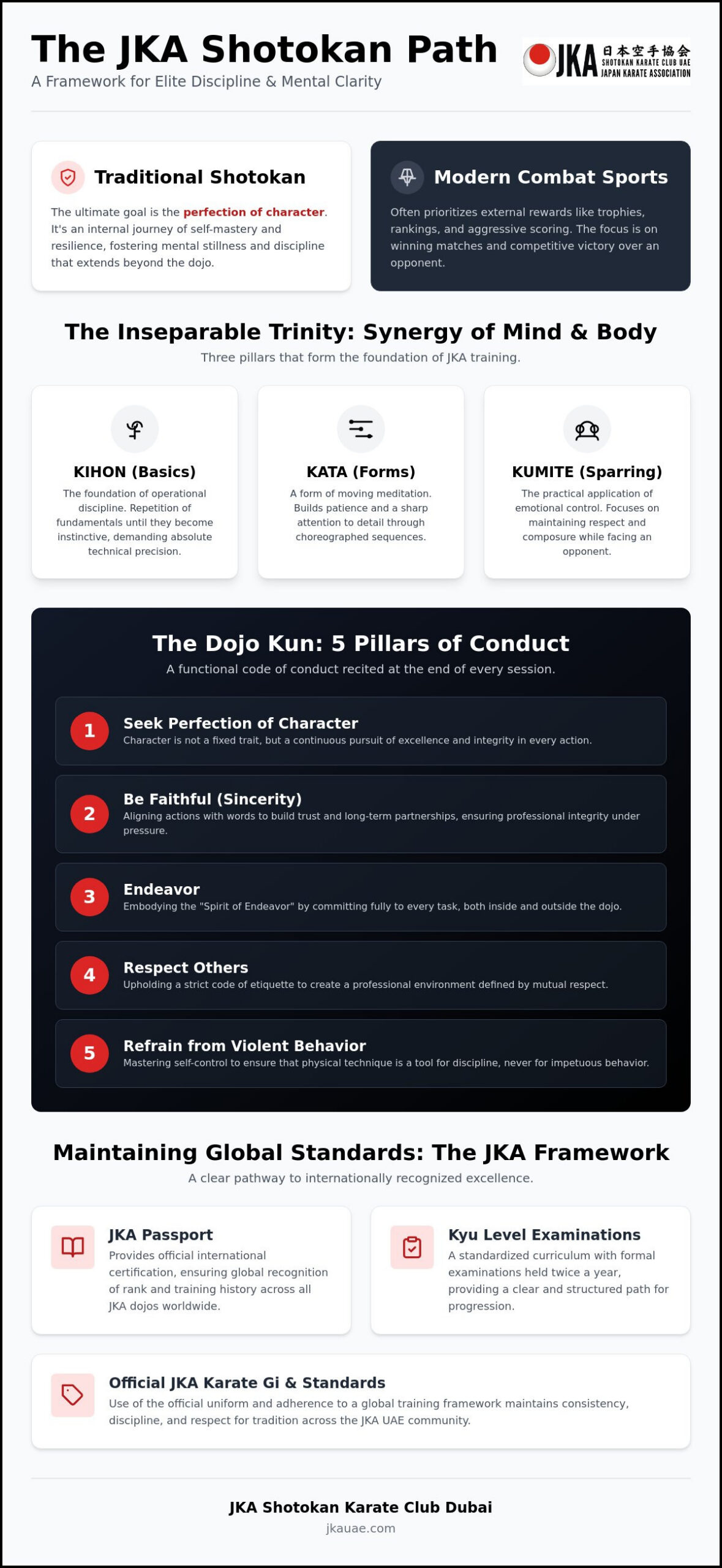
The JKA curriculum relies on three pillars to create a synergy between the body and mind. Kihon, or basics, acts as the foundation of operational discipline. It requires technical precision and the repetition of fundamentals until they become instinctive. Kata, the practice of choreographed forms, functions as a moving meditation. It builds patience and an acute attention to detail that is often lost in our fast-paced digital world. Finally, Kumite, or sparring, provides the practical application of emotional control. It isn’t about “winning” a fight; it’s about maintaining respect and composure while facing an opponent, ensuring that ego never overrides technique.
Forging a “Karate Mind” for the 21st Century
Consistent training helps practitioners move from reactive behavior to proactive, disciplined decision-making. We focus on the concept of “Mushin,” or “No Mind,” which allows for peak performance without the interference of anxiety or ego. This mental state is essential for anyone facing the complexities of 2026, whether they’re a student facing exams or an executive managing a team. Shotokan karate philosophy serves as a sophisticated mental operating system that builds the resilience needed to excel in an unpredictable global landscape.
The Dojo Kun: Five Pillars of Personal and Professional Conduct
Every session at JKA UAE concludes with the collective recitation of the Dojo Kun. These five precepts aren’t merely historical relics; they represent a functional code of conduct that governs every practitioner from white belt to master. By integrating JKA’s karate philosophy into the very rhythm of training, we ensure that the dojo remains a professional environment defined by mutual respect and operational discipline. This standard provides a “Standard Operating Procedure” for life, offering a clear framework for navigating the complexities of a fast-paced society. It’s this commitment to a shared set of values that distinguishes traditional training from casual fitness activities.
Seeking Perfection of Character and Sincerity
The first two pillars, seeking perfection of character and being faithful (sincerity), establish the moral compass of the practitioner. In shotokan karate philosophy, character isn’t a fixed trait but a continuous pursuit of excellence. For children, this means understanding that academic success is secondary to the integrity of their effort. For adults in high-stress corporate roles, “Makoto” (Sincerity) becomes a strategic asset for building trust and long-term partnerships. It’s about aligning one’s actions with their words, ensuring that professional integrity remains uncompromised even under pressure. This pursuit of sincerity creates a culture of reliability that benefits the entire community.
Effort, Etiquette, and Self-Control
The remaining three pillars focus on the “Spirit of Endeavor,” etiquette, and the refrain from impetuous behavior. JKA standards prioritize consistent effort over raw natural talent, teaching that resilience is the primary driver of success. Etiquette, or “Reigi,” serves as a vital tool for navigating social and professional hierarchies with grace. This isn’t about blind obedience; it’s about a sophisticated understanding of respect that facilitates smoother interactions in any boardroom. Finally, the commitment to self-control is the ultimate test of maturity. By learning to manage physical and emotional impulses in the dojo, students develop the proactive decision-making skills required to handle real-world conflicts without resorting to aggression.
Practitioners often find that these principles become second nature, transforming how they approach challenges across all areas of life. If you’re looking to instill these values in your daily routine, exploring JKA Karate Classes can be the first step toward a more disciplined and focused future. Mastering these pillars ensures that the benefits of training extend far beyond physical ability, fostering a mindset geared toward long-term stability and personal growth.
The Nijū Kun: 20 Precepts for Strategic Personal Development
The Nijū Kun, or the 20 Precepts, functions as a strategic guide for daily interaction that extends far beyond physical combat. While the Dojo Kun provides a broad moral compass, these precepts offer specific operational instructions for living with purpose. Central to shotokan karate philosophy is the principle that “Karate is not only in the dojo.” This means the discipline cultivated on the mats must be applied to every professional and personal engagement. By grounding martial skills in these ethics, the Japan Karate Association ensures that power is always balanced with responsibility, preventing the misuse of technique for ego or aggression.
A hallmark of a true JKA practitioner is the understanding that “Spirit first, technique second.” This isn’t a suggestion; it’s a foundational standard. It prioritizes the mental state and intentionality of the individual over raw physical prowess. This mental framework is what creates a stable and focused leader. For those seeking a deeper understanding of how these principles translate to modern life, JKA’s official philosophy provides a comprehensive look at how Zen and Bushido inform these daily practices. It’s about developing a mindset that remains unshakeable regardless of the environment.
Courtesy and Respect: The Alpha and Omega of JKA
One of the most vital precepts states that “Karate-do begins with courtesy and ends with courtesy.” This isn’t just about politeness; it’s about establishing a professional protocol for every interaction. The “Bow” serves as a primary sign of mutual respect and institutional pride, signaling that the practitioner is ready to engage with humility and focus. This commitment to protocol is detailed further in our resource on Traditional Karate Training: The Definitive Guide to JKA Shotokan in the UAE, which highlights how these standards are maintained across our branches in Dubai. Maintaining this level of etiquette ensures a safe and productive training atmosphere for everyone.
Mindfulness and Readiness in Daily Life
Precept #12 advises practitioners: “Do not think of winning. Think, rather, of not losing.” In a strategic context, this encourages a focus on risk management and defensive stability rather than reckless aggression. This mindset fosters “Zanshin,” or a state of relaxed awareness, which is essential for situational awareness in busy urban environments. Another crucial concept is that “Karate is like boiling water.” If you don’t heat it constantly, it grows cold. This emphasizes that consistency is the only path to mastery. Discipline isn’t a one-time event; it’s a continuous operational requirement for success in 2026 and beyond.
Applying Martial Arts Philosophy to Modern Leadership and Education
The strategic integration of shotokan karate philosophy into daily life serves as a powerful catalyst for achieving the UAE’s broader vision for excellence and youth leadership. While many view martial arts as a physical pursuit, the Japan Karate Association (JKA) framework functions as a comprehensive mental operating system designed for the complexities of 2026. For parents in Dubai, our curriculum offers a “Total Solution” to modern challenges such as excessive screen time and diminished attention spans. By instilling a “Black Belt Mindset” early in the training journey, we prepare students to approach their academic and personal responsibilities with the same precision they apply to a perfect punch or kick.
This philosophical framework isn’t limited to the youth. The discipline required to master traditional Shotokan is directly transferable to the high-stakes environment of the Dubai corporate boardroom. Professionals who train at JKA Shotokan Karate Club Dubai often find that the mental fortitude developed on the mats enhances their operational efficiency and strategic decision-making. It’s about moving beyond reactive habits to cultivate a proactive stance in all business interactions. This commitment to long-term excellence ensures that practitioners remain reliable partners in their professional spheres, mirroring the stability and institutional pride that defines the JKA standard.
Developing Future Leaders in Dubai
We utilize the Dojo Kun as a practical tool for teaching children accountability and organizational skills. By reciting and reflecting on these principles, students learn that their conduct reflects their character, fostering a sense of personal responsibility that translates to the classroom. Our Teen Karate Classes in Dubai: Developing Discipline and Leadership (2026) specifically leverage these values to build confident young adults. Additionally, the “Senior-Junior” (Senpai-Kohai) relationship within the dojo creates a natural mentorship structure. This hierarchy teaches younger students respect for experience while encouraging seniors to develop the empathy and guidance skills necessary for effective leadership.
Stress Management and Focus for Professionals
For busy professionals in Abu Dhabi and Dubai, training provides a “Strategic Reset” from the demands of a high-stress career. The intense focus required during Kata practice forces a mental shift that clears the mind of external noise, significantly improving concentration on complex business tasks. This structured, hierarchical system offers a psychological sense of order and progress that is often missing in volatile markets. By committing to a regular training schedule, executives can maintain peak performance levels while fostering a sustainable work-life synergy. If you’re ready to enhance your professional focus through traditional discipline, we invite you to explore our JKA Karate Classes and join a community dedicated to excellence.
Maintaining Global Standards: The JKA UAE Training Framework
The tangible markers of a student’s progress are deeply intertwined with the underlying shotokan karate philosophy. At JKA Shotokan Karate Club Dubai, every element of the training environment is designed to reinforce the Japan Karate Association’s global standards of excellence. Wearing the official JKA Karate Gi, for instance, serves as a powerful symbol of equality and commitment. Inside the dojo, external status is replaced by a shared identity and mutual respect. This uniform isn’t merely a requirement; it’s a statement of one’s dedication to a rigorous path of character development. It levels the playing field, ensuring that every practitioner is judged solely on their effort and technical precision.
Validation of this journey occurs through structured Karate Belt Examinations. These assessments aren’t simple physical tests. They serve as a comprehensive audit of both technical mastery and philosophical maturity. Our Kyu level examinations are held twice a year in Dubai, providing students with a clear, standardized timeline for advancement. For those looking to deepen their expertise, the JKA UAE network provides exclusive access to Karate Seminars and Workshops led by world-class instructors. These events offer a unique synergy between local training and international innovation, ensuring our members remain at the cutting edge of traditional martial arts while maintaining the highest operational standards.
The JKA Passport: A Global Mark of Quality
The JKA Passport is the most critical document for any serious practitioner. It acts as a permanent, official record of your training, grading, and seminar attendance. Because JKA Dubai is the official UAE branch, this passport ensures that your rank is recognized by the JKA World Federation in over 100 countries. Whether you’re traveling for business or relocating, your progress remains part of a verified global network. This international recognition is a key feature of our Karate Classes in Dubai: Authentic JKA Shotokan Training for 2026, bridging the gap between local effort and global stature. It’s a testament to a student’s journey and a primary seal of quality.
Join the Official JKA UAE Branch
Training with a certified JKA instructor is the only way to ensure you’re receiving the most accurate interpretation of shotokan karate philosophy. Our instructors are vetted through a rigorous international development pathway, prioritizing long-term stability over quick results. In your first class, you’ll experience a structured introduction to dojo etiquette, basic Kihon, and the foundational principles of respect. It’s an environment where technical capabilities meet specific character outcomes. If you’re ready to start your journey toward mastery and international certification, you can Register for JKA Shotokan Karate Classes in Dubai today. We provide a reliable partnership for your long-term success, helping you navigate the challenges of the modern world with the strength of a traditional foundation.
Mastering the Future Through Traditional Discipline
Adopting a rigorous shotokan karate philosophy provides more than just physical defense; it establishes a comprehensive framework for sustained excellence in an increasingly complex world. By prioritizing character over combat and integrating the Dojo Kun into daily life, practitioners develop the mental clarity required for high-stakes leadership and academic success. This standardized approach ensures that the discipline cultivated in the dojo translates directly into operational efficiency within every professional and personal sphere in the UAE.
As the Official UAE Branch of the Japan Karate Association, we provide a direct connection to the global standards of the JKA World Federation. Our expert instructors, certified by JKA Headquarters, ensure that every student receives authentic training supported by international JKA rank recognition. This synergy between global innovation and local expertise positions our club as a reliable partner for those seeking stability, focus, and long-term character development. We invite you to experience the transformative power of a structured, high-performance environment.
Begin Your Journey to Excellence at JKA UAE
Take the first step toward a more disciplined and purposeful future today.
Frequently Asked Questions
What is the main philosophy of Shotokan Karate?
The primary objective of shotokan karate philosophy is the perfection of the practitioner’s character rather than the achievement of sporting victory. This framework prioritizes internal mastery, sincerity, and self-control over external competition. By focusing on the “Single Blow” concept, students learn that every action carries significant responsibility. This mindset ensures that technical proficiency is always balanced with ethical conduct and mental stillness in every professional or personal engagement.
How does the Dojo Kun apply to children’s behavior at home?
The Dojo Kun provides a practical code of conduct that children apply to their domestic responsibilities and family interactions. By practicing principles like “Seek Perfection of Character” and “Be Faithful,” kids learn to take accountability for their schoolwork and daily chores. The emphasis on etiquette and self-control helps them manage emotional impulses and treat parents with consistent respect, creating a more harmonious and disciplined home environment.
Is Shotokan Karate philosophy different from other martial arts?
Shotokan differs from many modern combat sports by prioritizing non-violence and the development of a stable personality over aggressive scoring or general fitness. While some systems focus on competition, JKA Shotokan maintains a traditional Budo standard where physical technique is a vehicle for mental resilience. This structured, hierarchical approach ensures that practitioners develop a strategic mindset that remains unshakeable in both the dojo and the professional boardroom.
Do I need to be a Buddhist to practice Shotokan philosophy?
You don’t need to be a Buddhist to practice this art; it’s a secular philosophical framework designed for personal and professional development. While it draws on Zen concepts like “Mushin” to achieve peak performance, these are utilized as tools for situational awareness and focus. The system is inclusive and focuses on universal values such as respect, effort, and integrity, making it accessible to practitioners of all backgrounds.
How does JKA UAE ensure the philosophy is taught correctly?
JKA UAE ensures philosophical accuracy by employing instructors who are officially certified by the Japan Karate Association Headquarters. These experts follow a standardized international curriculum that integrates the Dojo Kun into every training session. By maintaining strict adherence to JKA’s global standards, we provide a reliable environment where the physical and mental aspects of the art are taught with institutional precision and a commitment to excellence.
Can adults benefit from karate philosophy if they start late in life?
Adults definitely benefit from shotokan karate philosophy regardless of their starting age; it provides a strategic reset for managing high-stress professional environments. The focus required for Kata practice improves concentration on complex business tasks and fosters a proactive mindset in daily decision-making. Starting later in life allows practitioners to approach the art with maturity, applying the principles of self-control and resilience to their existing leadership roles.
What does “Karate Ni Sente Nashi” mean in a modern context?
In a modern context, “Karate Ni Sente Nashi” translates to “there is no first attack in karate,” emphasizing proactive risk management and defensive stability. It teaches practitioners to avoid conflict whenever possible and to use their skills only as a last resort. This principle fosters a state of “Zanshin,” or relaxed awareness, which is essential for maintaining personal safety and situational awareness in busy urban settings.
How does the JKA Passport reflect a student’s philosophical progress?
The JKA Passport serves as an official record of a student’s long-term commitment and technical validation through standardized belt examinations. While it tracks physical rank, it also reflects the practitioner’s journey through the philosophical milestones of the JKA framework. Each entry represents a successful integration of discipline and effort, connecting the student to a global network of excellence and ensuring their progress is recognized with international authority.