In a global martial arts industry valued at over $21 billion, the distinction between a world-class institution and a profit-driven “McDojo” is often obscured by polished marketing. You likely recognize that selecting a dojo is a significant long-term investment in character and technical proficiency, yet the fear of choosing a school with unverified ranks or poor safety standards remains a valid concern. Understanding how to choose a karate school requires a strategic approach that prioritizes operational excellence and international accreditation over mere local convenience.
This professional guide outlines the essential criteria for identifying a reputable training center that offers authentic instruction and genuine character development. We’ll explore the necessity of global recognition through the Japan Karate Association, the strategic value of the JKA Passport for verifiable rank advancement, and how the 2026 WKF rule updates ensure a safe and disciplined environment. By focusing on these technical benchmarks, you can secure a training partnership that aligns with your goals for excellence and long-term growth.
Key Takeaways
- Learn the technical framework for how to choose a karate school by evaluating global accreditation and instructor lineage rather than mere proximity.
- Distinguish between competitive sport karate and traditional Shotokan training to ensure your personal or professional development goals are met.
- Identify critical red flags, such as guaranteed black belt programs and hidden fees, that characterize “McDojos” and compromise martial arts integrity.
- Discover the strategic importance of the JKA Passport and official documentation for securing a verifiable, internationally recognized rank advancement.
- Understand the value of a comprehensive training environment that integrates official JKA Karate Gi and standardized examinations for consistent excellence.
Defining Your Objectives: Sport Karate vs. Traditional Martial Arts
Before you step onto the mats, you must define the strategic intent of your training. Is your primary objective competitive sport, general fitness, or traditional character development? Many contemporary facilities operate as sport-centric centers where the focus remains on securing trophies and points. While these outcomes have their place, they often come at the expense of technical depth and mental fortitude. Authentic training is a lifelong pursuit, not a seasonal fitness program. Understanding how to choose a karate school starts with recognizing that a dojo should be a partner in your long-term growth and stability.
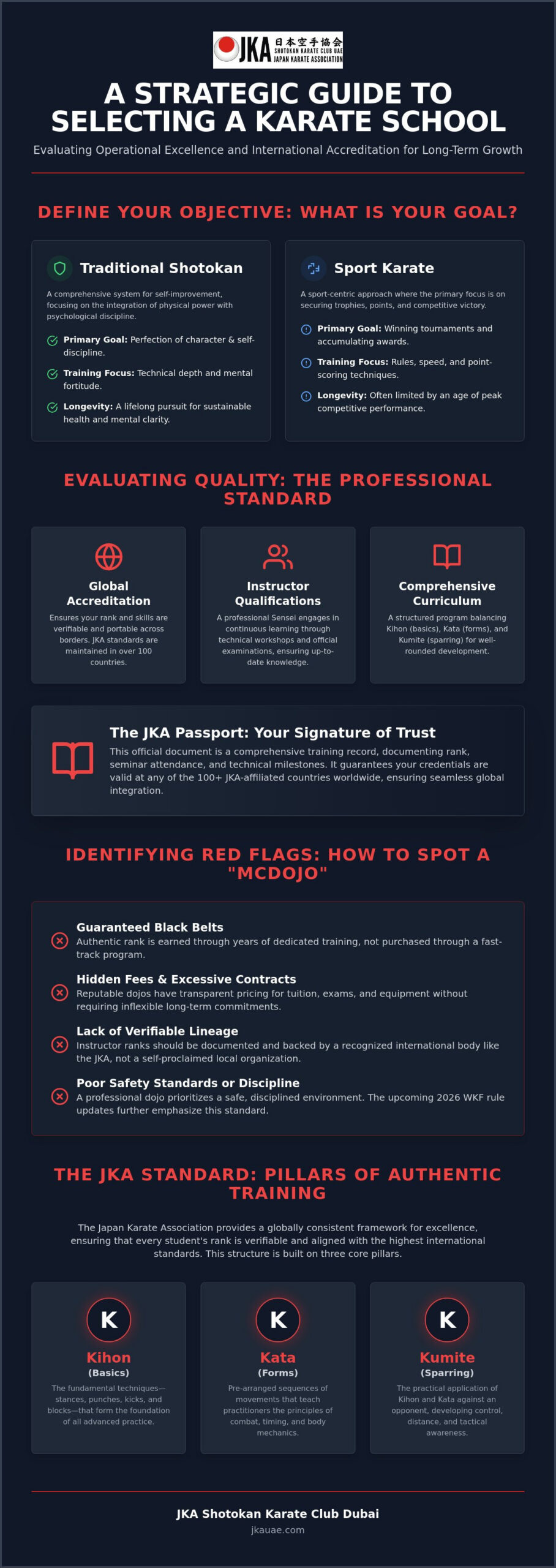
Traditional karate functions as a comprehensive system for self-improvement. Unlike sport-centric schools, traditional dojos emphasize the integration of physical power with psychological discipline. This ensures that the practitioner develops a resilient mindset capable of handling pressure both inside and outside the training environment. By prioritizing technical workshops and official belt examinations over tournament schedules, these institutions maintain a focus on operational excellence and individual mastery.
The Role of Discipline and Character Building
Traditional Shotokan training prioritizes the perfection of character above all else. This isn’t merely a philosophical concept; it’s a structured approach to building focus and resilience. By following the Dojo Kun, or the rules of the training hall, students cultivate respect and self-discipline. Modern karate systems prioritize this mental development, a standard JKA maintains through structured, professional instruction that benefits children and adults alike.
Evaluating the Curriculum Depth
A reputable dojo maintains a comprehensive curriculum that balances Kihon (basics), Kata (forms), and Kumite (sparring). When you’re determining how to choose a karate school, look for a logical progression of skills that is clearly documented. Professional institutions like JKA Shotokan Karate Club Dubai offer this level of technical synergy, ensuring that every student’s rank is verifiable and aligned with current international standards of excellence.
Choosing a school that focuses on traditional values ensures that the training remains relevant throughout various stages of life. While sport karate may have an age limit for peak performance, the traditional path offers a sustainable model for health and mental clarity. This strategic partnership between the student and the dojo fosters a culture of excellence. It moves beyond the transactional nature of a standard gym membership, offering a multi-faceted solution for personal development that remains effective for decades.
Evaluating Quality: Lineage, Accreditation, and Global Recognition
The integrity of a professional training program is defined by the organizational framework that supports its technical standards. When determining how to choose a karate school, you should prioritize institutions that maintain verifiable accreditation and global recognition. A rank awarded by an isolated local club often lacks the professional portability required for practitioners who may travel or relocate. In contrast, affiliation with a major international body ensures your credentials remain valid across borders, providing a seamless transition between dojos in different regions. This institutional stability is the hallmark of a professional training environment.
The Significance of International Affiliation
International affiliation provides a multi-faceted solution for quality assurance. JKA standards are currently maintained in over 100 countries, ensuring technical consistency across all global branches. A primary tool for this operational efficiency is the official JKA Passport. This document serves as a comprehensive training record, documenting rank, seminar attendance, and technical milestones. It functions as a signature of trust, allowing students to integrate into any global branch with full recognition of their current technical status. Without this documentation, a student’s progress remains localized and lacks the professional verification required for global movement.
Instructor Qualifications and Continuous Learning
Instructor qualifications represent another critical benchmark for assessing a school’s operational excellence. A professional Sensei doesn’t merely teach; they engage in a continuous cycle of technical workshops and official belt examinations to maintain their own proficiency. You should verify if an instructor is authorized by a global federation to conduct examinations, as this authority reflects a high level of technical trust. Inquire about the frequency of the teaching staff’s own assessments. This commitment to ongoing excellence ensures the instruction remains aligned with current, cutting-edge methodology rather than stagnant practices.
When you evaluate how to choose a karate school, look for those where the instructors are active participants in global training networks. This dedication to technical growth mirrors the corporate commitment to excellence found in leading regional conglomerates. For those seeking a strategic partnership in their development, JKA Karate classes offer a clear path toward internationally recognized mastery and long-term technical growth. By choosing a school with these credentials, you ensure that every training hour contributes to a globally recognized standard of skill.
Identifying Red Flags: How to Spot a “McDojo”
Identifying a professional training center requires a keen eye for operational standards that prioritize student development over commercial gain. When evaluating how to choose a karate school, you must be vigilant against the “McDojo” model. These facilities often market “Black Belt Programs” that guarantee a specific rank within a fixed timeframe. Authentic mastery cannot be scheduled or purchased; it is a byproduct of rigorous training and technical proficiency. Schools that pressure you into long-term contracts or offer “special” elite programs for an additional fee typically prioritize their bottom line over the integrity of the art. A reputable institution operates with transparency, ensuring that all costs for equipment and instruction are clearly defined from the outset.
The “Belt Mill” Warning Signs
A primary indicator of a commercialized dojo is the frequency of rank advancement. If a school conducts testing every few weeks, it is likely prioritizing the collection of fees rather than technical excellence. Professional karate belt examinations are strategic milestones that require months, or even years, of dedicated preparation. Instructors must have the integrity to fail students who haven’t met the required standards. This high level of quality control ensures that a belt represents genuine capability rather than a simple financial transaction. Without these rigorous standards, the value of the rank is effectively neutralized.
Safety and Sparring Protocols
Safety is a non-negotiable component of any disciplined training environment. You should observe whether beginners are pushed into sparring before they have mastered the fundamental basics of Kihon. Unsupervised or chaotic sparring sessions are a major liability and a sign of poor operational management. A professional dojo implements a “Safety First” approach, where techniques are taught with precision before they are applied in a controlled environment. This structured methodology protects the practitioner and ensures that the focus remains on technical refinement rather than aggressive competition.
Finally, observe the atmosphere of the dojo during a live session. A professional school maintains an environment of serious study, characterized by mutual respect and quiet focus. If the training hall feels like a chaotic playground or lacks a clear hierarchy of discipline, it’s unlikely to provide the character development promised by traditional martial arts. Your decision on how to choose a karate school should ultimately rest on finding a partner that values technical excellence as much as you value your personal growth. This strategic alignment ensures that your investment yields a multi-faceted solution for both physical and mental resilience.
Assessing the Dojo Environment and Practical Logistics
Evaluating the physical and operational infrastructure of a training facility is a critical step in determining how to choose a karate school. A dojo’s environment serves as a direct reflection of its management’s commitment to excellence and technical precision. In 2026, where the global martial arts industry is valued at over $21 billion, professional standards are a non-negotiable expectation for any serious practitioner. High-traffic schools must maintain rigorous hygiene and maintenance protocols to ensure a safe, professional atmosphere. A well-maintained training area suggests a culture of respect and attention to detail, which are essential components of traditional martial arts.
Standardization of equipment is another indicator of a school’s operational maturity. Professional institutions often require or provide high-quality gear, such as an official JKA Karate Gi, to maintain a uniform aesthetic and functional standard. This focus on consistency eliminates distractions and fosters a sense of shared purpose among practitioners. For those living in the UAE, practical logistics like location and class frequency are vital for sustaining a long-term commitment. A school’s schedule should offer the flexibility needed to integrate training into a busy professional life without compromising technical progress.
Professionalism and Etiquette
The concept of “Reigi,” or etiquette, is the cornerstone of a disciplined training hall. When you observe a class, look for the seamless integration of bowing and respect for senior ranks. Instruction should be clear, authoritative, and rooted in technical expertise. Professional instructors handle mistakes through constructive, technical guidance rather than emotional outbursts. This reflects an executive-level presentation of their services. This disciplined environment separates a world-class dojo from a casual fitness center.
Trial Classes and Observation
A reputable institution will always encourage you to participate in a trial class. It’s the best way to experience their teaching methodology firsthand. During this session, observe how the Sensei interacts with different demographics. Look for advanced students. Their presence is a key metric. A lack of high-ranking practitioners often signals high student turnover or a deficiency in curriculum depth. By choosing a school that demonstrates this transparency, you secure a reliable path toward mastery. To experience this standard of excellence, we invite you to explore Karate Classes in Dubai and begin your journey with a globally recognized partner.
The JKA Standard: Why Authenticity Matters in 2026
JKA Shotokan Karate Club Dubai serves as the operational benchmark for traditional instruction in the UAE. Our “Total Solution” approach moves beyond simple class instruction by providing a comprehensive infrastructure that includes official gear, international documentation, and world-class training standards. This integration ensures that every student operates within a system of maximum efficiency and technical reliability. When you consider how to choose a karate school, it is vital to select an organization that prioritizes these technical benchmarks over mere convenience, as the quality of your training environment directly dictates your long-term progress.
Members benefit from direct access to international seminars and technical workshops, which provide a multi-faceted solution for those seeking to refine their skills under global experts. This focus on current technical excellence ensures that our practitioners remain at the forefront of the art’s modern application. By aligning with a dojo that emphasizes operational transparency and rigorous standards, you are making a strategic investment in a training partnership that values technical depth and professional growth above all else.
International Portability of Your Training
Training within an official JKA branch ensures that your technical progress is recognized across a vast global network. This current international synchronization means that karate training completed in Dubai is fully valid in Japan and over 100 other countries. The JKA Passport provides students with a portable, verifiable record of their achievements, which is an essential asset for those who may relocate or travel for professional reasons. You can access authentic JKA Shotokan training in Dubai, knowing that your rank and technical development meet the highest contemporary standards.
Next Steps: Committing to a Global Standard
We invite you to visit our dojo to witness our operational standards in action and see how our instructors provide bespoke professional support to every student. Our facility provides a clear and professional path for enrollment, with specialized streams available for kids, teens, and adults to ensure optimal development. By choosing a partner that values technical excellence and operational transparency, you secure a future of consistent growth and achievement. Contact JKA Shotokan Karate Club Dubai today to begin your training within a world-class framework of excellence.
Securing Your Technical Future in Martial Arts
Selecting a training partner is a strategic decision that impacts your physical safety and long-term character development. We’ve examined the critical benchmarks of global accreditation and technical integrity that define a world-class dojo. Understanding how to choose a karate school in 2026 means looking beyond marketing claims to verify international lineage and operational standards. A professional institution provides a multi-faceted solution for growth; it ensures that every rank you earn is recognized by technical experts worldwide.
As the official UAE branch of the Japan Karate Association, we maintain a steadfast commitment to excellence through internationally recognized belt examinations and a structured curriculum. Our facility offers specialized classes for kids, teens, and adults, providing a disciplined environment for every stage of your journey. By prioritizing technical depth and global synergy, you ensure that your investment in martial arts yields lasting results. We invite you to experience this standard of professional instruction firsthand.
Start Your Journey with Authentic JKA Karate in Dubai today. Your path toward mastery and resilience begins with a partner dedicated to your success.
Frequently Asked Questions
How can I tell if a karate instructor is properly qualified?
A qualified instructor holds a verifiable rank from a major international federation and regularly participates in global technical workshops. You should verify their credentials by requesting documentation from a recognized body like the Japan Karate Association. This ensures the instruction aligns with cutting-edge technical standards rather than localized, unverified methods that lack global oversight.
What is the difference between JKA Shotokan and other styles of karate?
JKA Shotokan is distinguished by its strict adherence to the traditional standards of the Japan Karate Association, focusing on technical precision and character development. While other styles may prioritize sport competition or general fitness, the JKA model offers a multi-faceted solution. It integrates physical mastery with psychological discipline to create a more resilient practitioner.
Is it better to choose a school near my home or one with better accreditation?
You should prioritize international accreditation over local convenience to ensure the technical validity of your training. While proximity is a factor in sustainability, a school with global recognition provides a strategic partnership that ensures your rank is respected worldwide. This is a core consideration when researching how to choose a karate school for long-term growth.
How long should it typically take to earn a black belt in a reputable school?
Earning a black belt in a reputable dojo typically requires three to five years of consistent, disciplined practice. Any program guaranteeing a rank in a shorter timeframe lacks the operational integrity required for authentic martial arts mastery. Rank is a byproduct of technical proficiency and mental resilience, not a scheduled administrative outcome or a simple financial transaction.
Can my child transfer their belt rank if we move to another country?
Belt ranks are transferable internationally if they’re documented through an official global passport system. By training at an accredited branch, your child’s progress is recorded in a way that allows for seamless integration into affiliated dojos across different countries. This documentation serves as a primary seal of quality for families who may relocate for professional reasons.
What should I look for during my first visit to a karate dojo?
Observe the level of discipline, the cleanliness of the facility, and the clarity of the instruction during your initial visit. Professionalism is reflected in the “Reigi” or etiquette practiced by both students and staff. A high presence of advanced practitioners is a key metric for evaluating the school’s ability to provide a comprehensive solution for long-term student development.
Are there specific safety certifications I should ask the school about?
Inquire about instructor certifications from recognized global bodies and their familiarity with the 2026 WKF safety regulations. A professional dojo operates with a “Safety First” methodology, ensuring techniques are taught with control before they’re applied in sparring. This operational efficiency is essential for maintaining a safe and disciplined training environment for all age groups.
Why is official JKA gear and documentation important for my training?
Official gear and documentation are essential for maintaining technical synergy and verifiable rank advancement within a global framework. Using standardized equipment ensures your training is consistent with international branches. This professional approach is a vital part of how to choose a karate school that offers a total solution for your martial arts education and global portability.