Imagine your child is standing on the dojo floor ready for their session, but their belt unravels before the very first bow. It’s a common frustration for parents when the knot won’t stay secure or the ends look perpetually uneven. You want your child to feel confident and look professional, especially when adhering to the rigorous standards of JKA Shotokan. Learning how to tie a karate belt for kids is more than just a utility; it’s the first daily lesson in technical precision and operational discipline.
We recognize that preparing for a Karate Belt Examination requires attention to every detail, from the crispness of the Gi to the symmetry of the Obi. This guide provides clear, professional instructions to help you master the specific knotting technique that remains secure through the most intense training sessions. You’ll learn the correct way to overlap the jacket and the precise steps to achieve a balanced appearance that aligns with international JKA standards. By the end of this article, you’ll have the confidence to prepare your child for excellence in every class.
Key Takeaways
- Learn the essential “left-over-right” rule for the Gi jacket to ensure your child meets professional dojo standards.
- Master the precise technique for how to tie a karate belt for kids to create a secure, symmetrical knot that stays in place during training.
- Discover professional solutions for common issues like slipping knots on new cotton belts and correcting a twisted back for a polished appearance.
- Understand how the ritual of tying the Obi prepares students for the structured JKA kyu ranking system and official belt examinations.
- Explore how maintaining a professional appearance supports your child’s progression and technical record within the JKA Passport system.
Preparation: Setting the Standard with the JKA Karate Gi
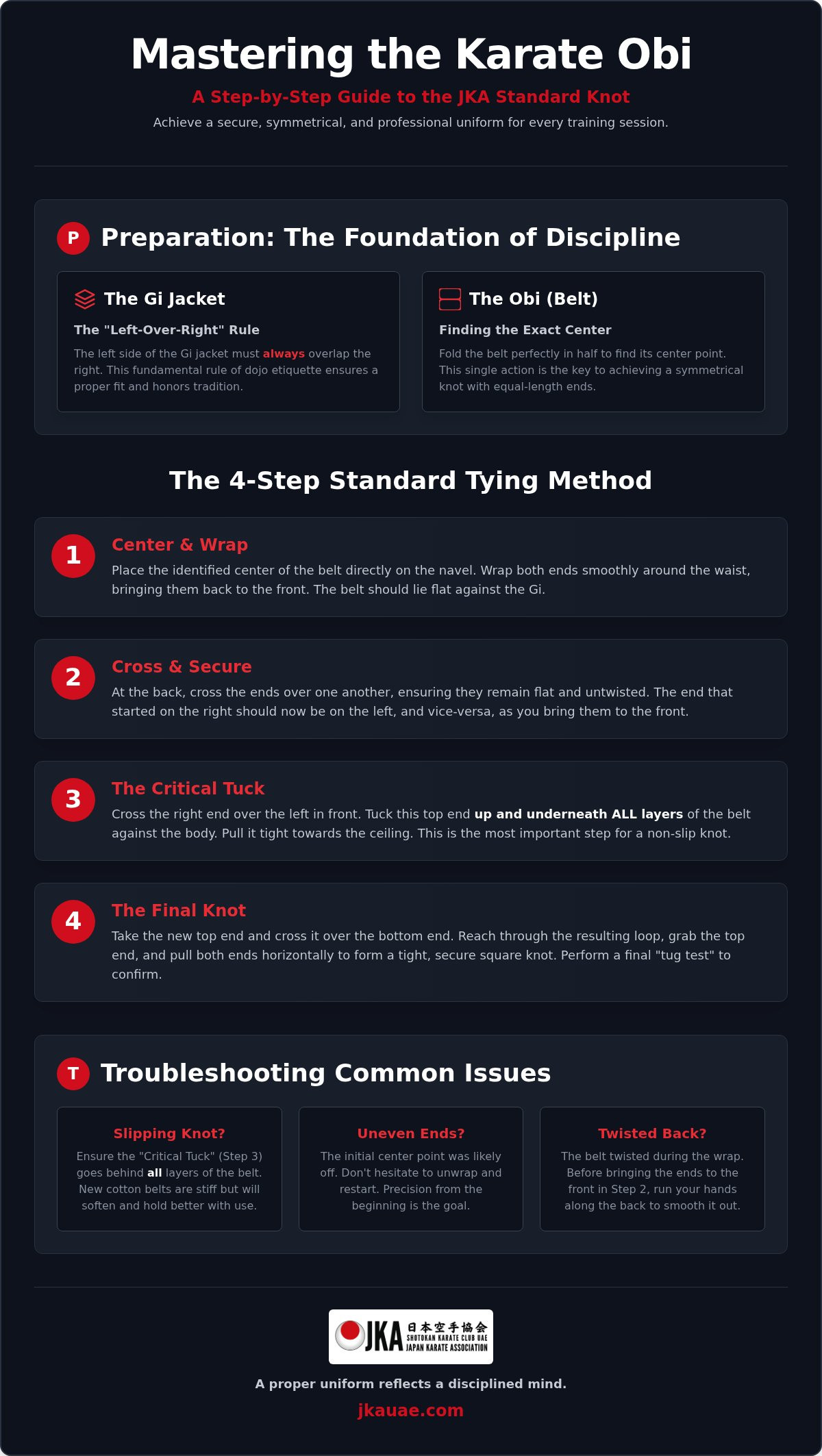
Establishing professional standards begins the moment a student prepares their uniform. In JKA Shotokan, the Obi (martial arts) is not merely a piece of fabric used to secure a jacket; it’s a critical component of a student’s technical equipment. Before you begin learning how to tie a karate belt for kids, you must ensure the Karate Gi is worn correctly. A fundamental rule of dojo etiquette is the left-over-right overlap. The left side of the Gi jacket must always overlap the right side. Reversing this is a significant breach of protocol that affects the symmetry of the uniform and the security of the belt knot later in the process.
Utilizing a high-quality, official JKA Karate Gi from JKA Shotokan Karate Club Dubai simplifies the preparation process for parents. These uniforms are engineered with specific fabric weights that provide the necessary structure for a secure fit. When the jacket is aligned correctly, it creates a stable foundation for the belt. This preparation serves as a vital pre-training ritual. It transitions the child from their daily routine into a state of operational focus and discipline. By treating the uniform with precision, students develop a sense of responsibility toward their equipment and their technical progress.
The Anatomy of the Karate Obi
The thickness and material of the belt directly influence how well a knot holds during dynamic movement. A standard JKA belt is designed to provide enough friction to prevent the “slipping knot” common in lower-quality alternatives. To begin, you must identify the exact center point of the belt by folding it in half. This ensures a symmetrical finish where both ends of the belt are of equal length after the knot is tied. The Obi serves as a precise symbol of the student’s current technical proficiency and their commitment to the JKA curriculum.
Uniform Etiquette for UAE Students
Maintaining a clean and pressed Gi is a requirement for all students across our UAE dojos. This attention to detail reflects the high standards of the Japan Karate Association and prepares the student’s mind for the rigors of traditional training. Proper uniform care is closely linked to the administrative side of a student’s journey. Every achievement and rank advancement is officially recorded in the JKA Passport. This document acts as the essential record of progress, ensuring that the child’s dedication is recognized globally within the organization. Mastering how to tie a karate belt for kids is the first step in respecting these international standards.
Step-by-Step: The Standard Method for Tying a Karate Belt
Mastering the physical sequence of how to tie a karate belt for kids requires a systematic approach to ensure the knot remains functional throughout a rigorous class. Following the standardized JKA method ensures that the student’s appearance reflects their commitment to technical excellence. This process is a foundational skill that parents can use to support their child’s early martial arts journey. By focusing on these specific steps, you provide your child with the security they need to move with confidence during training.
- Step 1: Find the center of the belt by folding it in half. Place this center point directly on the child’s navel to establish a balanced starting position.
- Step 2: Wrap both ends around the waist, crossing them at the small of the back. Bring both ends back to the front, ensuring the belt lies flat against the Gi jacket.
- Step 3: Cross the right end over the left. Tuck the right end up and behind all layers of the belt, pulling it through so it points toward the ceiling. This tuck is the most critical step for long-term knot security.
- Step 4: Form the final knot by crossing the top end over the bottom end. Reach through the resulting loop, grab the top end, and pull it through horizontally.
For parents who prefer seeing illustrated variations of these technical folds, you can consult this resource on How to Tie a Karate Belt to verify the alignment of the layers.
Achieving Perfect Symmetry
In JKA Shotokan, symmetry represents the internal and external balance a karateka strives to achieve. Both ends of the belt should be of equal length once the knot is finalized. If the ends are uneven, it’s often a sign that the center point shifted during the initial wrap. Don’t hesitate to unwrap and start over; precision is the goal. If your child is smaller and the belt seems excessively long, ensure the wrap is snug. You can slightly overlap the layers at the back to take up slack without compromising the professional look of the uniform.
Securing the Square Knot
The final step is the “tug test.” Pull the ends of the belt horizontally away from the center. A correctly tied square knot should resemble a fortune cookie and feel firm against the waist. It shouldn’t be so tight that it restricts deep breathing during Kihon or Kata. We often encourage parents to let their child perform the final tug. This small gesture builds a sense of autonomy and prepares them for the independence required in our Kids Karate Classes. A secure knot ensures the student can focus entirely on their technique rather than their uniform.
Troubleshooting Common Belt Tying Challenges
Even after mastering the mechanics of how to tie a karate belt for kids, parents often encounter operational hurdles. New belts, specifically those made of high-grade heavy cotton, possess a stiffness that can cause knots to loosen during active karate training. This “slipping knot” is rarely a failure of technique; rather, it’s a result of the material’s initial rigidity. For those just starting, consulting a Beginner’s Guide to Tying a Karate Belt can provide additional perspective on belt tension and material behavior. If the belt continues to unravel during Kihon or Kata, verify that the final knot is being pulled horizontally with sufficient force to lock the cotton fibers together.
Another frequent aesthetic and functional issue is the “twisted back.” This occurs when the layers of the belt cross over each other unevenly behind the child, creating a bulky and uncomfortable overlap. It looks unprofessional during formal dojo activities and can distract the student during movement. To resolve this, ensure the first wrap stays perfectly flat against the small of the back before crossing the second layer directly over it. A flat, parallel wrap is the hallmark of a disciplined karateka. While a simple re-tie usually solves most issues, a belt replacement is only necessary if the internal core has snapped or the length no longer permits a secure square knot as the child grows.
Dealing with Stiff or New Belts
You can soften a new Obi by gently rolling the fabric or working it with your hands to break the initial starchiness. Avoid harsh machine washing, as this can degrade the color and structural integrity required for JKA standards. For extra security during sparring, consider a double-tuck technique where the top end passes through both layers of the belt wrap before the final knot is formed. A well-maintained belt is a sign of a diligent student.
Correcting Uneven Ends
Symmetry is not just an aesthetic preference; it is a core requirement for official belt examinations. If the ends appear uneven after the knot is tied, you don’t always need to untie the entire assembly. You can often shift the belt around the child’s waist until the ends align. Encourage your child to use the dojo mirror to verify their own symmetry. This habit of self-correction fosters the technical precision necessary for long-term progress. If you are ready to enroll your child in a structured environment that prioritizes these standards, explore our Kids Karate Classes today.
The Path Forward: From White Belt to Technical Mastery
Tying the belt is the final step of preparation before stepping onto the tatami. It signals a critical shift in mindset from the external world to the internal discipline of the dojo. Understanding how to tie a karate belt for kids is the parent’s primary contribution to this professional transition. Once the knot is secure, the child is ready to participate in a Shotokan karate class, where the focus moves from uniform preparation to technical execution. This ritual instills a sense of order that carries through the entire training session.
The journey through the JKA kyu ranking system is a structured path toward technical mastery. Unlike generic martial arts programs, the Japan Karate Association maintains a standardized international curriculum. Each belt color represents a specific level of proficiency, moving from white belt (10th kyu) toward the ultimate goal of Shodan, or first-degree black belt. This progression is not merely about time spent in the dojo. It requires a demonstrated commitment to the technical principles of Shotokan and the development of strong character.
Preparing for the First Belt Examination
Instructors evaluate more than just physical strength during a Karate Belt Examination. They look for focus, respect, and the ability to maintain professional uniform standards. As you help your child master how to tie a karate belt for kids, you’re also preparing them for their first formal assessment. The JKA Passport serves as the essential record of this progress. It’s a mandatory document that tracks every examination and seminar, ensuring that a student’s rank is recognized by JKA branches worldwide. Consistent practice at home helps children internalize these high standards early in their development.
Joining the Global JKA Community
Training at an official branch provides students with direct access to a prestigious network of global expertise. Students in the UAE benefit from specialized seminars and technical workshops led by internationally certified instructors. This connection ensures that the karate practiced in local dojos remains consistent with international standards. It builds a foundation of leadership and discipline that serves youth well beyond their martial arts training. Enroll your child in an authentic JKA Shotokan program today to begin their journey toward technical excellence and personal growth.
Empower Your Child Through Technical Precision
Mastering the technical nuances of the uniform is the first step toward excellence on the mat. By applying the left-over-right rule and ensuring a symmetrical square knot, you provide your child with the operational stability they need for rigorous training sessions. Knowing how to tie a karate belt for kids correctly isn’t just about utility; it’s about aligning with the international standards of the Japan Karate Association. This attention to detail ensures your child is professionally prepared for every Karate Belt Examination and that their progress is accurately documented in their official records.
As the official UAE branch of the Japan Karate Association, we provide a standardized curriculum that guarantees global recognition through the JKA Passport. Our expert instructors specialize in traditional Shotokan, offering a structured environment where youth develop leadership and technical mastery. We invite you to Start Your Child’s Journey at JKA Shotokan Karate Club Dubai today. With the right preparation and professional guidance, your child’s path toward technical mastery will be built on a foundation of discipline and accuracy. We’re excited to support your child’s growth in the dojo.
Frequently Asked Questions
What should I do if my child’s karate belt is too long?
If your child’s belt is excessively long, you should wrap it around the waist an additional time or overlap the layers more significantly at the back. It’s important to maintain the structural integrity of the Obi, so we don’t recommend cutting the material or altering the factory stitching. A professional appearance is maintained when the ends hang at an equal length, typically reaching the mid-thigh area after the knot is secured.
Is there a difference between how boys and girls tie their karate belts?
There’s no technical difference between how boys and girls tie their belts in JKA Shotokan. The Japan Karate Association maintains a standardized protocol for all students to ensure organizational uniformity and equality on the dojo floor. Both genders must follow the same square knot technique to reflect their shared commitment to the international curriculum. This consistency ensures that every student meets the same rigorous standards during training and examinations.
Which side of the karate jacket should be on top?
The left side of the Gi jacket must always overlap the right side for all practitioners. This is a fundamental rule of dojo etiquette that ensures a uniform professional presentation across the organization. Reversing this overlap is considered a significant breach of protocol. Maintaining the correct left-over-right alignment provides a stable foundation for the belt and reflects the student’s attention to the technical details of their equipment.
How often should I wash my child’s karate belt?
You should wash the karate belt as infrequently as possible to preserve the material’s rigidity and color. While the Gi jacket and trousers require cleaning after every session, the Obi is designed to maintain its shape through limited laundering. If cleaning becomes necessary due to heavy use, use a cold hand wash to prevent the cotton fibers from degrading. This approach ensures the belt remains a durable piece of technical equipment for the long term.
What does the knot in the karate belt symbolize?
The knot represents the center of the student’s focus and their commitment to technical precision. When learning how to tie a karate belt for kids, parents help symbolize the balance between the child’s physical movements and their mental discipline. A correctly tied knot serves as a functional anchor for the uniform. It acts as a visual reminder of the student’s current rank and their official standing within the global JKA community.
Can my child tie their own belt, or should a parent always do it?
We encourage students to begin tying their own belts as soon as they develop the necessary manual dexterity. While parents provide essential support during the early stages, mastering how to tie a karate belt for kids is a vital milestone in a student’s path toward technical independence. Developing this skill early fosters a sense of personal responsibility. It effectively prepares the child for the autonomy required during advanced training and official belt examinations.