JKA karate grading in Dubai is a structured assessment of a student’s development in Kihon, Kata and Kumite. It also considers discipline, concentration, etiquette, control and readiness for the next rank.
This guide explains the general JKA belt-grading pathway, examination preparation and factors that instructors consider before recommending a student for Kyu or Dan grading. Students should always confirm the current syllabus, eligibility and examination procedure directly with their instructor.
Key Takeaways
- Understand the difference between JKA Kyu and Dan grades.
- Learn how Kihon, Kata and Kumite are assessed.
- Understand how attendance, discipline and instructor recommendation affect grading readiness.
- Learn how students can prepare for a JKA belt examination in Dubai.
- Confirm the current syllabus and examination requirements directly with the instructor.
Understanding the JKA Ranking System: Kyu vs. Dan
The Japan Karate Association operates with a level of organizational precision that mirrors a The Japan Karate Association uses a structured ranking system to support consistent technical development across its branches. . This ensures that the Shotokan karate ranking system remains a credible benchmark for technical proficiency across all international borders. While some independent schools may offer accelerated paths to advancement, JKA belt requirements are intentionally demanding to maintain the technical rigor and effectiveness of the style. This structured hierarchy is divided into two primary categories: Kyu, which represents the student levels, and Dan, which signifies the professional or black belt grades.
A centralized technical examiner panel acts as the ultimate authority on quality control. These individuals aren’t just instructors; they’re Examiners assess each student’s technique, discipline and readiness according to the applicable JKA examination standards. of technique who ensure every practitioner demonstrates the power, form, and discipline required by the Tokyo headquarters. This rigorous oversight transforms the ranking system into a comprehensive roadmap for personal development. It’s a training relationship between the student and the association, where each new rank validates the student’s clear and organized process in applying karate fundamentals. Every examination is a performance review that measures technical growth against a official JKA technical standards .
The 10 Kyu Ranks: The Student’s Journey
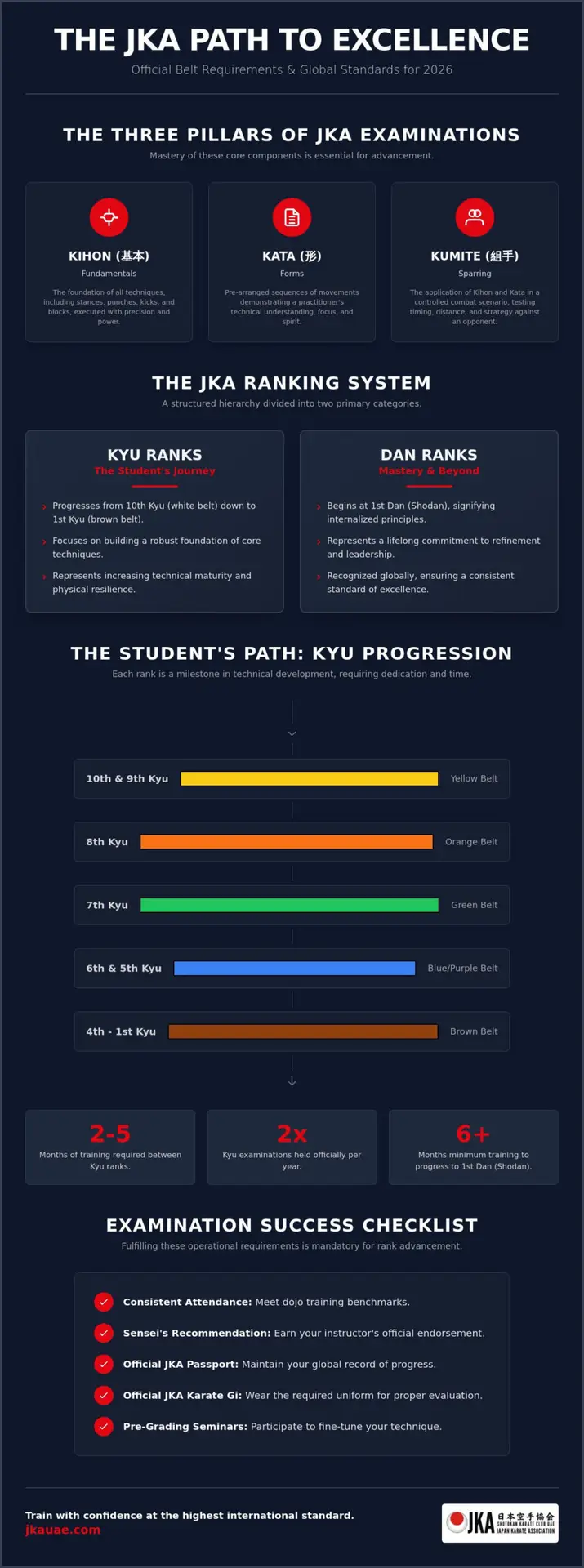
The path begins at 10th Kyu, represented by the white belt, and progresses numerically downward to 1st Kyu, the final brown belt stage. Each color change serves as a visual indicator of the student’s increasing technical maturity and physical resilience. In the UAE, practitioners typically train for two to five months between these student ranks, depending on their current level and the intensity of their practice. Standardized JKA belt requirements ensure that because Kyu examinations are officially held scheduled JKA examination opportunities at the JKA Shotokan Karate Club Dubai, students must demonstrate consistent attendance to earn their Sensei’s recommendation for the exam. This phase focuses on building a robust foundation of Kihon and Kata.
The 10 Dan Ranks: Mastery and Beyond
Achieving 1st Dan, or Shodan, marks a significant transition from a student learning the mechanics to a practitioner who has internalized the core principles. The Dan hierarchy extends from 1st to 10th Dan, representing a lifelong commitment to technical excellence and leadership within the martial arts community. Unlike the student ranks, the time intervals between Dan grades expand significantly, requiring years of dedicated training and contribution to the art. These ranks are recognized globally, ensuring that a Dan grade earned in the UAE is respected in any JKA dojo worldwide. The Dan rank is a commitment to continuous refinement rather than an end goal.
Kyu Belt Requirements: Technical Milestones for Students
Adherence to JKA belt requirements ensures that every student’s progression is built on a foundation of technical integrity and physical readiness. Unlike independent organizations that might prioritize rapid advancement, the JKA mandates standardized time intervals to guarantee that techniques are internalized through consistent practice. Students typically train for a duration of two to five months between Kyu examinations. This period allows for the necessary physiological adaptation and muscle memory development required to execute high-level Shotokan techniques with the power and precision the association demands. Consistency is the primary metric for consistent progress in this phase.
The examination process isn’t an automated right of passage; it’s a formal evaluation that requires a Sensei’s professional recommendation. This endorsement serves as a quality assurance mechanism, confirming that the student has met the necessary attendance benchmarks and demonstrated the discipline expected within the dojo. During these evaluations, examiners maintain a consistent technical standard for both children and adults. While the physical output may vary based on age, the core requirements for form, focus, and spirit remain identical. This ensures that a junior brown belt possesses the same functional understanding as their adult counterpart.
Professionalism extends to the practitioner’s appearance and equipment. Wearing an official JKA Karate Gi during testing is an examination requirement that facilitates standardized technical auditing. A professional uniform allows examiners to clearly observe joint alignment and posture without the distractions of non-standard attire. It reflects a commitment to the organizational standards of the association, creating a polished, professional presentation that aligns with the stature of the JKA. It’s the first indicator of a student’s readiness to move toward the Official JKA Dan ranking requirements that await them at the end of their student journey.
Beginner Levels (10th Kyu to 7th Kyu)
The initial phase of training focuses heavily on the mechanics of stance, or Dachi, and the development of core balance. Students are introduced to the concept of ‘Embusen,’ the specific floor lines and movement patterns that define each Kata. Mastery of Heian Shodan is the primary objective, alongside the development of a strong ‘Kiai.’ This vocal expression of spirit must be timed perfectly with basic punches and blocks to demonstrate the cooperation of breath and physical impact. It’s about establishing the baseline coordination needed for more complex maneuvers.
Intermediate and Advanced Kyu (6th Kyu to 1st Kyu)
As practitioners move into the intermediate ranks, the curriculum expands to include all five Heian Katas and the introduction of Tekki Shodan. The sparring requirements also evolve from basic five-step drills to the more demanding one-step, or Ippon, Kumite. This shift requires greater technical precision and a deeper understanding of distance and timing. 1st Kyu (Brown Belt) serves as the most critical stage for Dan preparation because it’s where the student must synthesize all previous lessons into a professional-grade performance. Success at this level confirms that the student is ready for the transition to the black belt ranks.
The Three Pillars of JKA Examinations: Kihon, Kata, and Kumite
The JKA curriculum operates as a sophisticated ecosystem where Kihon, Kata, and Kumite function as integrated components of a single educational strategy. This holistic approach ensures that students don’t just learn isolated movements but develop a deep, functional understanding of martial arts. By aligning these three pillars, the association provides a Total Solution for character development and technical mastery. Mastering these elements is the core objective for anyone seeking to meet the JKA Kyu belt requirements and advance through the ranks with clear and organized process. Every examination is a comprehensive audit of how these pillars synergize to produce a well-rounded practitioner.
Technical examiners in the UAE look for a seamless transition between these components. A student who excels in basics but falters in application hasn’t yet achieved the balance required by the Japan Karate Association. This rigorous standard ensures that every rank carries global credibility. It’s not about passing a test; it’s about demonstrating that your training has reached a specific technical and psychological threshold. This commitment to excellence is what defines the JKA as in the martial arts sector.
Kihon: The Foundation of JKA Excellence
Kihon involves the repetitive practice of basic techniques to achieve maximum power and technical precision. Examiners look specifically for the correct application of hip rotation, distinguishing clearly between the driving force of Jun-zuki and the reactive power of Gyaku-zuki. Technical success depends on ‘Kime,’ the instantaneous tensing of the body at the moment of impact, and ‘Zanshin,’ a state of total awareness and mental readiness. Many unsuccessful grading attempts stem from a lack of floor connection or improper posture during transitions. These flaws signal a fundamental gap in the practitioner’s technical foundation that must be corrected before they can progress to more complex maneuvers.
Kata and Kumite: Application and Spirit
While Kihon builds the engine, Kata and Kumite demonstrate how that power is applied in dynamic scenarios. In higher-level examinations, students must select a ‘Tokui’ or favorite Kata that showcases their specific technical maturity and physical capabilities. This performance isn’t just a sequence of movements; it’s a strategic demonstration of combat logic against imaginary opponents. Advanced Shotokan karate techniques are the core of every successful exam, and their execution in Kata proves a student’s grasp of the style’s complex geometry and timing.
Kumite represents the final test of these pillars in a live environment. In the UAE, the JKA maintains strict no-contact or controlled-contact regulations to prioritize student safety while testing their ability to manage distance and timing. This controlled environment allows practitioners to apply their skills with intensity without the risk of injury. It’s a professional setting that demands mutual respect and composure. This ensures that the spirit of the dojo remains central to the evaluation process, reflecting the high standards of a major regional organization.
Dan Ranking Prerequisites and Time Intervals
The transition from student Kyu ranks to the professional Dan hierarchy represents a significant shift in a practitioner’s technical and mental maturity. Meeting the JKA belt requirements for a black belt isn’t just about physical endurance; it’s a rigorous audit of a practitioner’s ability to maintain the association’s official JKA technical standardsunder pressure. This progression is governed by applicable time-in-grade prerequisites that ensure every Dan rank is earned through sustained excellence rather than temporary performance. These intervals act as a quality control mechanism, maintaining the technical integrity of the JKA brand across all regional branches. It’s a strategic partnership between the practitioner and the association that prioritizes long-term stability over rapid advancement.
A critical component of this structured training and examination support is the JKA Passport. Students should confirm with the club whether a current JKA membership record, passport or other documentation is required for the specific examination.. It functions as a practitioner’s professional ledger, ensuring that a rank earned in Dubai is instantly recognized at the JKA Headquarters in Tokyo or any other international branch. Without this passport, a student cannot access the global network of rank recognition that the JKA provides. It serves as the essential bridge between local training and international innovation, positioning each student within a worldwide framework of excellence.
Testing for Dan ranks often moves beyond the local branch dojo. While Kyu exams are typically handled at the branch level, higher Dan evaluations may require attendance at Regional Headquarters or even the JKA HQ in Tokyo during international seminars. These gatherings offer specialized karate seminars and workshops where practitioners can fine-tune their techniques with JKA-authorized instructors. This exposure to high-level technical auditing is essential for achieving the clear and organized process required for advanced black belt ranks. These events create a synergy between different regions, ensuring a consistent application of Shotokan principles.
The Path to Shodan (1st Black Belt)
The journey to Shodan is defined by the 6-month training interval required after achieving 1st Kyu. This period is dedicated to the total refinement of the three pillars, with a heavy emphasis on advanced Katas such as Bassai-Dai. Practitioners must demonstrate a level of focus and awareness that transcends basic student performance. Mental preparation is just as vital as physical training, as the intensity of a Dan grading session is designed to test a candidate’s composure and spirit. Establishing this foundation often begins early, and karate classes for teens Dubai provide the discipline and technical grounding necessary for future Dan success.
Advanced Dan Grades (2nd Dan and Above)
Progression beyond the first black belt follows a specific timeline that prioritizes technical depth. A practitioner must train for at least 1 year after Shodan before attempting 2nd Dan (Nidan), and 2 years after Nidan before attempting 3rd Dan (Sandan). This structured timeline ensures that each rank reflects a genuine growth in expertise and a commitment to the art’s lifelong refinement. Because the JKA is an with a presence in within the JKA network, subject to applicable JKA records and requirements, these ranks carry immense prestige and international validity. To understand the full scope of what earning a karate black belt under the JKA international standard truly means in the UAE, review the comprehensive Dan ranking criteria before beginning your preparation. To begin your journey toward these professional milestones, you should apply for your JKA Passport and begin Dan preparation through our authorized Dubai branches today.
Preparing for Success at JKA Shotokan Karate Club Dubai
Students should wear a clean, suitable Karate Gi and follow the official examination instructions provided by the club before the grading date.
Examination dates, eligibility and administrative requirements depend on the official JKA schedule and the examination notice issued by the club. Students should confirm the current syllabus, required documents, fees and registration deadline directly with their instructor. Preparation sessions may be arranged before an examination when officially scheduled.
Dojo Etiquette and Exam Readiness
Technical mastery is incomplete without the proper application of ‘Reigi,’ the foundational concept of respect that governs all JKA interactions. During the examination, your conduct is scrutinized as closely as your Kata. On exam day, candidates must arrive with a complete checklist: their JKA Passport, a clean official uniform, and a focused mental state. This holistic readiness is a core focus of our teen karate classes Dubai, where we emphasize that leadership and discipline are just as critical as physical performance. Being prepared means understanding that the exam begins the moment you enter the dojo.
Beyond the Belt: Continuous Education
Earning a new rank is a milestone, but it shouldn’t be viewed as the conclusion of your training. We encourage all practitioners to participate in regional workshops and specialized karate seminars and workshops to maintain the high technical standards the JKA is known for. Being part of an official JKA branch in the UAE offers a strategic partnership that connects you to international innovation and global expertise. For those who want to deepen their understanding of authentic practice, our traditional karate training guide for JKA Shotokan in the UAE provides a comprehensive framework for distinguishing rigorous, internationally recognized programs from commercialized alternatives. This continuous education ensures that your skills remain sharp and your understanding of Shotokan principles continues to evolve through synergy with other practitioners. It’s this commitment to excellence that defines a true JKA student.
Ready to start your journey? Register for JKA Karate Classes in Dubai and take the first step toward achieving your global rank.
Advancing Your Technical Journey with JKA Standards
Navigating the path to a black belt requires a strategic commitment to the technical benchmarks established by the Japan Karate Association. Success is built upon the consistent refinement of Kihon, Kata, and Kumite, ensuring every practitioner meets the rigorous JKA belt requirements for international recognition. By following the standardized time-in-grade intervals and utilizing the official JKA Passport, you secure a rank that carries professional weight in over 100 countries. This structured approach guarantees that your technical proficiency is verified by a official JKA technical standards rather than localized interpretations.
As the official UAE branch of the Japan Karate Association, we provide the essential infrastructure for your advancement. Our dojos feature Our instructors support students through structured training and examination preparation. of your progress, maintaining the highest levels of technical integrity. This synergy between local expertise and official JKA technical standards creates a stable environment for your personal growth. It’s time to translate your dedication into a globally recognized achievement within a community that prioritizes excellence and reliability.
Enroll in Authentic JKA Karate Classes in Dubai and begin your professional progression toward mastery today. We look forward to supporting your journey to the black belt and beyond.
Frequently Asked Questions
How long does it take to get a black belt in JKA karate?
Achieving a black belt typically requires three to five years of consistent, dedicated training. This timeline depends on the student’s ability to master the technical milestones at each level and maintain a regular training schedule. A practitioner must complete a minimum of six months of training at the 1st Kyu level before they are eligible to attempt the Shodan examination. This ensures theclear and organized process required for practitioner-level ranks.
What is the difference between Kyu and Dan ranks?
Kyu ranks represent the student levels, counting down from 10th Kyu to 1st Kyu, while Dan ranks signify advanced mastery and count upward from 1st Dan. The Kyu levels focus on building a robust technical foundation through Kihon and Kata. In contrast, Dan ranks represent a strategic commitment to the lifelong refinement of Shotokan principles and the development of leadership within the global association.
Is the JKA belt I earn in Dubai recognized in other countries?
Yes, every rank earned through our official Dubai branch is internationally recognized in over 100 countries. Because we strictly adhere to standardized JKA belt requirements, your rank carries the Recognition of a rank depends on the applicable JKA records, examination process and requirements. . This global portability is a primary advantage of training within an officially authorized JKA infrastructure.
What happens if I fail a karate belt examination?
If a student does not meet the required standards, they will receive detailed technical feedback from the examiner panel and must wait until the next scheduled examination. We view a setback as an opportunity for targeted refinement and professional growth. You’ll spend the interim period addressing specific technical gaps to ensure your performance meets the association’s gold standard during the next evaluation cycle.
Do I need a JKA Passport to take a belt test?
Students should confirm with the club whether a current JKA membership record, passport or other documentation is required for the specific examination. This document serves as your professional global ledger, recording every rank achievement and seminar attendance within the association’s centralized international network. It is the essential tool for ensuring your progress is documented and recognized by JKA-authorized examiners and instructors worldwide.
Can I skip a belt rank if I train more frequently?
No, the JKA ranking system does not permit skipping ranks, as each level serves as a critical prerequisite for the next stage of development. The curriculum is designed to ensure technical maturity through standardized training intervals. While increasing your training frequency will certainly enhance your performance and readiness, you must still fulfill the applicable time-in-grade requirements to maintain the integrity of the system.
What are the age requirements for JKA Dan grading?
While there is no fixed minimum age for 1st Dan, candidates must demonstrate the physical and mental maturity necessary to uphold the rank’s standards. Higher Dan ranks involve specific age and time-in-grade prerequisites to ensure depth of expertise. For example, a practitioner must train for at least one year after achieving Shodan before they can attempt the examination for 2nd Dan (Nidan).
Is there a specific Gi required for the belt exam?
All candidates are required to wear an Official JKA Karate Gi during the examination process. This uniform is a visual representation of your commitment to the professional standards of the Japan Karate Association. Adhering to these JKA belt requirements regarding attire ensures a polished, professional presentation and demonstrates proper dojo etiquette and respect for the technical examiner panel conducting the audit.