Earning a JKA karate black belt is not merely a local achievement; it is the acquisition of a globally recognized credential that signifies adherence to the highest technical standards of the Japan Karate Association. While many practitioners in the UAE aspire to this rank, there is often significant confusion regarding the distinction between sport certifications and traditional Dan grades that carry weight in Japan. It’s natural to feel uncertain about the timeline or whether your dedication will translate into a certification recognized by the international martial arts community. We understand that for the serious karateka, a rank is only as valuable as the global organization that stands behind it.
This article clarifies the rigorous path toward achieving the JKA international standard, ensuring you understand the strategic requirements for technical excellence and operational discipline. We provide a comprehensive overview of the Dan ranking system and the specific Kihon, Kata, and Kumite syllabus required for a successful examination. By the end of this guide, you will know exactly how to align your training with an official JKA branch to secure an authentic certification that serves as a lifelong passport to elite Shotokan training. This commitment to excellence ensures your progress is documented and respected worldwide.
Key Takeaways
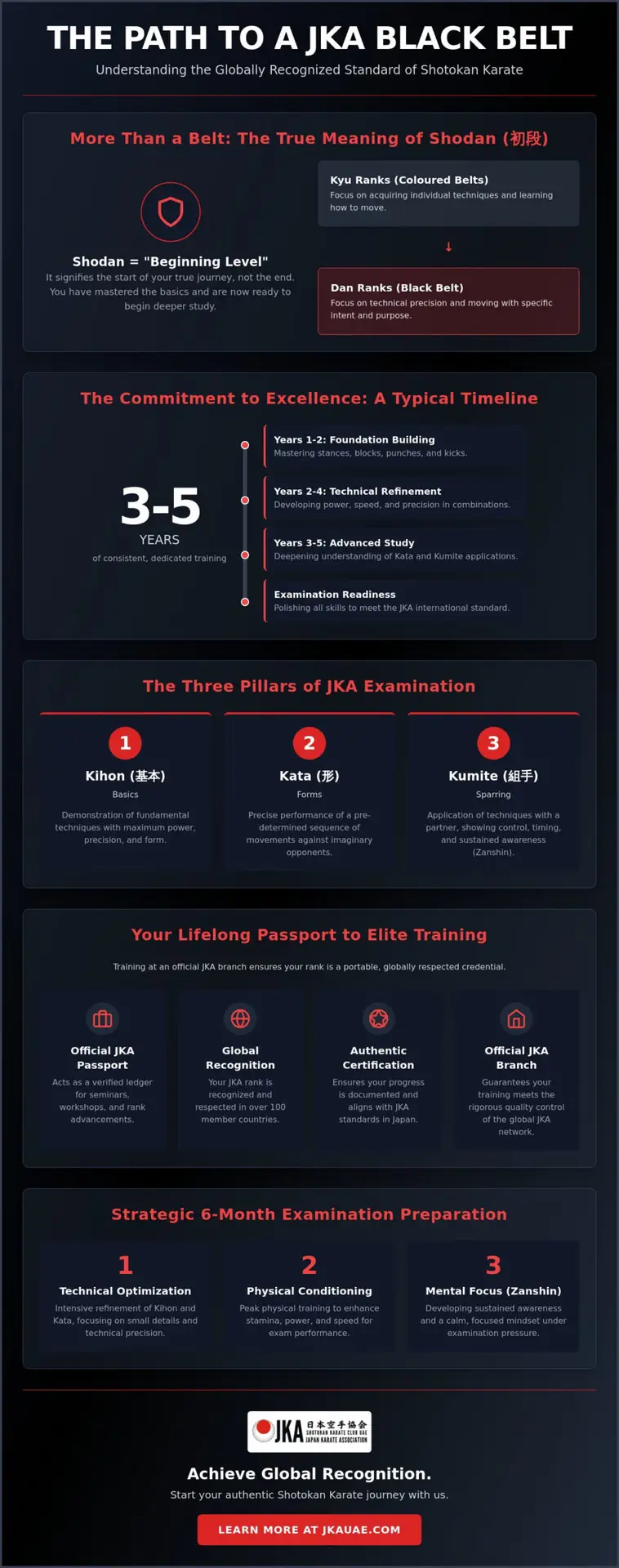
- Understand that earning a Shodan rank represents the commencement of your journey rather than the conclusion, fostering a mindset geared toward long-term technical development.
- Explore the rigorous technical requirements across the three pillars of Kihon, Kata, and Kumite that define the JKA international standard of excellence.
- Gain clarity on the standardized timeline for achieving a karate black belt, which typically requires three to five years of consistent and dedicated training to meet global benchmarks.
- Discover how to implement a strategic six-month preparation plan designed to optimize physical conditioning and mental focus for the Shodan examination.
- Identify the critical advantages of training at an official JKA branch to ensure your certification remains portable and recognized across more than 100 countries.
Defining the Karate Black Belt: More Than Just a Rank
In popular culture, the karate black belt is often depicted as the final destination of a martial artist’s journey. However, within the Japan Karate Association (JKA), this perspective is technically inaccurate. The term for a first-degree black belt is Shodan, which literally translates to “beginning level” or “first step.” This distinction is vital for any serious practitioner in the UAE to understand because it shifts the focus from a trophy-hunting mindset to one of continuous operational improvement. Reaching this rank signifies that you’ve finally moved past the stage of merely learning how to move and have begun the more sophisticated process of moving with specific intent and technical precision. It is the point where the student transitions from a consumer of knowledge to a disciplined practitioner of the art’s core mechanics.
The Symbolism of the Black Belt in Shotokan
Transitioning from the colored belt (Kyu) ranks to the Dan ranks is a significant milestone that changes a student’s role within the dojo infrastructure. While Kyu ranks focus on the acquisition of individual techniques, the black belt represents a practitioner who has mastered the fundamental basics to a degree where they can begin deeper study. It’s the difference between learning the alphabet and beginning to write complex sentences. Wearing the belt carries an institutional responsibility; you’re no longer just a student, but a professional representative of the JKA standard. This requires a commitment to excellence that serves as a benchmark for junior grades to emulate. In Dubai’s competitive environment, this rank acts as a verified seal of quality and technical reliability.
Shodan vs. Higher Dan Grades
The international Dan ranking system provides a structured framework for progression, typically ranging from 1st Dan (Shodan) to 10th Dan. While Shodan serves as the essential foundation for all future specialized training, higher grades represent decades of technical refinement and pedagogical expertise. Achieving a 2nd or 3rd Dan requires more than just physical prowess; it demands a synergy of teaching capability and a profound understanding of Shotokan’s biomechanical principles. Higher ranks aren’t simply awarded for time served but are earned through rigorous examination and a documented history of contribution to the art. This hierarchical structure ensures that the quality of instruction remains consistent across all global branches, positioning the JKA as a stable partner in a practitioner’s long-term development. You can find more information about these standards at jkauae.com.
The JKA International Standard: Technical Requirements
Achieving a karate black belt within the JKA framework requires meeting a specific set of global benchmarks that transcend regional boundaries. This isn’t a localized certification; it’s a standardized grade recognized in over 100 countries. To maintain this level of operational integrity, every practitioner must possess an official JKA Passport. This document acts as a verified ledger for seminars, workshops, and rank advancements, ensuring that a rank earned in Dubai is functionally equivalent to one earned in Tokyo. Following the JKA International Standard ensures that technical quality remains uncompromised regardless of geographic location. It provides a strategic roadmap for practitioners who value global portability in their martial arts credentials.
The examination evaluates three distinct pillars: Kihon (basics), Kata (forms), and Kumite (sparring). Examiners look for more than just the mechanical execution of moves. They demand high levels of power, technical precision, and Zanshin, or sustained mental awareness. Technical workshops and seminars in the UAE provide the necessary platform to refine these attributes under the guidance of senior instructors. These sessions are essential for aligning local training with international expectations, creating a synergy between daily practice and global standards.
Kihon and Kata: The Foundation of the Exam
Candidates for Shodan must demonstrate mastery of fundamental basics before performing a chosen Sentei Kata. The list of eligible forms includes Bassaidai, Kankudai, Jion, and Empi. Examiners scrutinize technical nuances such as the stability of the Zenkutsu-dachi (front stance) and the explosive rotation of the hips during strikes. It’s not enough to know the sequence; you must demonstrate the application of each movement. Consistent practice in professional Dubai dojos allows students to internalize these mechanics, ensuring their performance meets the rigorous criteria of the JKA syllabus.
Kumite: Demonstrating Control and Spirit
The sparring component transitions from basic drills to Jiyu Ippon Kumite (one-step free sparring). This format tests a candidate’s ability to react under pressure while maintaining the strict JKA rule of Sun-dome. This principle requires delivering a technique with maximum power and speed but stopping it millimeters before contact. It demonstrates complete physical and mental control, reflecting the character of the practitioner. Sparring at this level isn’t about defeating an opponent, but about demonstrating technical maturity. If you’re ready to begin this technical journey, exploring JKA Karate Classes in the UAE is the first strategic step toward excellence.
The Timeline: How Long Does It Take to Earn a Black Belt in the UAE?
One of the most frequent inquiries from practitioners in Dubai and Sharjah involves the duration required to achieve a karate black belt. According to verified JKA standards, reaching the Shodan level typically requires between three to five years of consistent, dedicated training. This timeline isn’t arbitrary; it represents the period necessary to internalize complex biomechanics and develop the mental fortitude required by JKA’s official Dan ranking system. While time is a factor, the rank is ultimately awarded based on technical competency and the demonstration of character rather than simple attendance. A student who trains four days a week will naturally develop a different technical synergy than one attending only twice.
The Kyu to Dan Progression Path
The journey begins at 9th Kyu (white belt) and progresses through a structured series of examinations toward 1st Kyu (brown belt). Each stage serves as a strategic building block, ensuring the student’s foundation is stable before introducing more advanced concepts. For a detailed breakdown of these milestones, practitioners should consult the JKA belt requirements guide. There is a mandatory waiting period between the final Kyu exam and the black belt examination, typically requiring several months of intensive preparation at the 1st Kyu level. This ensures that the candidate isn’t just performing techniques but is embodying the principles of Shotokan.
Factors Influencing Your Progress in the UAE
Progress in the UAE is often accelerated by the availability of specialized training opportunities across our regional infrastructure. Attending official karate seminars and workshops provides a unique opportunity to receive direct feedback from senior international instructors, which significantly enhances operational efficiency in one’s movement. Consistent attendance at official branches in Dubai, Sharjah, or Abu Dhabi remains the most reliable predictor of success. Rushing the process often leads to technical gaps that become apparent during the rigorous Shodan examination. By respecting the timeline, a student ensures that their karate black belt carries the full weight of its international certification, reflecting a genuine mastery of the basics rather than a hurried achievement. This methodical approach ensures long-term stability in the practitioner’s martial arts career.
Preparing for the Black Belt Examination in Dubai
Success in the Shodan examination requires a strategic six-month operational plan that balances technical refinement with physical conditioning. During the initial two months, your focus should remain on high-volume Kihon to build the necessary muscle memory and stamina. As you enter months three and four, the training shifts toward the precision of your chosen Sentei Kata and the tactical nuances of Kumite. The final eight weeks should be dedicated to high-intensity simulations, ensuring your performance remains stable under the pressure of official scrutiny. This methodical preparation ensures that when you step onto the mat for your karate black belt test, your technique is a reflection of disciplined, long-term preparation rather than a last-minute effort.
Physical readiness in the UAE requires specific attention to the regional climate. Maintaining peak performance during an intensive examination demands a sophisticated approach to hydration and electrolyte balance. Beyond the physical, candidates must ensure their equipment aligns with global standards. An Official JKA Karate Gi is mandatory, and it’s essential that it’s maintained in pristine condition to reflect the institutional pride of the association. Administratively, candidates must coordinate with their dojo to finalize registration and ensure all documentation is processed through the official JKA regional office.
Pre-Exam Checklist for UAE Students
Before the examination date, every candidate must complete a series of administrative and technical verifications to ensure eligibility. These steps are essential for maintaining the operational integrity of the ranking system:
- Ensure your JKA Passport is current, with all Kyu ranks and seminar attendances officially recorded.
- Verify that you’ve attended the mandatory technical workshops in the UAE, as these sessions provide the necessary alignment with the international syllabus.
- Confirm that your Gi meets JKA standards for both appearance and fit, as presentation is a key component of the professional martial arts standard.
Mental and Physical Readiness
Developing the stamina to endure a rigorous examination involves more than just cardio. It requires the mental discipline of Mushin, or a clear mind, which allows the practitioner to react instinctively without the interference of anxiety. Participating in mock examinations conducted by JKA UAE Senseis is a highly effective strategy for identifying technical gaps and acclimatizing to the exam environment. These simulations provide a synergistic benefit, combining physical exertion with the mental pressure of formal evaluation. If you’re ready to begin your final preparation, you can register for our upcoming Karate Belt Examination to secure your place in the next testing cycle.
Achieving Global Recognition with JKA Shotokan Karate Club Dubai
Choosing a training center is a strategic decision that determines the lifelong validity of your martial arts credentials. Earning a karate black belt at an official JKA branch provides a level of institutional security that independent clubs simply cannot replicate. Because we’re a verified part of the global JKA infrastructure, your rank is recorded in the central registry in Japan and recognized in over 100 countries. This portability is essential for professionals and students who may relocate internationally. It ensures that your years of dedication remain an active, recognized asset regardless of your geographic location. It is a global passport to elite training circles.
Black belt practitioners within our organization gain exclusive access to international JKA camps and elite-level tournaments worldwide. These events offer a unique synergy with the world’s most senior instructors, allowing for continuous technical refinement beyond the initial Shodan level. Whether you’re training in Dubai, Sharjah, Abu Dhabi, or Fujairah, you’re part of a unified technical system that prioritizes quality and operational excellence. We provide the essential bridge between regional dedication and international innovation, ensuring our students are prepared for the global stage.
The Advantage of the Official JKA Branch Status
JKA UAE maintains a direct operational link with the JKA headquarters in Tokyo, ensuring our curriculum remains authentic and technically rigorous. Our instructors aren’t merely teachers; they’re active practitioners who maintain their own high-level ranks through consistent participation in international JKA seminars. This commitment to professional development ensures that every student receives instruction that adheres strictly to the traditional Shotokan syllabus. We focus exclusively on the technical depth of karate. We intentionally exclude MMA or general fitness programs to maintain the purity and stability of our training environment. This focus ensures that your karate black belt represents a specific, high-level technical mastery.
Next Steps: Joining the Black Belt Path
The journey toward achieving an international standard is open to practitioners of all ages through our diverse training programs. We offer specialized karate classes for kids designed to build a foundation of discipline and physical coordination. For older students, our teen karate classes in Dubai focus on developing leadership skills alongside technical precision. We also provide ladies karate classes for those seeking a specialized and supportive training environment. Each program serves as a strategic entry point into a global community of excellence. Visit our homepage today to find the nearest dojo in the UAE and begin your path toward a globally recognized rank.
Secure Your International Standard in Shotokan Karate
Reaching the level of a karate black belt is a strategic milestone that validates your technical proficiency and operational discipline on a global scale. As established, the Shodan rank serves as the foundational first step toward a deeper understanding of the art’s biomechanics and philosophical principles. By adhering to the rigorous technical syllabus of the Japan Karate Association, you ensure that your progress is documented through an official JKA Passport and recognized across more than 100 countries. This global portability remains a primary advantage for serious practitioners who value technical stability.
Training at an official UAE branch provides a direct link to the technical excellence of the headquarters in Tokyo. Our certified JKA instructors lead a traditional Shotokan curriculum that prioritizes precision, power, and character development over generic fitness or recreational trends. This institutional commitment to quality ensures that every practitioner is equipped with the tools necessary for long-term success. Begin your journey to a black belt—Register for a JKA Karate class today. We look forward to supporting your path toward achieving this prestigious international standard with confidence and technical integrity.
Frequently Asked Questions
How long does it take to get a black belt at JKA Shotokan Karate Club Dubai?
Achieving a karate black belt typically requires three to five years of consistent and dedicated training. This timeline ensures that a practitioner has mastered the fundamental biomechanics and mental focus required by international standards. Regular attendance and participation in official seminars are critical factors in maintaining this progression, as the rank is awarded based on technical competency rather than simple time served.
Is a black belt from JKA UAE recognized internationally?
Yes, a Dan grade earned through an official JKA branch in the UAE is recognized across more than 100 countries. Because we follow the standardized JKA international ranking system, your certification is recorded in the central registry in Japan. This provides a portable credential that maintains its technical value and institutional recognition regardless of your global location or future relocation needs.
What is the difference between a 1st Dan and a 2nd Dan black belt?
Shodan (1st Dan) signifies the mastery of fundamental basics and the commencement of serious training, while Nidan (2nd Dan) represents a higher level of technical refinement and pedagogical understanding. A mandatory training period of at least two years after achieving Shodan is required before testing for Nidan. This waiting period ensures the practitioner has internalized the advanced principles of the Shotokan syllabus through consistent practice.
Can children earn a black belt in JKA Shotokan?
Children are eligible to test for a karate black belt once they meet the specific technical requirements and minimum training duration. The JKA provides a structured path for young practitioners, often involving a junior Dan ranking system that emphasizes age-appropriate technical execution. This ensures that younger students develop the necessary discipline and physical coordination before transitioning to senior ranks as they mature.
Do I need to participate in tournaments to get a black belt?
Tournament participation is not a mandatory requirement for achieving a black belt, although it’s highly encouraged for technical development. The primary focus of the examination remains on your proficiency in Kihon, Kata, and Kumite during formal testing. However, attending official technical workshops and seminars is essential to ensure your techniques align with international JKA standards and to verify your technical readiness.
What happens if I fail my black belt examination?
If a candidate does not meet the required standard during an examination, they receive specific technical feedback and a mandatory waiting period before re-testing. This process is designed to maintain the integrity of the rank and provides a strategic opportunity for the student to address technical gaps. It reflects our commitment to excellence and the long-term technical success of every practitioner in our organization.
Are there age limits for starting the path to a black belt in the UAE?
There are no upper age limits for starting your journey toward a black belt, as the JKA curriculum is designed for lifelong technical development. We offer specialized classes for children, teens, and adults, ensuring that instruction is tailored to the physical capabilities of each group. Many practitioners begin their training later in life and successfully achieve their Dan grades through consistent dedication and focus.
What are the costs associated with the black belt exam and certification?
The costs associated with the examination include a testing fee and a separate international registration fee for the Dan certificate and JKA Passport updates. These administrative costs ensure your rank is officially recorded in the global database in Japan. For current administrative details regarding these fees, we recommend consulting directly with your branch’s administrative office to receive the most accurate and updated information.